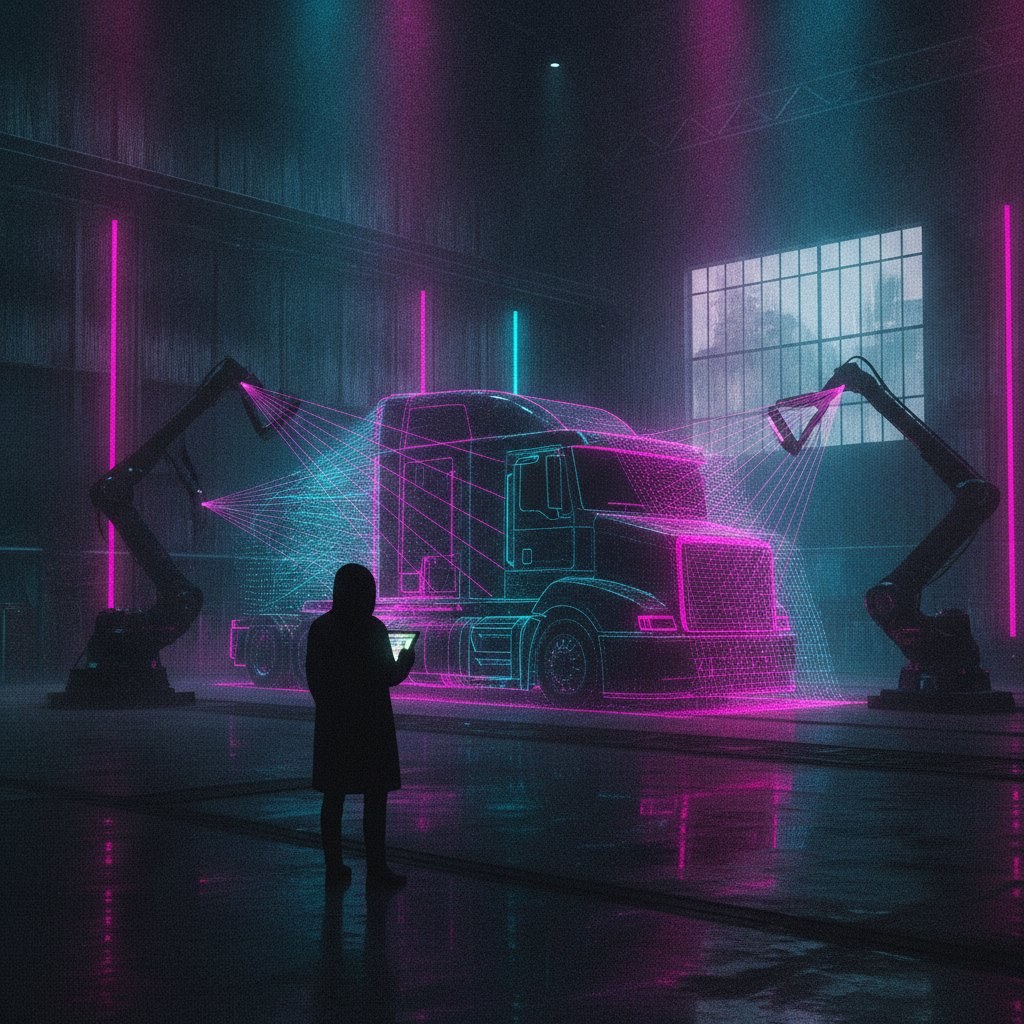
Logistics still suffers from a "black hole" that companies traditionally plug with manual labor: visual inspection of truck bodies before loading. At first glance, the problem seems trivial—a truck arrives, the warehouse clerk glances inside, and waves it in. But when dealing with high-density stacking on fixed 2.40-meter pallets, the human factor translates directly into bottom-line losses. The industry has hit a ceiling: a truck body that looks "straight enough" to the naked eye has become a systemic error paralyzing distribution centers.
The mechanics of these losses are painfully transparent. If a pallet fits into a truck with almost no clearance, any surprise—a bowed side wall, a sagging roof, or a makeshift hook on a pillar missed by a tired employee—guarantees an incident. The forklift simply rams the goods into the overlooked obstruction. The cost of that moment includes damaged cargo, disrupted schedules, and gate downtime while the vehicle is painstakingly extracted. For large manufacturers handling dozens of trucks daily, these "geometry-based turn-backs" eat up a significant portion of operating profit.
Millimeters vs. Subjectivity
Attempts to automate this process with standard 2D cameras are merely an imitation of productivity. They lack depth perception and fail against the shadows of a dark semi-trailer. Experience shows that the task requires genuine 3D scanning with millimeter precision across the entire 15-meter depth of the trailer. The cutoff thresholds are dictated by math: a width under 2.43 meters or a height below 2.60 meters triggers an automatic rejection. The error margin is a mere two centimeters. Achieving such accuracy by sight, especially in the far corner of the body, is physically impossible.
The real-world utility of a sensor is determined by the distance at which the scanning step can collect a point cloud dense enough to reliably detect a 2cm defect.
This is where the line is drawn between marketing promises and industrial operation. LiDAR specifications are often misleading; the maximum range listed in the datasheet usually only guarantees the detection of random reflections. For business, point cloud density at the far boundary is critical. If the grid degrades at 15 meters, the system will miss the very hook that rips open your packaging.
Infrastructure Audit as Insurance
Implementing these systems in the real sector isn't about buying a software license; it's a rigorous audit of physical infrastructure. Industrial LiDAR lead times span weeks, and you cannot test them "in the field" before payment. To avoid wasting the budget, one must build a preliminary spatial model of the scene. This isn't a nod to the digital twin trend, but a mathematical validation: calculating field-of-view angles and truck trajectories before purchasing any hardware. Without such analysis, implementation becomes an expensive lottery.
The tech stack is also moving away from monolithic designs. Using Ubuntu 22.04 and ROS 2 Humble allows for the decoupling of hardware from business logic. All mathematical processing is moved to a separate service that converts binary LiDAR data into NumPy arrays for geometric analysis. This architecture enables "load or no-load" decisions based on hard data, completely stripping subjectivity from the control point.
Ultimately, automation here isn't a matter of prestige. It is about eliminating unpredictable bottlenecks in the logistics pipeline. When the gap between the product and the truck wall is measured in millimeters, the only way to protect P&L is to move geometry from the "looks fine" category into the category of verified data. In modern systems based on ROS 2 Humble, a single frame passes through seven stages of filtering before a verdict is reached. This is real AI transformation: boring, precise, and saving millions by simply measuring correctly.