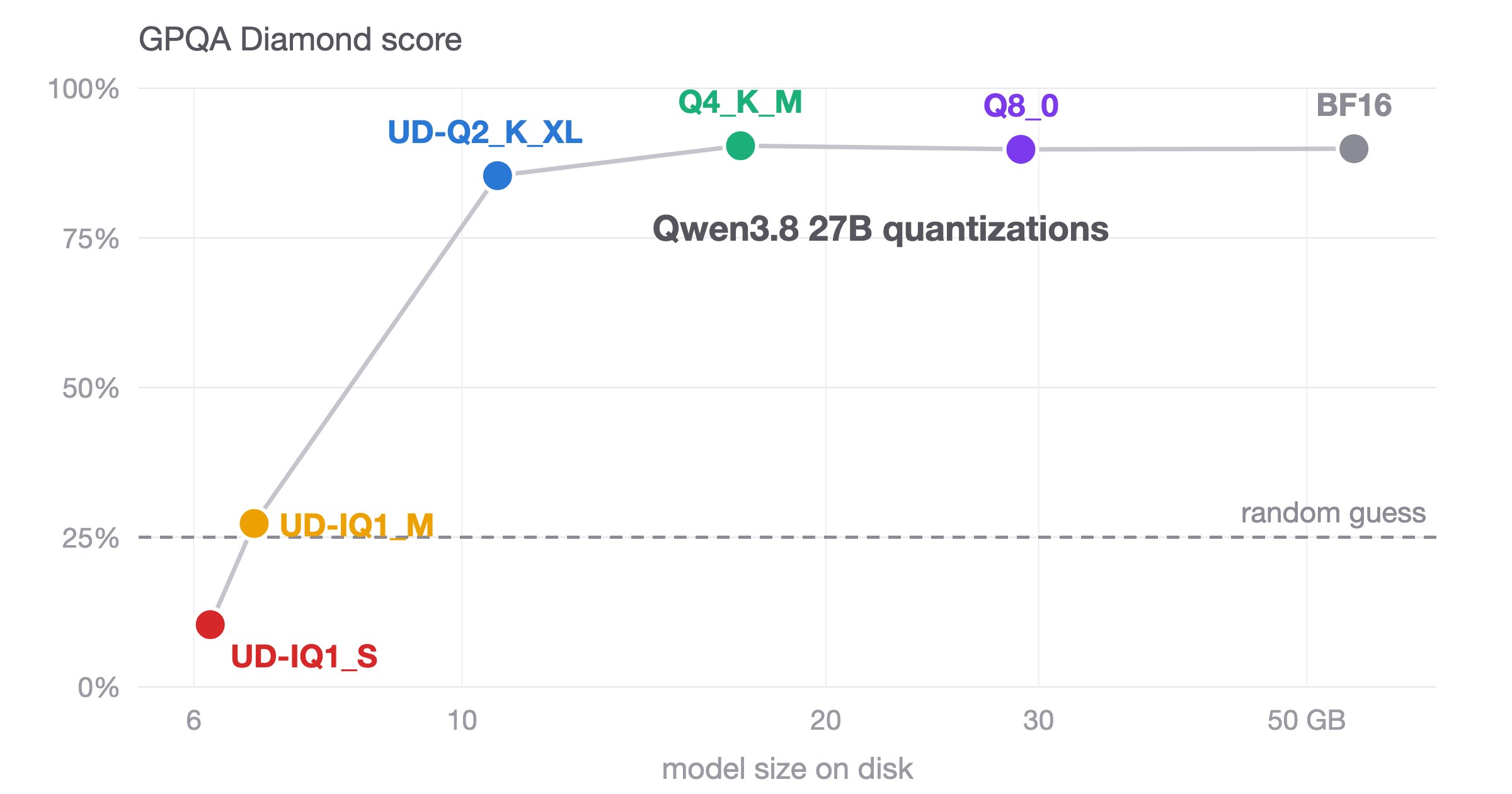
Deploying state-of-the-art open-weight models routinely forces engineering teams into an expensive infrastructure tax. Running raw architectures at full precision demands massive VRAM pools that immediately price out commodity workstation hardware. The Qwen3.8 27B model illustrates this operational wall: in its uncompressed BF16 format, the weights consume 55 GB, rendering single-card deployment on standard enterprise hardware impossible.
To establish where aggressive compression actually breaks task execution, an independent benchmark suite published on Quesma Blog evaluated multiple Unsloth GGUF quantizations via llama.cpp. Burning roughly $3,000 on Modal GPU clusters, the benchmark bypassed synthetic perplexity metrics to stress-test real-world agentic execution, scientific reasoning, and strict instruction compliance from 8-bit down to 1-bit formats.
Parity at 4-Bit Compression
The benchmark confirmed that compression down to 4 bits introduces zero measurable capability degradation across core workloads. The 17 GB Q4_K_M quantization matched the uncompressed 55 GB BF16 baseline point-for-point on Terminal-Bench 2.1, a rigorous autonomous coding benchmark. At 17 GB, the 27B model fits comfortably inside a single 24 GB card like the RTX 4090, leaving sufficient VRAM overhead for an unquantized F16 KV-cache supporting up to 64k context tokens.
"In short, if you go with a 4-bit quantization Q4_K_M (17GB), you won’t notice a difference on these benchmarks."
This parity demonstrates that moderate quantization leaves complex multi-step reasoning pathways intact. Across the graduate-level science benchmark GPQA Diamond and the instruction-following IFBench, the Q4_K_M format fully replicated Qwen's official baseline figures. Intermediate formats like Q8_0 showed identical stability, validating that 4-bit compression represents a mathematical sweet spot rather than a performance compromise.
The Reasoning Cliff at Ultra-Low Precision
Pushing compression past 4 bits introduces a steep performance cliff. While the 2-bit UD-Q2_K_XL format (10.7 GB) preserved basic instruction following on IFBench with a 4k context, it suffered visible degradation on Terminal-Bench 2.1. Stepping down to the extreme 1-bit UD-IQ1_S format at 6.2 GB triggered a total collapse of the model's underlying logic circuits.
On GPQA Diamond, 1-bit quantization degraded output accuracy to the level of pure random chance. More critically, increasing the reasoning effort parameter amplified errors instead of resolving them: extended reasoning loops merely produced longer chains of corrupted logic. While the 4-bit baseline utilized approximately 8k reasoning tokens at high effort to lock in accurate solutions, the 1-bit format accumulated compounding hallucinations with every additional step, proving that extended compute chains cannot compensate for decimated weight representations.
These empirical results draw a firm operational line for inference optimization. Standardizing on 4-bit formats like Q4_K_M cuts enterprise memory footprints by more than a factor of three, enabling reliable agentic deployment on single 24 GB GPUs without sacrificing accuracy. Conversely, pursuing extreme sub-2-bit compression in production environments that demand deterministic code execution or complex reasoning represents false infrastructure economy.