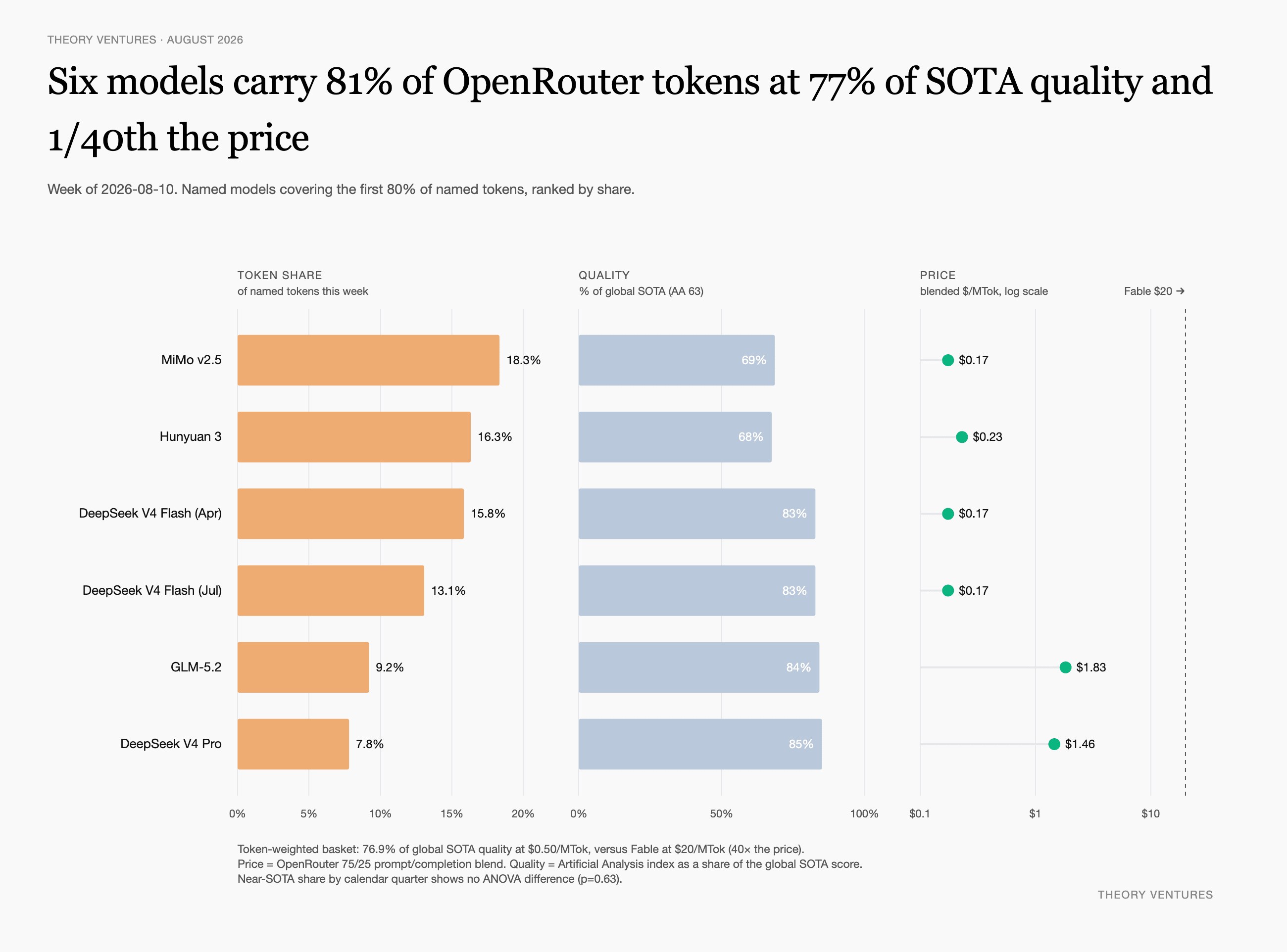
State-of-the-art models may be outpacing last year's benchmarks, with research labs rolling out fresh releases nearly every other day, but actual production balance sheets tell a very different story. According to data analyzed by Tomasz Tunguz from OpenRouter, a staggering 84% of generated tokens completely bypass frontier tiers. Enterprise workloads are consolidating around mid-tier models that prioritize unit economics over vanity benchmark scores.
The math behind this migration is straightforward. Six workhorse models accounted for 80% of OpenRouter volume in mid-August, capturing roughly 77% of flagship performance at barely 2.5% of the cost. With a blended basket price of $0.50 per million tokens versus the steep $20 per million demanded by top-tier proprietary models, enterprise buyers are proving ruthlessly price-elastic. Consumption data consistently reveals that while top-tier flagships secure single-digit token share shortly after launch, the overwhelming majority of production volume flows straight into cheaper alternatives.
Frontier models still hold a defensible niche for high-leverage architectural planning, subtle reasoning, and security design. But for routine production pipelines, the performance floor has risen fast enough that open-weight and mid-tier models easily clear the bar. Practical engineering teams are voting with their infrastructure budgets, systematically settling on the Pareto frontier where lower cost beats marginal benchmark gains every time.
Engineering leads should audit active token logs immediately to flag high-volume, non-reasoning endpoints currently routed to expensive flagship APIs instead of cost-optimized alternatives.