AI · This text was generated with artificial intelligence
As the horizon of AI interaction expands, the industry has hit a functional dead end: the promise of the infinite context window is failing to deliver. In complex domains like collaborative software engineering, simply inflating "memory" or relying on traditional recursive summarization leads to a degradation of logic. Even heavyweights like Cursor with its Composer 2.5 or Grandcode (powered by Qwen 3.5-397B) still attempt to survive on context compression—a fundamentally flawed strategy. In practice, providers like Cursor explicitly advise users to disable compactness during active sessions because quality drops visibly. The problem is structural: forcing a model to simultaneously execute code and engage in self-reflection (summarization) overloads the architecture with mutually exclusive tasks.
The Failure of the Summarization Bottleneck
Data suggests that even fine-tuning via Reinforcement Learning (RL) cannot help summarization strategies catch up to full-context models. In the "Combination Lock" benchmark, which requires a sequence of precise moves, summarization-based models failed to match the stability of those viewing the entire history. This gap becomes critical where high-quality training data is scarce. As researchers Lin and Tomlin note, creating an adequate human simulator for training is nearly impossible. Without it, one cannot generate the trajectories needed to teach a model how to compress history without losing nuance. For an agent to effectively assist in development over hundreds of steps, it needs an active internal state rather than a shrinking archive.
ABBEL and Belief Grading Mechanics
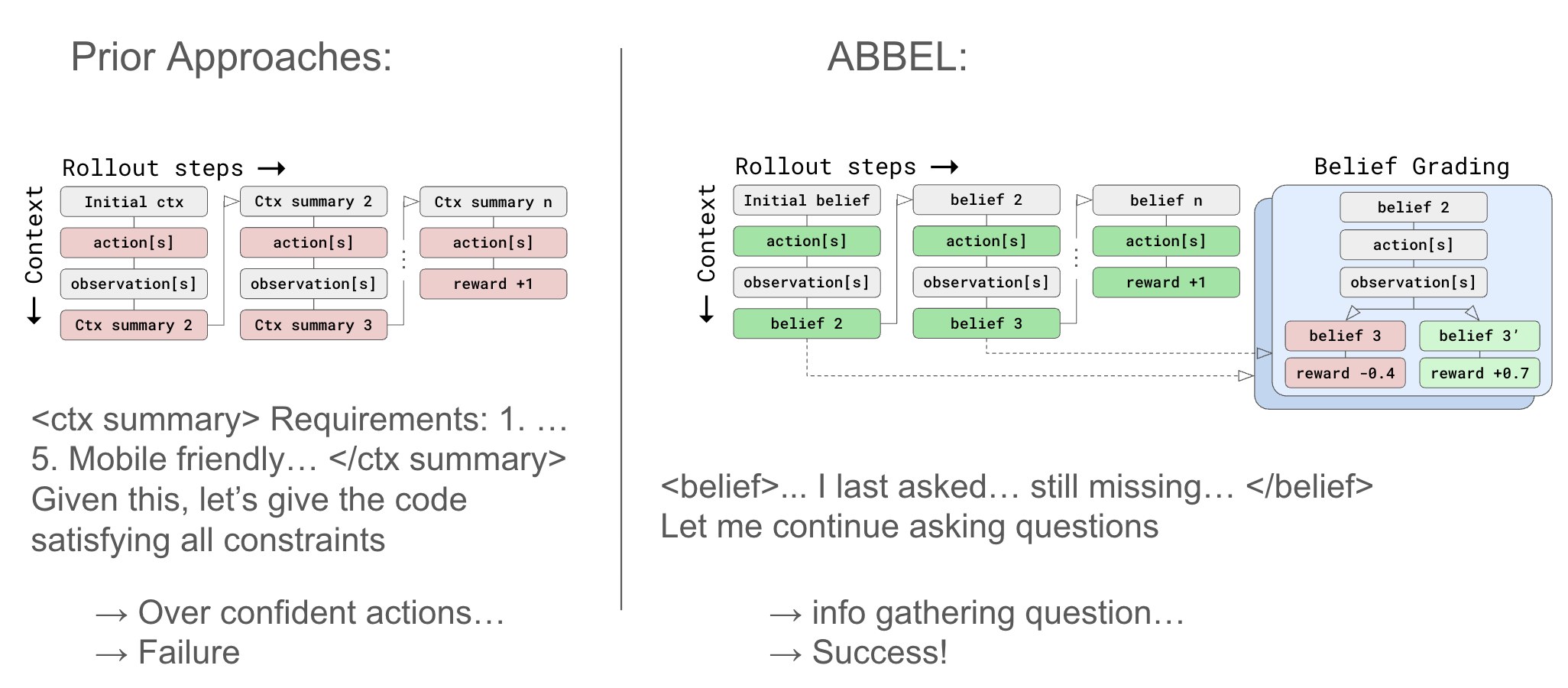
ABBEL offers a solution by replacing bland summaries with "belief states." Instead of merely hacking away at text, the model isolates and updates its internal presuppositions based on new actions and observations.
"We address the problem with ABBEL: a framework that isolates and controls the information content of summaries in the form of natural language beliefs."
To keep these beliefs relevant over long durations, the framework introduces a "belief grading" methodology. This is a side task where the model is rewarded based on how well its "belief" allows it to reconstruct facts from the original history. By treating the model as both the coder and the decoder of its own past, ABBEL ensures that only actionable information—not just a truncated log—is passed into the future.
The End of Passive Storage
Figures confirm that reconstruction-based evaluation drastically boosts the quality of summarization models. The future of long AI sessions lies not in massive memory buffers, but in strict control over how agents interpret and store their experience. The shift from passive compression to active belief management marks a watershed moment in building autonomous systems. While ABBEL significantly narrows the gap with full-context models, it does not eliminate it entirely, and the subjectivity of "useful" information remains a challenge. For tech leads, the takeaway is clear: do not expect infinite context windows to solve logical drift. The next generation of reliable coding assistants will require architectures focused on reconstructing meaning rather than mechanical text compression.