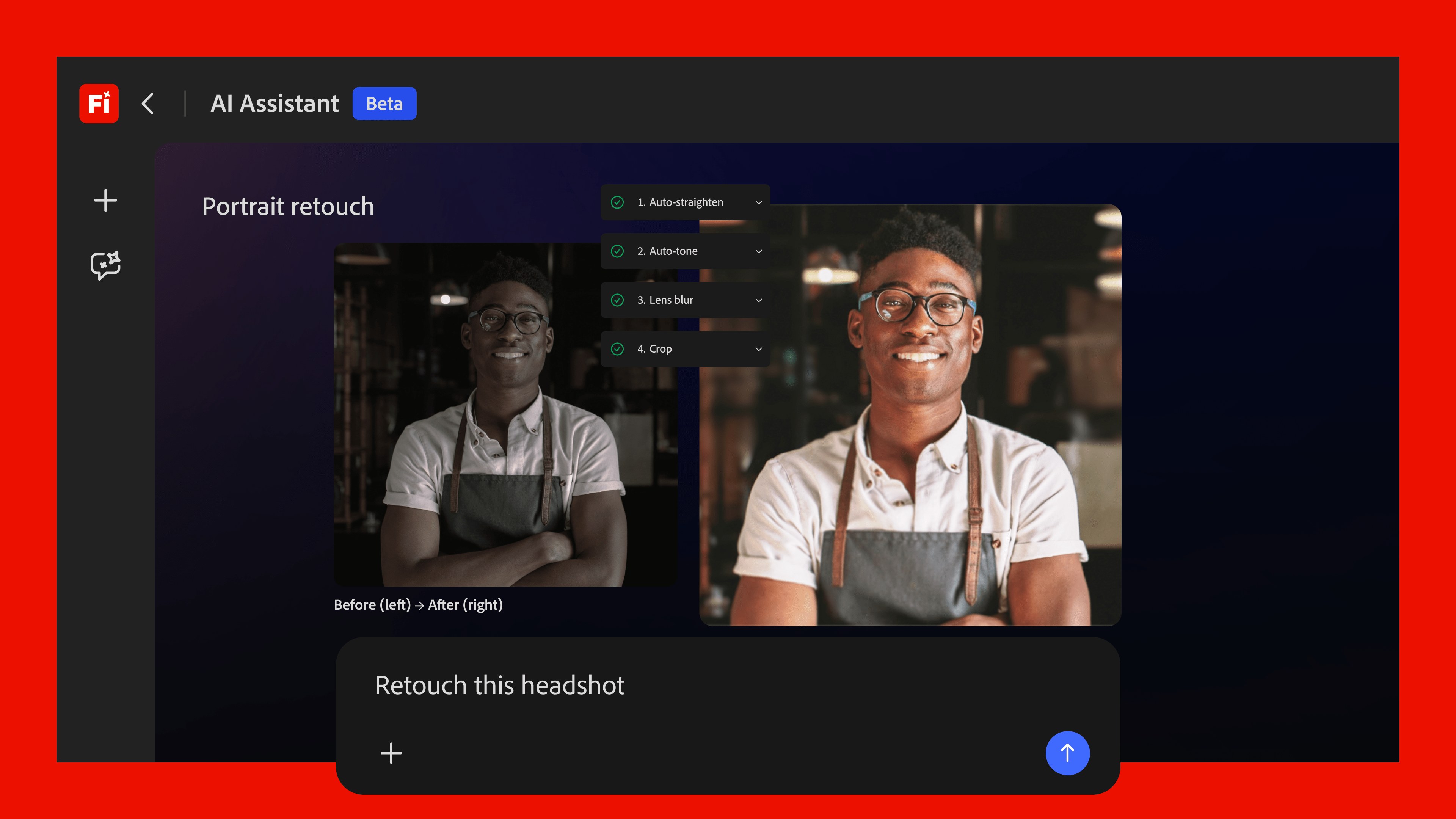
Adobe has decided that endless mouse clicks through complex toolbars belong to a bygone era. The new Firefly AI Assistant is designed to shift creative professionals from manual control of Photoshop and other Creative Cloud apps toward natural language interaction. By entering commands like "retouch this image" or "resize for social media," Adobe’s AI agent promises a "fundamental shift" in creative processes, suggesting both visual options and the specific tools needed to execute them.
The AI assistant, set to arrive "soon" in the Firefly AI Studio, is more than just a new interface. It represents Adobe’s attempt to unify complex workflows by enabling the AI agent to operate Photoshop, Premiere, and Illustrator independently. The system will learn user preferences—specific tools, styles, and workflows—to deliver increasingly personalized results. According to Alexander Costin, Adobe’s VP of Generative AI, training the AI and creating custom "Creative Skills" (AI presets) will be optional. This isn't Adobe's first foray into assistants—Acrobat, Express, and Photoshop already feature AI help—but the company's ambitions go much further. Adobe plans to grant access to its tools via third-party AI platforms, such as Anthropic’s Claude. These integrations will be paired with new Firefly capabilities for image, video, and audio editing, including Adobe Stock integration and enhanced color grading.
For businesses, this translates to one key outcome: a drastic reduction in routine manual labor and a lower barrier to entry for newcomers. Suddenly, prompt engineering and strategic vision become far more valuable than the technical ability to move sliders in Photoshop. Routine tasks that once required hours of manual work can now be automated. By opening its tools to third-party AI agents, Adobe is not just expanding its influence; it is fortifying its position against competitors like Figma and Canva, as well as startups promising "one-click" content generation.
Adobe is effectively transforming its value proposition from selling complex software to selling the ability to delegate tasks. This shift doesn't just change the creative landscape—it forces a rethink of corporate training investments. Businesses must now decide which tasks to outsource to AI and which require new human skill sets. The integration with Claude is a clear signal: Adobe aims to be a universal provider of creative AI services rather than just a software developer. Creative Cloud risks evolving from a standalone platform into a suite of plugins for a more generalized AI agent. The key challenge for business leaders is to redefine the essence of creative work and identify exactly where human input remains irreplaceable in an era where AI writes scripts, generates images, and mixes audio.