AI · This text was generated with artificial intelligence
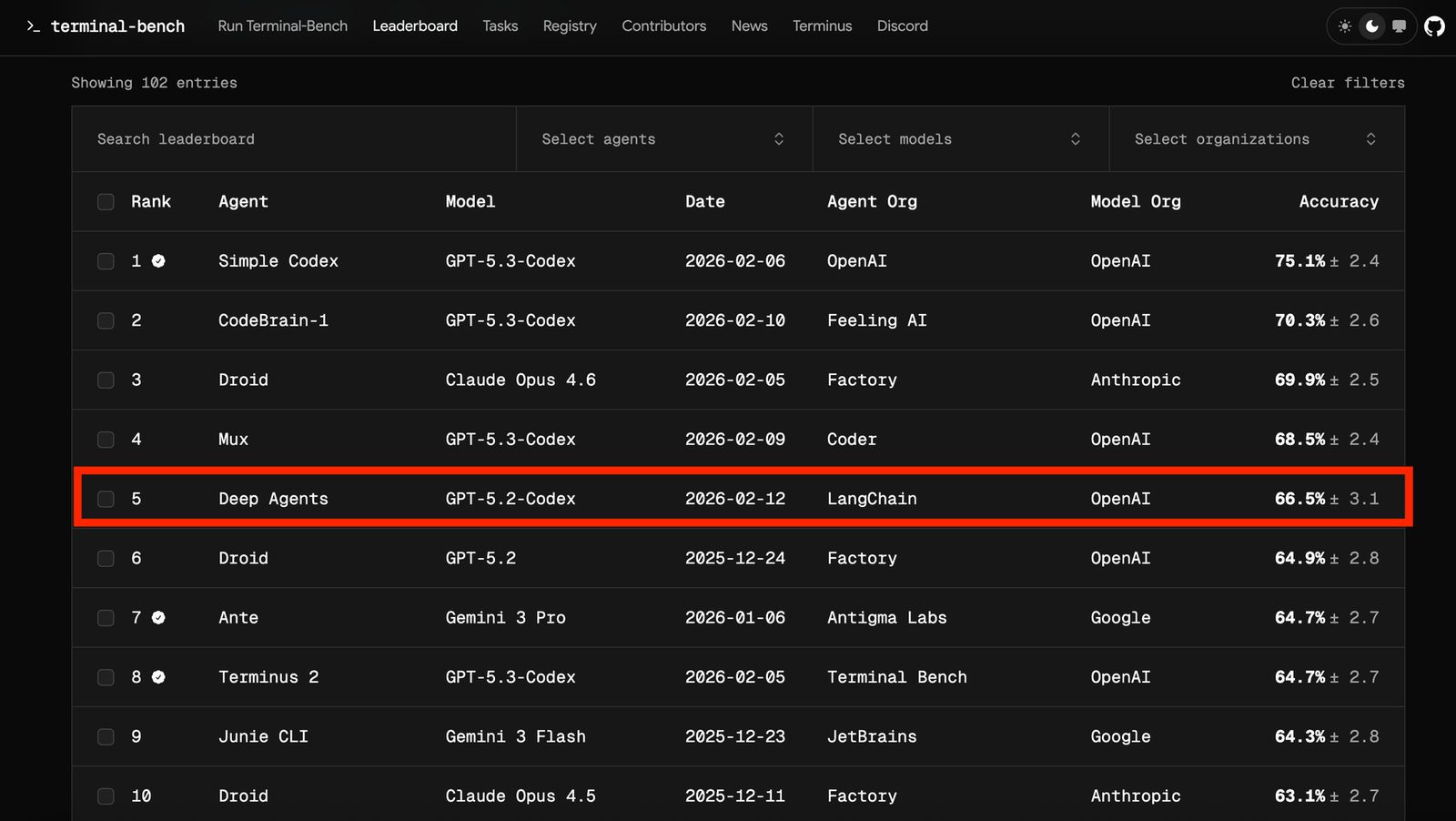
Corporate strategy around autonomous systems has long suffered from model worship. Decision-makers routinely burn capital waiting for larger, more expensive foundational architectures, hoping that raw parameter growth will automatically translate to operational gains. However, recent engineering data exposes a fundamental shift in development economics. As demonstrated by the team at LangChain, their coding agent deepagents-cli vaulted from 30th to 5th place on Terminal Bench 2.0 without a single modification to the underlying model, locked at version gpt-5.2-codex.
Executing 89 tasks across domains like machine learning, debugging, and biology—as documented in the Terminal Bench 2.0 findings—is now a triumph of environmental plumbing. The agent's success rate surged by 13.7 points, climbing from 52.8 to 66.5 percent on Terminal Bench 2.0. This shatters the illusion that the primary bottleneck of autonomous systems is raw machine intelligence. The real ceiling lies in the quality of the surrounding harness.
Engineering Levers and Execution Control
Traditional AI scaling locks companies into an exponential spiral of inference costs and compute inflation. In practice, optimizing system parameters proves vastly cheaper and yields predictable efficiency gains. LangChain’s experimental setup relies on the Harbor orchestrator, which spins up isolated Daytona sandboxes, manages the agent lifecycle, and executes result verification alongside scoring.
We only tweaked the harness and kept the model fixed, gpt-5.2-codex
Every action taken by the autonomous system feeds directly into the LangSmith tracing pipeline, which aggregates granular metrics on latency, token consumption, and financial overhead. Out of a sprawling array of control knobs, the engineering team zeroed in on three critical components: the system prompt, the toolset, and intermediate software middleware. The default configuration paired with the base model yielded a modest 52.8 percent success rate, but the introduction of automated trace analysis and rigorous code verification fundamentally rewired the performance metrics.
The Investment Priority of Infrastructure Harnessing
This architectural reality demands an immediate reallocation of enterprise technology budgets. Instead of hemorrhaging capital on the perpetual wait for commercial model releases from major providers, organizations should redirect funds toward building hardened control loops. Implementing components like LocalContextMiddleware for directory mapping during agent initialization and enforcing mandatory self-correction cycles before task termination eliminates the root causes of autonomous code failure.
Capital expenditure in infrastructure scaffolding pays immediate dividends through operational stability and a drastic reduction in manual error correction. As autonomous agents mature to construct their own execution plans, write tests for edge cases, and analyze their own logs via specialized skill sets, development spend must shift decisively toward systems engineering.
The market for autonomous software is abandoning blind faith in raw model scaling in favor of pragmatic environmental engineering. The long-term winners will not be those with the largest models, but the enterprises capable of building rigorous verification and tracing frameworks around off-the-shelf LLMs.