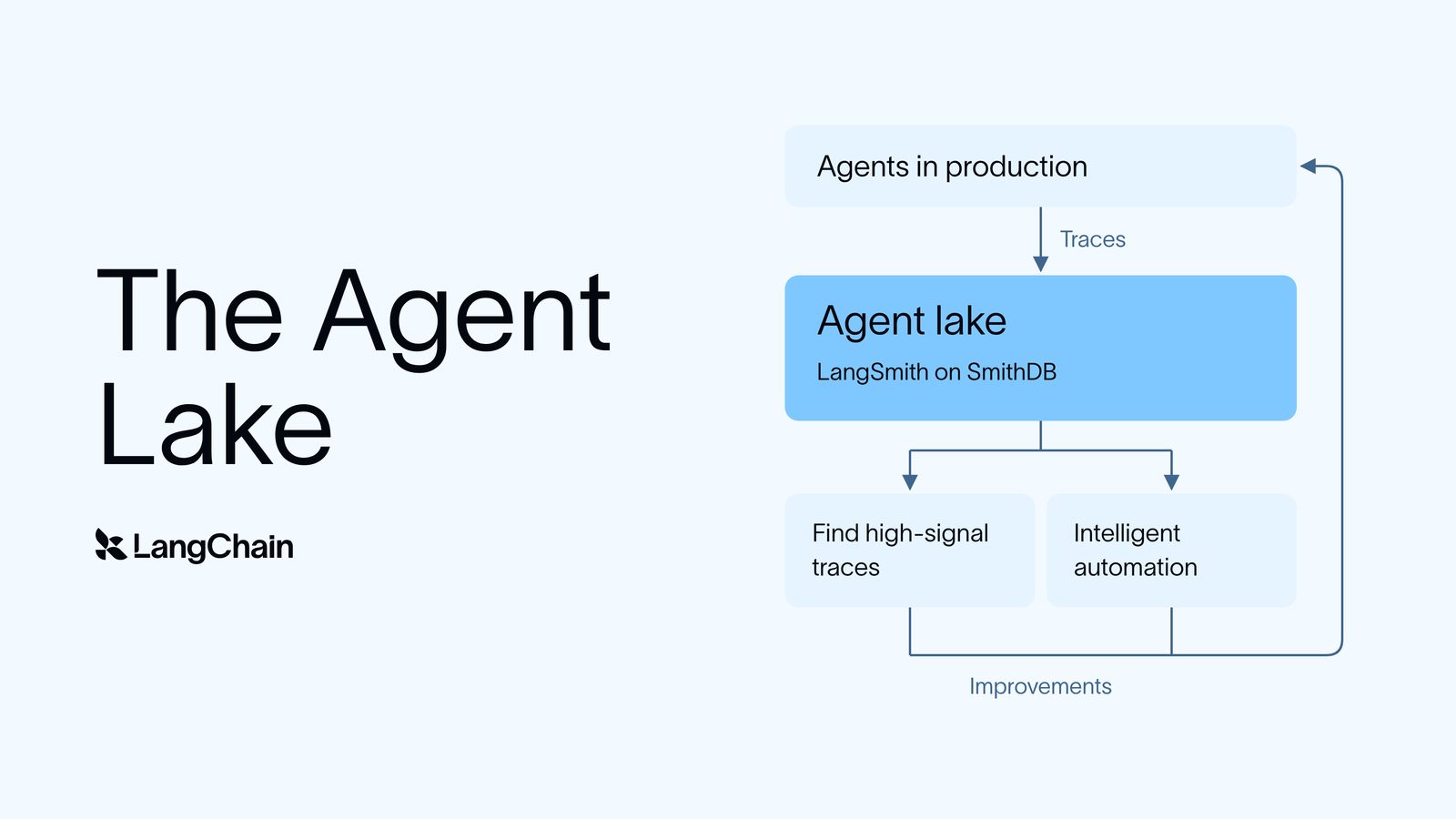
LangSmith ingests traces from billions of agent runs per month, processing unstructured execution trajectories as autonomous systems move into live business workflows. As agent traces become longer due to increasing system capability and more plentiful as workloads reach production, manual inspection of execution paths breaks down. Engineering teams initially reviewed traces individually to confirm that underlying models adhered to operational instructions at every step. That workflow ceases to function when deployment volumes expand across core infrastructure.
Corporate deployments now expose the baseline operational question facing engineering leaders: how can enterprises audit billions of agent execution steps without inflating infrastructure budgets? Traditional data lakes like Snowflake and Databricks do not have storage or intelligent compute optimized for this agent data. The operational consequence is straightforward: retaining and querying multi-step reasoning in relational engines or columnar lakes triggers steep query overhead and complex custom data pipelining.
Migrating from standard analytical warehouses to specialized agent lakes is emerging as a requirement to protect enterprise margins. In the architecture outlined by LangSmith, an agent lake serves as a unified platform that combines storage optimized for agent traces with intelligent compute to query, analyze, and learn from them.
"Traditional data lakes like Snowflake and Databricks don’t have storage or “intelligent compute” optimized for this agent data."
The absence of purpose-built storage layers leaves organizations paying high compute rates to parse multi-turn prompt logs and tool calls using infrastructure built for tabular data.
Dedicated Architecture for Scale
Certain enterprise customers, such as workflow automation platform Clay, send hundreds of millions of events per day into the LangSmith platform. Absorbing this operational volume prompted the release of SmithDB, a purpose-built database for traces that LangSmith launched as the first core component of its platform. SmithDB functions as the industry's most performant database specifically for real-time workloads on top of agent trace data, structuring multi-turn conversations into unified threads.
A common argument among enterprise architecture teams is that existing data warehouses can ingest agent logs if engineers apply proper indexing and relational schemas. Yet relational indexing falters against the dynamic structure of reasoning trajectories, where each agent run records intermediate model calls, tool executions, and unstructured outputs. Running automated evaluators across unstructured steps requires models to read the reasoning itself, an operation that general-purpose engines cannot execute natively without routing data through external computation layers.
Beyond basic execution traces, the agent lake architecture stores outcomes, providing the explicit link required to judge system returns on investment. These outcomes measure real-world performance, ranging from explicit user feedback like downvotes to automated signals such as merged pull requests or LLM-as-a-judge scores. Recording outcomes alongside operational paths is what allows organizations to determine whether their production agents are improving or failing over time.
The Economics of Evaluation
Analyzing vast volumes of trace data requires automated filtering to locate high-signal execution errors. LangSmith utilizes online evaluators with tuned prompts to detect issues like hallucination, toxicity, and customer dissatisfaction across live traffic. However, deploying secondary large language models as judges across every production trace introduces prohibitive evaluation expenses.
"Crucially, an agent lake contains not just traces, but also outcomes. That’s ultimately how you judge ROI and tell if your agents are working or improving."
To address these cost barriers, TypeSafe AI introduced decision models in September, offering a lower-cost approach to evaluating production traces without sacrificing analytical precision.
While enterprises deploy autonomous agents on the promise of slashing operational overhead, feeding unstructured reasoning traces into legacy warehouses converts runtime automation into bloated infrastructure invoices. Purpose-built platforms isolate storage and trace evaluation, yet continuous agent monitoring remains tethered to model inference costs that scale alongside corporate traffic.
What it means
Infrastructure budgets and query overhead will surge if teams keep dumping unstructured model reasoning into relational engines or traditional platforms like Snowflake. Standard columnar warehouses cannot natively evaluate dynamic tool calls and multistep prompts without complex custom pipelines. Moving traces into dedicated agent lakes removes these fragile workarounds by combining specialized storage with compute tuned specifically for automated evaluators and business outcomes. A single customer like Clay generates hundreds of millions of events daily, turning the overhead of processing multi-step traces into a direct drag on operational margins.