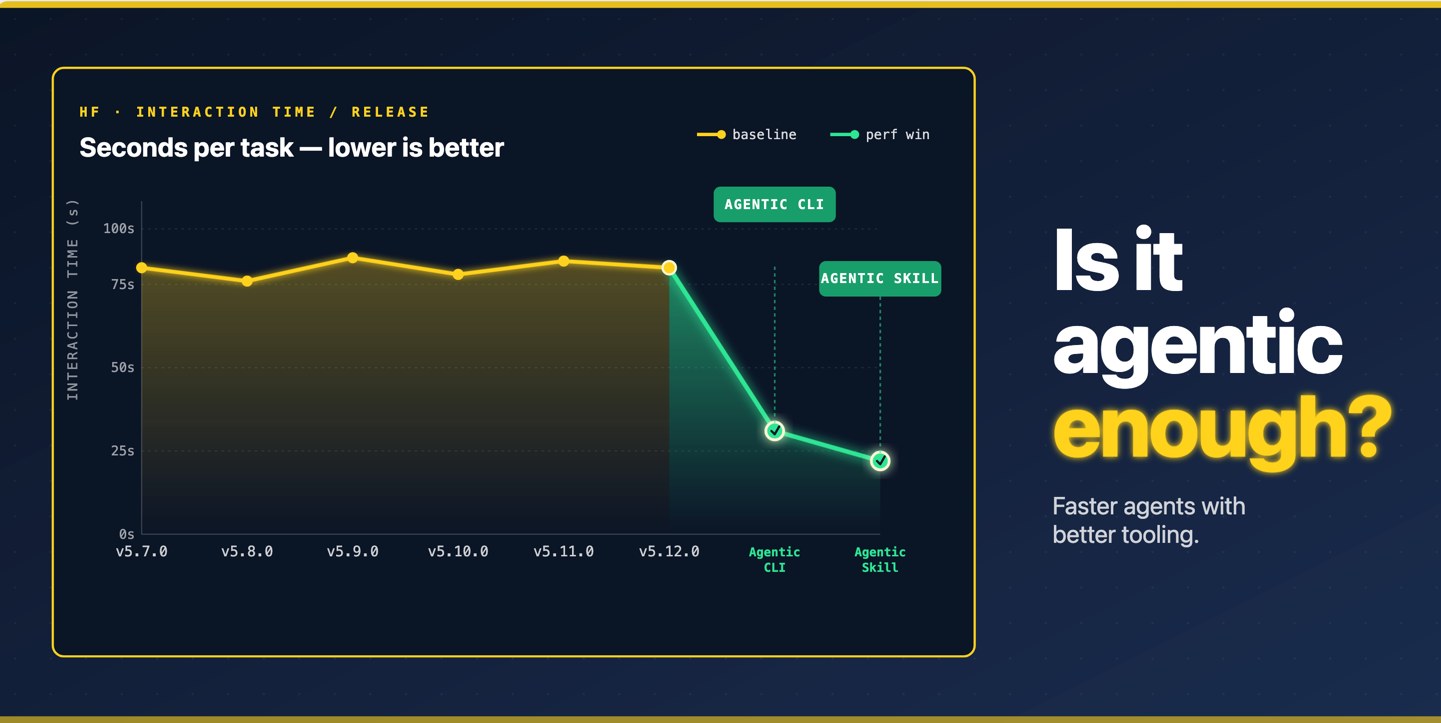
Benchmarks in their current form are a useless metric for evaluating real-world AI performance. As Lysandre Debut, Nathan Habib, and the Hugging Face team rightly point out, standard evaluations of the final answer ignore the "cost of the process." We see the result, but we overlook how many redundant debugging cycles an agent endured before delivering the basics. If your AI agent is forced to struggle through a clunky API or hallucinate due to outdated documentation, you are paying for its struggle in cold, hard cash: wasted tokens and increased latency. Modern models no longer just read code; they manage it, independently selecting libraries and calling functions. This shift demands a move toward Agentic Design—a concept where software is engineered so that neural networks can "steer" it without makeshift workarounds.
The Economics of Redundant Cycles
The gap between a "human-centric" and an "agent-centric" approach to code translates into direct financial gains. Researchers using the transformers library demonstrated that the same result—text classification—can be achieved via two distinct paths. In the first scenario, the agent writes code the old-fashioned way: importing dependencies and catching execution errors before finally producing an answer. In the second, it uses an optimized CLI tool to solve the task in a single step. The output is identical, but the cost profile and token consumption differ radically.
"A clunky API or outdated documentation might annoy a human developer, but it sends an agent down a long, expensive path of error correction at your expense."
According to the report, updating the Hugging Face CLI for agentic needs reduced token consumption by 1.3 to 1.8 times, with savings reaching up to 6x in peak scenarios. This is a clear sign that designing interfaces intuitively "for humans" is becoming a relic in the AI era. For a tool to be effective for an agent, it must be easily discoverable, possess a transparent structure, and offer atomic examples that the model can instantly integrate into its context without further clarification.
Infrastructure Audit Methodology
To help businesses transition to an agent-led workflow, Hugging Face introduced a testing framework based on their Jobs service using the "pi" agent. The core thesis: if software fails the "agentic-use" test, it is unfit for purpose. CTOs need to stop evaluating model accuracy in a vacuum and start assessing the entire problem-solving journey. As part of a case study, specialized "Skills" were added to transformers for ML tasks like audio transcription. This allowed compact open-source models to compete head-to-head with proprietary giants in niche markets by simply having the right environment design.
Preparing infrastructure for the era of autonomy requires a mandatory analysis of traces—the chains of actions an agent takes. This is the only way to identify hidden costs sunk into infinite correction loops within the system. In our view, the team’s two core principles—"if it's not tested, it doesn't work" and "if it's not documented, it doesn't exist"—must form the basis of any audit. For AI, this means providing structured examples and hyper-specific instructions that eliminate the need to reinvent the wheel. Today, AI efficiency is defined not by a model's parameter count, but by the quality of the interfaces through which it interacts with your code. Optimizing APIs for agentic logic isn't a matter of convenience; it’s a way to slash inference costs by up to 85%.