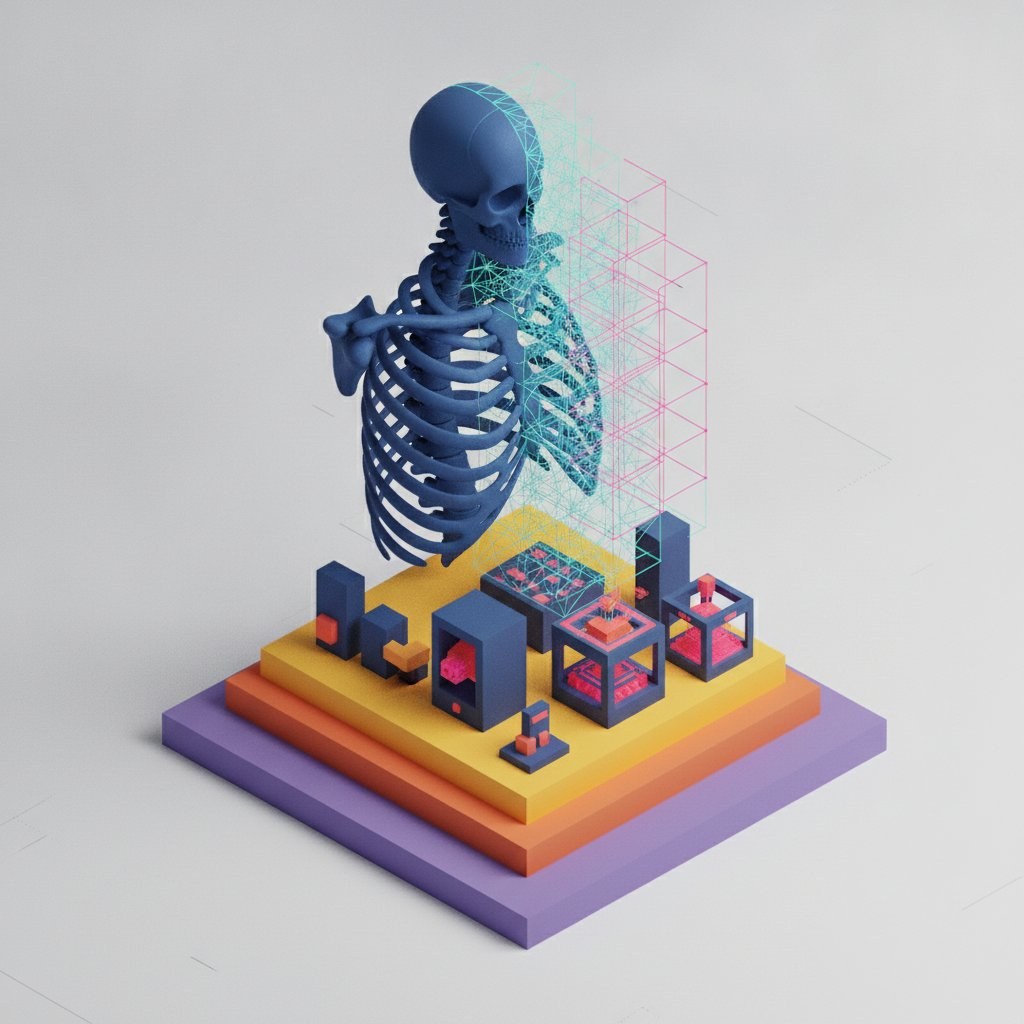
Traditional medicine has spent decades trying to squeeze living human beings into the confines of "standard sizes," as if replacing spare parts on a conveyor line. However, a recent case from Israel’s Rabin Medical Center (Beilinson) proves that in oncological surgery, the era of catalog-based solutions has come to an end. Faced with an aggressive tumor in a young patient, doctors were forced to perform a radical resection of the sternum and part of the ribs. In the pre-digital era, this would have meant lifelong disability—the human body does not forgive the absence of a rigid frame where the respiratory pump is located.
The challenge isn't simply "plugging a hole" with a titanium plate. The chest wall is a complex biomechanical hub under constant cyclic load. This is where the line is drawn between artisanal prosthetics and high-precision engineering: the implant must mimic the dynamics of inhalation and exhalation without becoming a foreign object.
Engineering instead of craftsmanship
The Beilinson case is becoming an industrial benchmark, demonstrating the convergence of generative design and additive manufacturing. Instead of fitting the patient to the product, algorithms processed CT and MRI datasets specific to this individual. Within a tight timeframe, AI designed a digital model accounting for vector loads and anatomical specifics. The resulting implant, 3D-printed using biocompatible composites, is no longer a part from a supplier's price list, but a mathematically precise replica of the lost structure. This level of customization minimizes the risk of rejection and spares the patient from the chronic inflammatory reactions typical of "universal" designs.
"When an algorithm designs a structure for respiratory dynamics, medicine finally moves into the realm of precision mechanical engineering."
The economics of survival
For hospital administrators and the insurance sector, this precedent is primarily a lesson in pragmatism. On the surface, high-tech on-demand reconstruction appears more expensive than a mass-produced prosthesis. However, the math shifts when calculating the Total Cost of Ownership (TCO) of a patient's health. Using AI-driven design radically reduces rehabilitation costs and prevents the disability of a working-age individual. A patient in her 20s returns to a full life almost immediately, which is more profitable in the long run than any "budget" solution.
Key points
Shifting from mass-produced medical devices to on-demand 3D printing based on CT/MRI data. AI design serves as the only viable method to recreate complex chest wall dynamics. Minimizing long-term rehabilitation costs through initial anatomical precision. Establishing a new standard in surgical oncology where the implant becomes an integrated part of the biomechanical system.
The bottom line
Scaling these complex calculations represents the new frontier of the MedTech market. The future belongs to those who stop viewing surgery as a "plug-and-patch" service and begin implementing algorithmic customization. In a world where bone can be calculated and printed for a specific breath, "standard size" sounds like a life sentence.