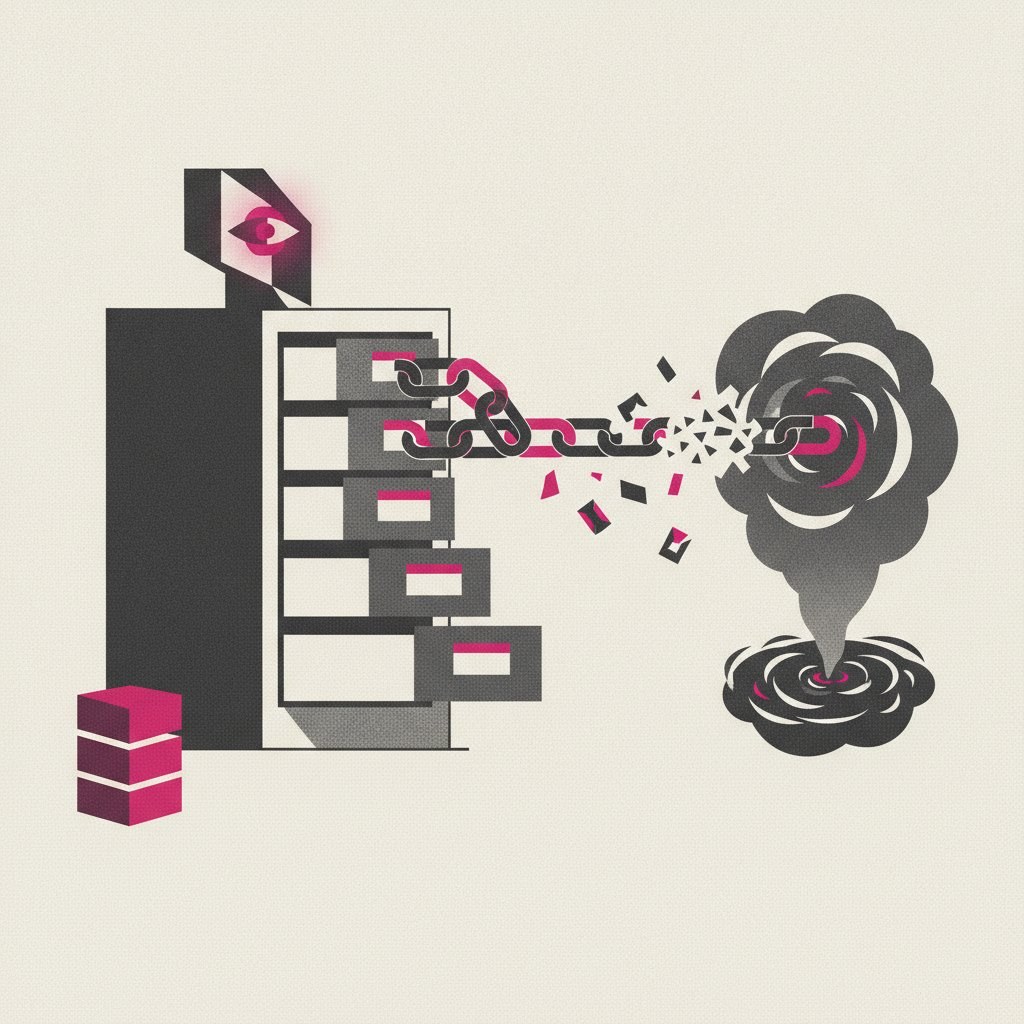
AI agents are routinely sabotaging their own reasoning chains before retrieval algorithms ever run. A study by Minkyu Song of Yonsei University, accepted at the ICML 2026 Workshop on Failure Modes of Agentic AI (FAGEN@ICML 2026), exposes a systemic pre-retrieval flaw: structurally indirect prerequisite eviction.
When constrained by fixed memory budgets, standard compression heuristics purge upstream context blocks that exhibit weak semantic or lexical similarity to the final query. Because these prerequisite blocks validate subsequent decisions, their premature eviction fatally snaps multi-step logical chains. Retrieval cannot fetch evidence that crude garbage collection has already wiped from existence.
To counter this blind spot, Song evaluated Dependency-aware Semantic Garbage Collection (DSGC), a one-hop graph-aware mechanism that safeguards memory blocks based on structural reachability. In benchmark evaluations, DSGC lifted full-chain retention from a disastrous 0.03 to 0.90 under lexical encoders, and surged from 0.23 to 1.00 when tested with sentence encoders.
Most current agent architectures delegate graph expansion entirely to the downstream retrieval stage, leaving upstream memory pruning to simplistic semantic filters. By reframing memory retention as a structural reachability task, engineering teams can prevent context managers from gutting the logical foundations of agent workflows.