AI · This text was generated with artificial intelligence
Eliminating Phantom Waves
For years, traditional transportation analytics blamed traffic congestion on a lack of asphalt. However, a case study from Berkeley researchers proves that jams are primarily a bug in human psychology and delayed reaction times. "Phantom traffic jams" appear out of nowhere: one driver taps the brakes slightly too hard, triggering a chain reaction of deceleration that transforms into a total standstill a kilometer back. This isn't just a matter of frayed nerves; it results in direct financial losses due to senseless stop-and-go cycles that burn fuel on an industrial scale. The problem becomes systemic the moment traffic density hits the critical threshold on the fundamental flow diagram.
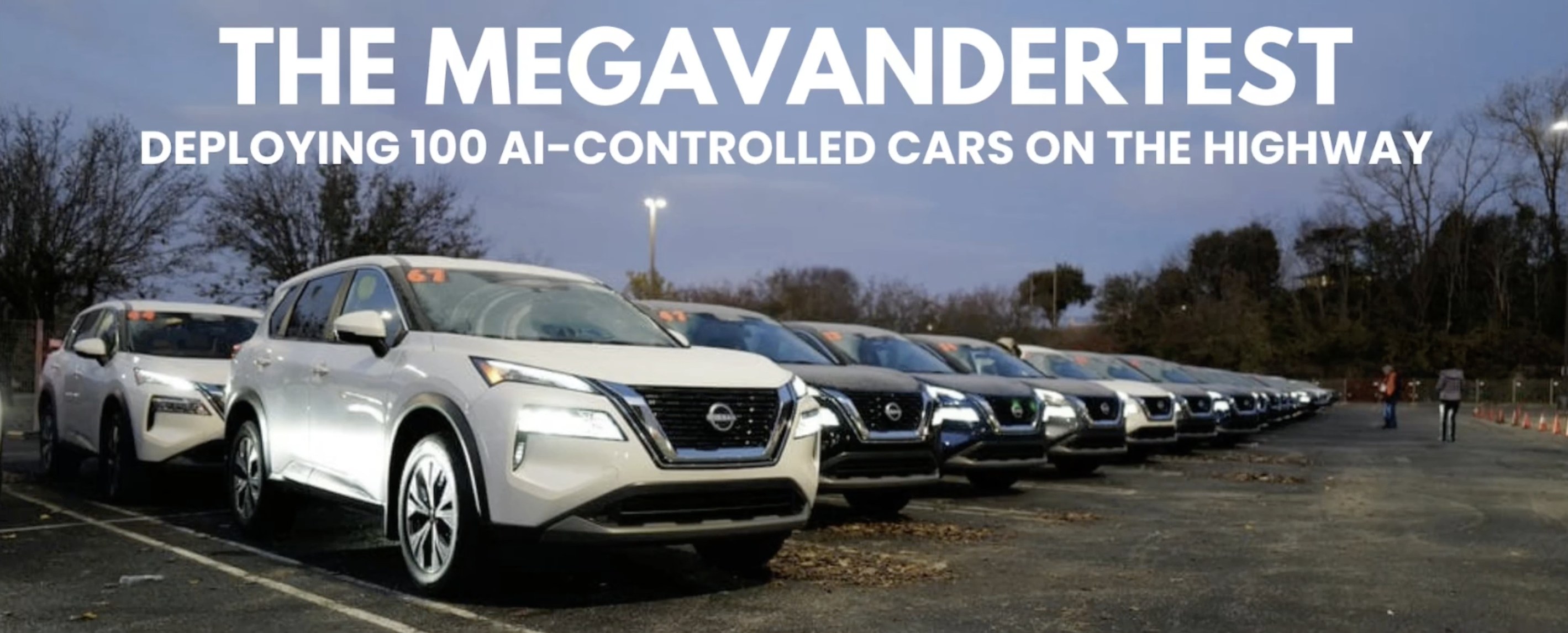
During a real-world peak-hour experiment, 100 vehicles controlled by reinforcement learning (RL) agents were deployed onto the road. Unlike primitive adaptive cruise control, which merely maintains a passive following distance, these algorithms are tuned for global optimization. The AI agent doesn't just drive itself—it acts as the "rhythm guitarist" for the entire flow, forcing the human drivers behind it to move more smoothly. Essentially, we are seeing how a tiny fraction of smart machines can dampen wave oscillations, forcibly returning a chaotic system to a stable state.
Decentralized Optimization Technology
To successfully bridge the gap from simulation to the physical environment (sim-to-real), engineers ditched expensive sensors in favor of a spartan dataset. The controllers use only basic radar metrics: their own speed, the lead vehicle's pace, and the distance between them. This minimalism isn't about cutting costs; it's a scaling strategy. It allows RL algorithms to be integrated into production vehicles without installing LIDAR or rebuilding road infrastructure. Agents were trained to maximize a reward function where fuel efficiency, safety, and comfort are all balanced in a single equation.
The key business insight here lies in non-linearity. Logistics operators don't need to wait for every vehicle on the highway to become autonomous. According to the Berkeley data, even at low penetration rates, smart vehicles provide a disproportionately high profit for all road users.
"A small proportion of AI-controlled vehicles is sufficient to radically improve fuel consumption and flow smoothness across the entire distance."
For fleet owners, this is a clear signal: by equipping a small portion of their trucks with specific software, they can dictate the rhythm of the entire highway, slashing operating expenses by minimizing acceleration phases.
The Human Factor Barrier
A critical challenge for RL controllers was the organic unpredictability of human drivers. The system had to learn to operate in dense traffic without provoking humans into aggressive maneuvers. Successfully moving these strategies "from the cloud to the asphalt" changes the traffic management paradigm itself. Instead of helplessly watching congestion on a navigation screen, fleet operators gain a tool to actively influence road throughput.
Implementing these systems into production vehicle firmware seems inevitable, but the real impact hinges on regulation. Whether authorities are ready to trust decentralized agents to set the pace on federal highways remains an open question. While AI masterfully smooths out the mistakes of others, humans continue to slam on the brakes out of habit just by seeing red lights ahead. But now, we have the technology to transform that herd mentality into an organized economy.