Databricks is sounding the alarm on a paradox that should haunt every CTO: agentic coding has delivered a staggering 10x spike in team output, yet this productivity comes with an unsustainable financial tail. According to co-founder Patrick Wendell and the Databricks team, the cost of AI-driven development is scaling exponentially, threatening to overtake company revenue if left to run on autopilot. For technical leads, the 'efficiency gain' is starting to look like a debt trap where the aggregate cost profile reverses the very value the technology creates.
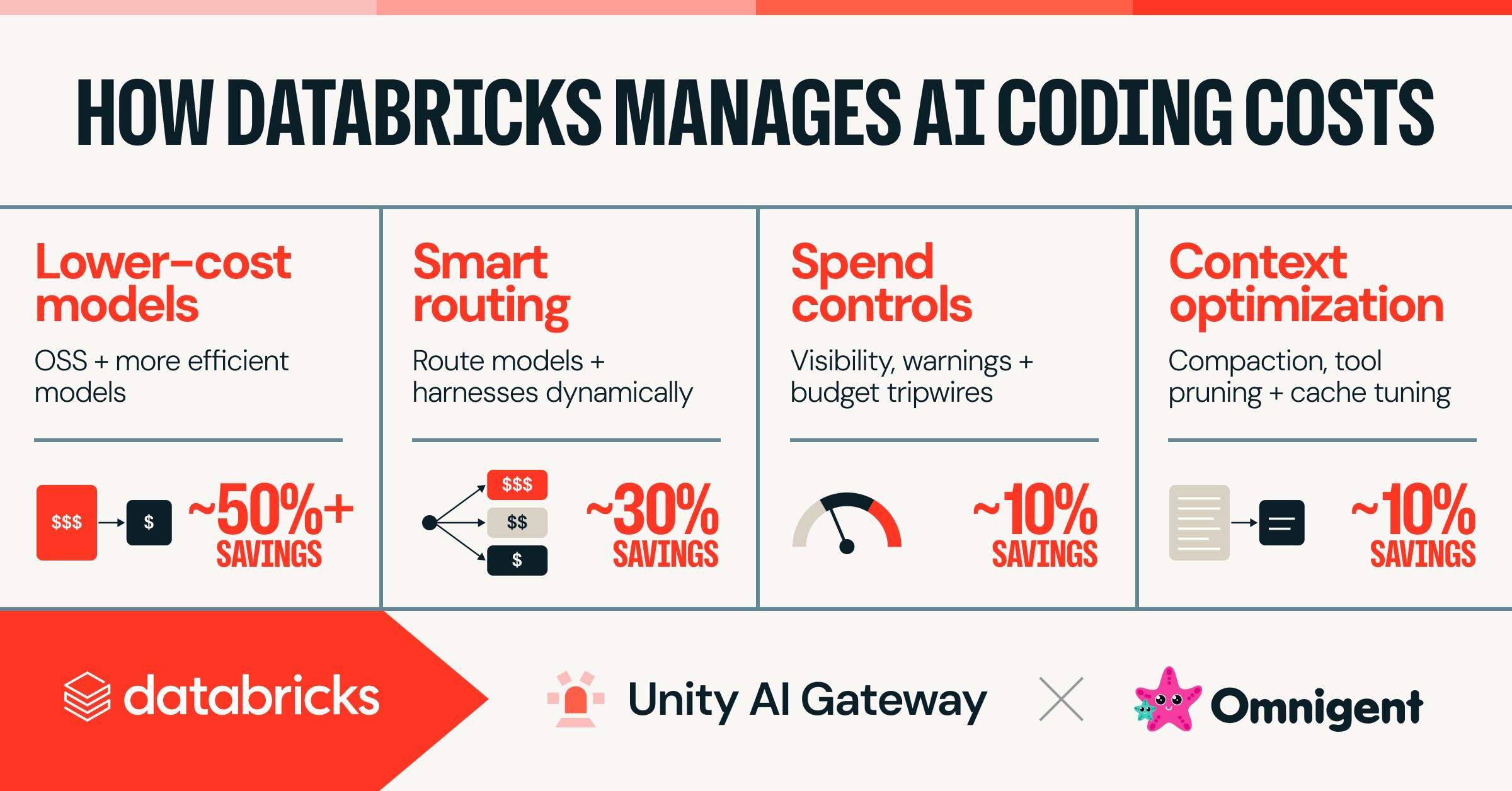
Data from digital-native heavyweights—including Stripe, Coinbase, Uber, and Ramp—confirms that the primary challenge of enterprise AI has shifted from 'how do we build it' to 'how do we pay for it' without breaking the bank. Maintaining a fixed cost envelope per user is no longer a luxury; it is the baseline for survival. To stabilize the burn, leading adopters are pulling four specific levers: aggressive migration to open-source models that don't tax every query, dynamic task routing to avoid using a 'sledgehammer' model for a 'nut' task, establishing personal developer budgets with automated tripwires, and ruthlessly trimming token overhead.
The Architecture of Control
Migration to high-performance open-source models to bypass proprietary tax. Implementation of dynamic request routing to match task complexity with model tier. Granular developer limits and usage transparency to prevent 'runaway' experiments. Minimization of token overhead through optimized context window management.
The industry is waking up to the fact that the 'efficiency frontier'—the point where intelligence meets affordability—is currently moving faster than the 'intelligence frontier' itself. This shift makes the AI Gateway a mandatory piece of infrastructure rather than a nice-to-have plugin. Tools like the Unity AI Gateway are now essential for providing the inference control and transparency required to survive enterprise-scale operations.
Ultimately, the winners won't be the firms blindly adopting every new LLM release. Success now belongs to those like Stripe and Databricks that treat model evaluation as a core engineering discipline, prioritizing the unit economics of a token over the hype of a benchmark.