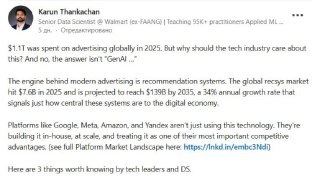
The $1.1 trillion global advertising market is bracing for a brutal redistribution of power. While the corporate sector is busy burning budgets on prompt engineering and social media image generation, the real heavyweights—Walmart, Amazon, and Meta—are building deep-tier defenses. Their weapon of choice? Proprietary recommendation systems (RecSys) that turn Generative AI into a flashy but secondary sideshow.
According to top data scientists at Walmart, the hype surrounding large language models obscures a fundamental shift: the magic of targeting no longer lives in the creative, but in ranking architectures like Meta’s HSTU, Yandex’s ARGUS, or Google’s DLRM. These are the 'black boxes' that decide whether your product even exists for the consumer.
Value is decisively shifting from the 'wrapper' to the infrastructure. Projections show the RecSys market catapulting from $7.6 billion to $139 billion by 2035, locking demand inside closed ecosystems. In this new reality, old-school targeting—where marketers manually tweaked budget dials—is disintegrating. Market leaders are building foundations on first-party data, tracking the entire lifecycle from the initial click to a return two weeks later. While you are busy deploying yet another chatbot, the giants' algorithms are autonomously optimizing goals, leaving advertisers with nothing more than the right to set a final KPI and wait for the results.
The technological gap between those who own the data signals and those who buy access to them is becoming insurmountable. Businesses investing in 'AI wrappers' to write social posts are buying a ticket on the Titanic: in a world of smart agents, the classic search interface will die, and your banners will die with it. Controlling the ranking algorithm is the new oil, and the drilling rights have already been carved up by platform owners. Any attempt to override the power of internal RecSys architecture with 'revolutionary' creative is like trying to storm a fortress with a water pistol.
The industry continues to label the installation of image generators as 'digital transformation,' even as algorithms quietly siphon off the last bits of margin from those who still believe in the power of the prompt. A fresh report on the 'incredible impact of AI on marketing' has just hit the presses—conveniently timed for budget season to justify spending on useless interface toys while real power consolidates within the infrastructure giants.