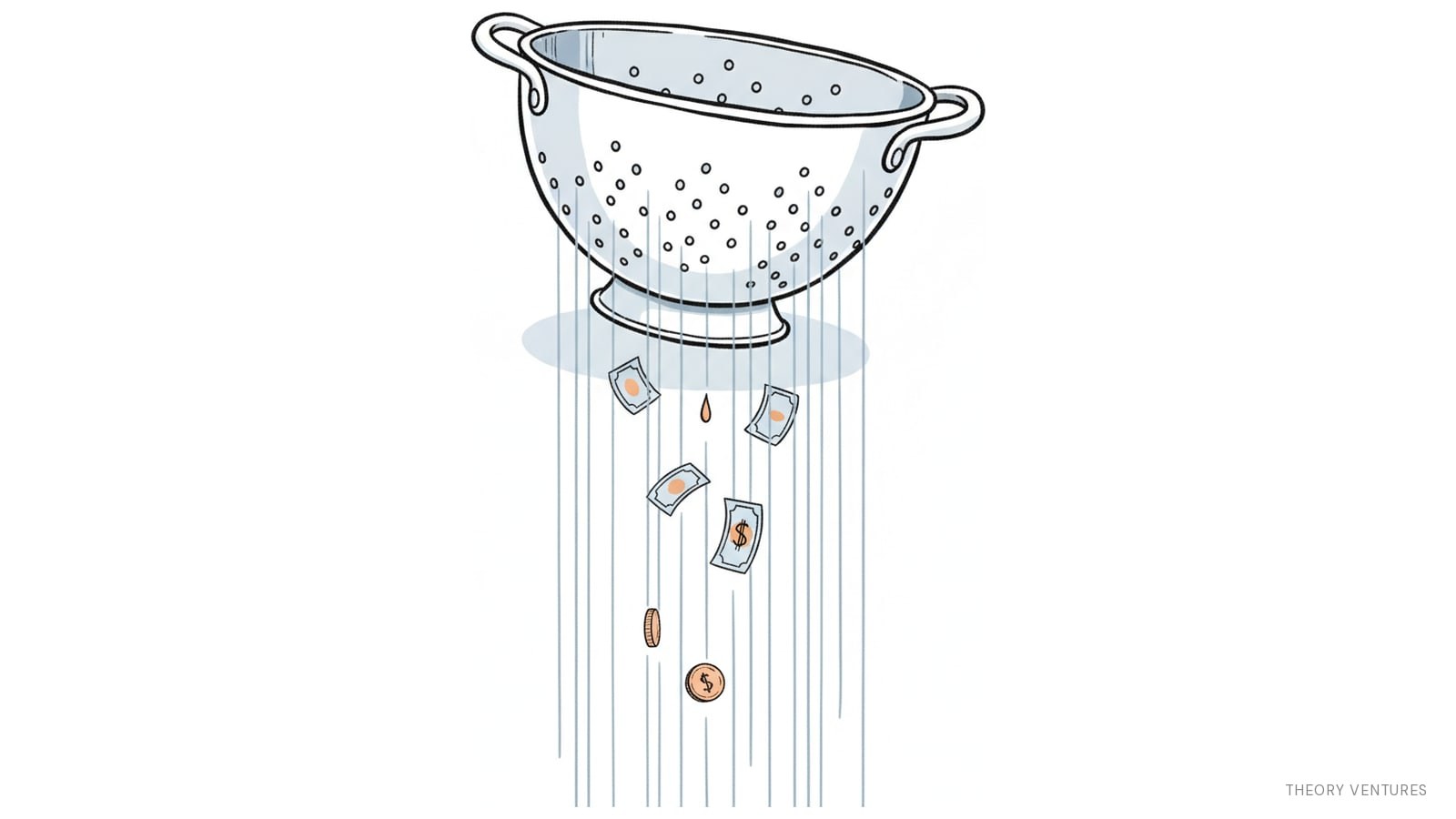
The generative AI market currently resembles a leaking bucket. While traditional SaaS products enjoy customer retention rates as high as 90%, the AI sector has seen its loyalty metrics plummet to the level of mobile games and social networks. According to data from Tomasz Tunguz, retention in AI services fluctuates from a passable 40% down to a catastrophic 10% by a user's fifth month. This is the "colander effect": customers arrive on a wave of hype and wash out faster than marketing departments can calculate the losses. For startups, this spells doom for unit economics—the customer acquisition cost (CAC) simply never pays off.
A 41-Day Reign
Betting on a specific "most powerful" model as your business foundation is strategic myopia. Tunguz calculated that the average lifespan of a benchmark leader is just 41 days. Today, a technological edge is not a "moat"—it is a perishable good. As soon as OpenAI or Anthropic drops a new update, users unencumbered by brand loyalty migrate to the new favorite.
The king is dead, long live the king—this slogan now rings out monthly across the industry.
This "war of the weights" benefits only the buyer. Developers are forced to live in a state of permanent instability, while startups must rewrite workflows for the latest model every few weeks just to maintain efficiency. Intelligence has been devalued to the level of a utility: you simply switch to whichever socket offers higher voltage at a lower rate.
The Tenfold Deflation Trap
Intelligence is no longer measured by the quality of answers in a vacuum; performance per dollar is what matters. According to an Artificial Analysis report, the cost of solving programming and math tasks is dropping tenfold annually. This is a deflationary trap: you are building a company on a product that depreciates by 90% every 12 months.
For example, GPT-5.5 and Claude Opus 4.8 are neck-and-neck on the Intelligence Index (around 60 points), but OpenAI’s model is 28% cheaper. Meanwhile, xAI’s Grok 4.5 scores 54 points but costs just $0.31 per task—60% cheaper than the leaders. Similarly, Microsoft’s MAI-Code-1-Flash matches Claude Haiku 4.5 in coding tasks while using 60% fewer tokens.
Founders are being sold the dream of building "generational companies," but in reality, they are operating in a commodity market where buyers gain new leverage every 41 days. In this environment, the winner won't be the one who trains the smartest model, but the one who embeds this cheapening intelligence into an indispensable business process that no competitor's discount can disrupt.