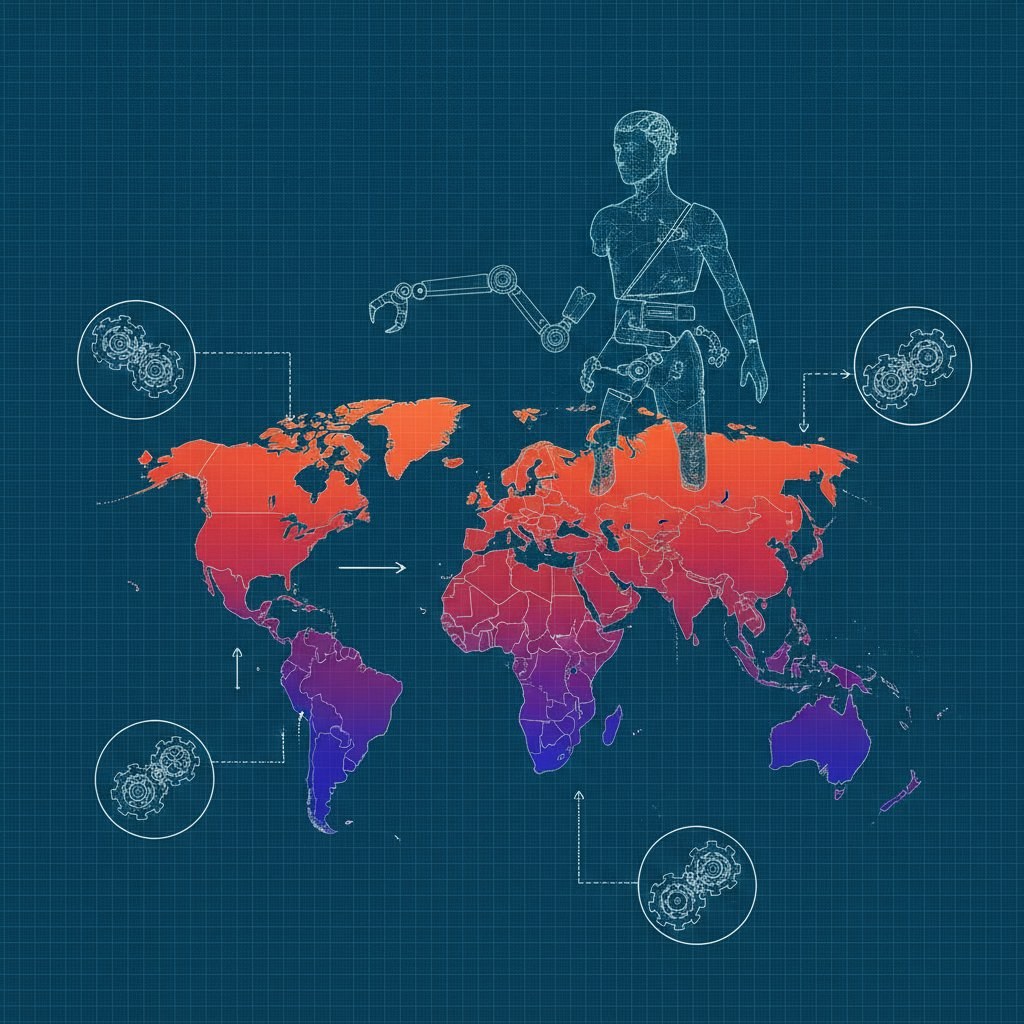
Frontier AI models do not act like a rising tide that lifts or sinks all boats equally. Instead, as researchers Arul Murugan, Abhishek Nagaraj (UC Berkeley), Tomas Aguirre (University of São Paulo), and Rishi Bommasani (Stanford) explain, AI capabilities are distributed across work tasks in a "jagged exposure" pattern. A model might master complex analytical cases while stumbling over elementary logic. Because national economies distribute human labor differently, this jaggedness creates a skewed map of global AI impact. Developed nations, where the workforce is concentrated in white-collar and service sectors, are being hit first, while emerging markets remain relatively sheltered.
The Anatomy of National Exposure
To quantify this chaos, researchers introduced a national AI exposure metric for 141 countries. The methodology combines task-complexity assessments from frontier model literature with employment data. This isn't crystal-ball gazing about job losses; it's a measurement of how much a country's current labor structure overlaps with what AI can already do well. The figures speak for themselves: Europe and Central Asia are 50% more exposed to AI than sub-Saharan Africa. This is a direct result of wealthy nations shifting the bulk of their personnel into offices where algorithms can now accelerate or entirely replace traditional processes.
Frontier AI capabilities are unevenly distributed across work tasks, and national economies diverge radically in how they utilize human labor.
Data also reveals a gender gap: in 91% of the countries studied, women are more exposed to AI than men. The reason is pragmatic—the high concentration of female labor in office administration and sales. The only exceptions are regions where women are predominantly employed in agriculture, a sector AI has yet to reach. The researchers validated their findings by showing that their indices correlate with real-world AI adoption statistics from giants like Anthropic, Microsoft, and OpenAI.
Indirect Blows and Economic Leaks
Beyond the direct impact on office staff, the study identified a mechanism for indirect exposure via cross-border income. Some countries may seem protected due to low digitalization, but they remain vulnerable through the global labor market. For example, Tajikistan's direct AI exposure is lower than the global average. However, 37% of the country's GDP comes from remittances from Russia. Since the Russian economy is highly exposed to AI, any disruption in its labor market immediately ricochets back to Tajikistan. This proves that digital immaturity provides no sanctuary if your key economic partners are undergoing a structural shift.
National differences are so vast that policy decisions calibrated for the US or European markets simply will not work for the rest of the world.
This interconnectedness shatters the myth of technological isolation. A productivity shock in an outsourcing hub or a donor country can reshape a labor market thousands of miles away. Implementing generative AI in a large call center increases the number of resolved issues per hour—which isn't inherently bad. It is a signal of massive productivity growth that, however, carries the risk of devaluing human labor in specific sectors. It is time for local strategies to stop mimicking Western templates and start accounting for their own market structures. Otherwise, developing countries risk finding their export services redundant before they have time to pivot to more resilient economic models.