AI · This text was generated with artificial intelligence
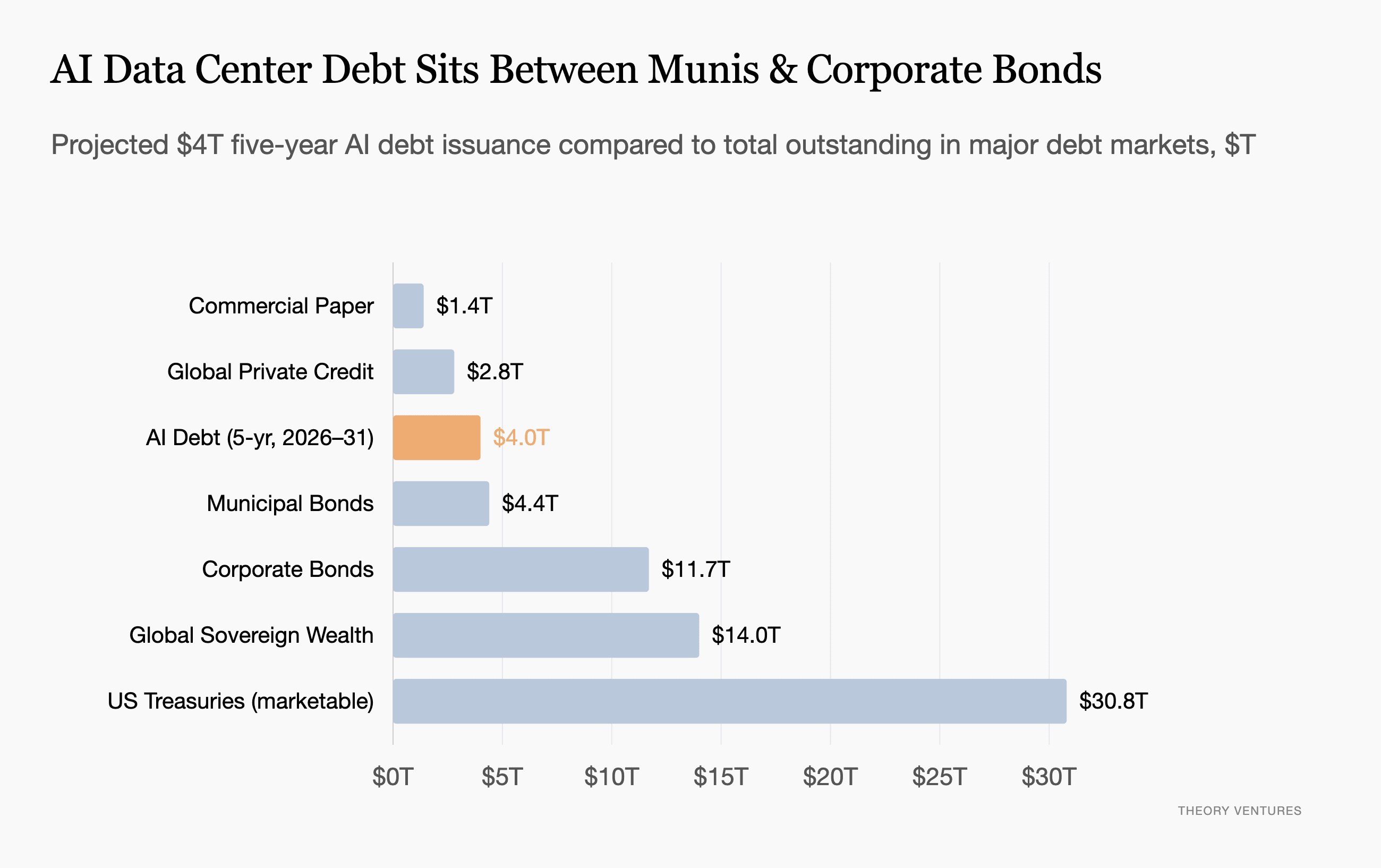
The expansion of artificial intelligence infrastructure has outgrown hyperscaler cash reserves and collided with global debt markets. As venture capitalist Tomasz Tunguz outlines, hyperscalers and data center operators face issuing an estimated $4 trillion in debt over the next five years to underwrite AI infrastructure. This debt frenzy underpins a broader $5 trillion global buildout designed to lift US data center capacity from 25 gigawatts to 70 gigawatts.
The Scale of Project Leverage
Data centers are fundamentally structured as debt-heavy real estate projects, typically carrying 70% or more leverage. Research from Columbia Business School professor Stijn Van Nieuwerburgh and CREFC shows facility-level data center leverage routinely hits 65% to 75% debt, escalating to 90% in synthetic joint venture special purpose vehicles such as Meta's Beignet vehicle.
"Financing the AI infrastructure boom is no longer a venture capital or corporate earnings story. It is a macroeconomic credit event that will rival the largest debt expansions in financial history."
Absorbing $4 trillion in debt strains broader credit markets: this sum equals 286% of the US commercial paper market, 143% of the global private credit market, and demands a 34% expansion of the entire US corporate bond market. For enterprise buyers, this level of leverage turns interest rate volatility into an operational risk—threatening to trigger computing cost surges and infrastructure delivery delays whenever credit markets tighten.
The Revenue Math Required for Solvency
Servicing this debt pile requires unprecedented end-user revenue growth.
"Reaching $1.35t from roughly $150b today requires a 55% compound annual growth rate (CAGR) over the next five years."
While cloud segments show strong momentum—with growth rates at 37% for AWS, 43% for Azure, and 82% for Google Cloud—sustaining a 55% CAGR across the entire ecosystem tests historical precedents. Generating $1.35 trillion in annual revenue means capturing nearly the entire $1.4 trillion enterprise software market today out of a projected $9 trillion in total worldwide IT spending by 2030, leaving zero margin for delayed enterprise adoption or macroeconomic shocks.