Rising infrastructure expenses are mounting pressure on software margins as short-term burst compute reaches $13 per GPU-hour, according to Anthropic’s Form S-1/A. As public filings begin to trace capital allocations from power plants directly to end-user software, software developers face a structural shift where capacity expenses dictate operational viability.
Five distinct layers make up the artificial intelligence value chain: the power plant, the data center operator, the neocloud, the inference vendor, and the AI application. Each segment operates on an entirely disconnected billing model. Power utilities bill for kilowatt-hours, neoclouds rent out GPU-hours, and applications charge end users per completed task. Normalizing every operational step to dollars per watt per year ($/w/yr) establishes a uniform baseline across the stack. Rising infrastructure expenses and aggressive expansion by neoclouds are compressing application margins, prompting the market toward vertical integration. The central uncertainty remains whether software vendors can pass escalating compute costs down to enterprise buyers or find themselves trapped by infrastructure inflation.
Normalizing the Stack from Megawatts to Software
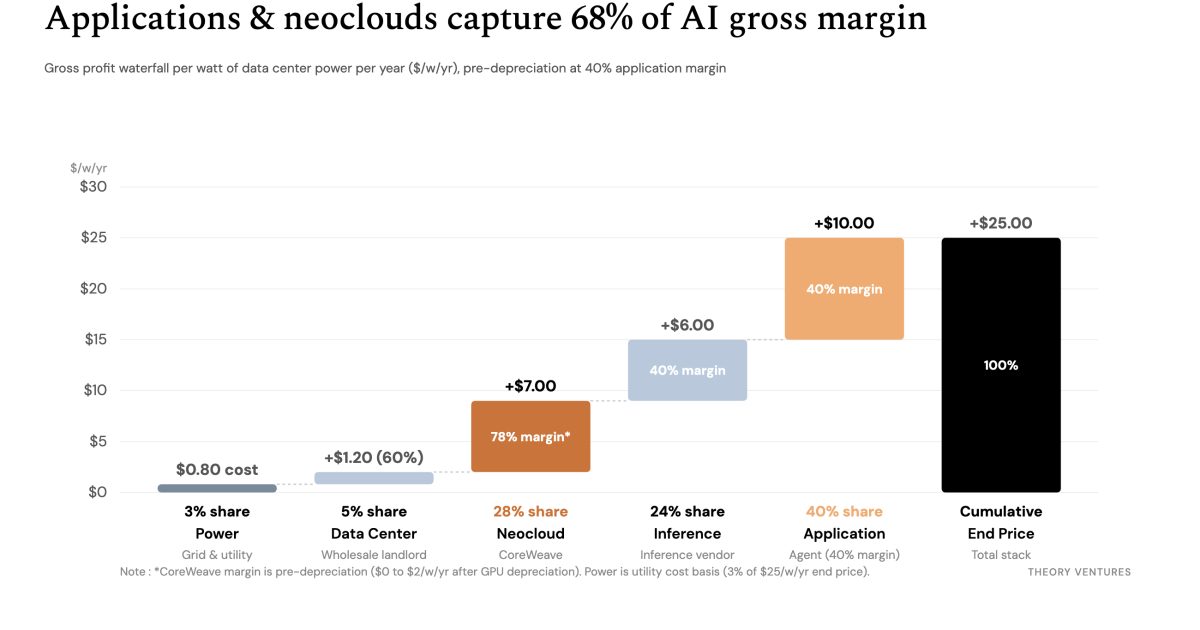
Tracing the waterfall distribution reveals which segment captures the bulk of the economic return. At a 40% application gross margin, the total gross profit pool divides across the chain as 3% for power, 5% for data centers, 28% for neoclouds before accounting for GPU depreciation, 24% for inference vendors, and 40% for the application layer. At the same time, the market reflects a substantial spread between the cost of electricity and long-term capacity lease rates.
Who takes the primary financial strain when base capacity reprices across multi-year cycles?
Contract adjustments at the physical tier cascade directly into software unit economics. On CoreWeave’s Q3 earnings call, CEO Michael Intrator confirmed that infrastructure pricing is shifting upward.
"Selling capacity at more than $40m per megawatt annually while pricing for new infrastructure on four & five year contracts is moving to $20m to $25m per megawatt."
This pricing environment marks a decisive shift. Securing new infrastructure at $20m to $25m per megawatt means contract rates are pricing at more than double CoreWeave’s current blended fleet level of $9 per watt per year. If application builders cannot extract commensurate pricing from their customers, neoclouds, inference providers, and software developers will be forced to compete over an increasingly constrained profit pool.
Capital Concentration and Vertical Integration
Scale requirements are intensifying pressure across balance sheets. In its Q3 earnings release, CoreWeave reported revenue of $3.661b, representing a 168% year-over-year increase, alongside GAAP operating income of $207m at a 6% margin and adjusted operating income of $379m at a 10% margin. The same filing recorded an Adjusted EBITDA of $2.26b with a 62% margin, set against depreciation and amortization of $1.89b, net interest expense of $846m, and a GAAP net loss of $709m. CoreWeave's active power footprint expanded from 1.5gw at the end of Q2 to above 1.7gw at the close of Q3, backed by contracted power exceeding 4.6gw and a backlog of $132.5b.
Some argue that application vendors delivering high return on investment can easily pass rising compute costs onto corporate clients. Yet pricing leverage across software categories remains highly uneven. An AI application that cuts enterprise expenses by 30% commands far less pricing flexibility than one delivering a 70% reduction. Software builders rely on defensive techniques such as deploying smaller models, fine-tuning, and dynamic routing to protect their spreads, demonstrating that different vertical markets will sustain unequal gross profit pools.
To hedge these structural pressures, infrastructure operators are aggressively acquiring software assets to consolidate margins. CoreWeave purchased Weights & Biases for $1.03b, alongside acquisitions of OpenPipe, Marimo, and Monolith AI for a combined $185m to capture training, evaluation, and enterprise workflows. Similarly, Nebius has deployed more than $1b in acquiring four companies covering search, model optimization, cold-start scaling, and orchestration.
Independent software providers that lack vertical control or exceptional enterprise ROI face an infrastructure bottleneck. When foundational capacity contracts surge to $25m per megawatt, standalone application layers cannot defend software-era margins against fully integrated compute stacks.
What doesn’t add up
Where does the margin of software startups actually go? Corporate disclosures show a stark trade-off: while neoclouds like CoreWeave command the lion's share of the stack's gross profit pool, application builders risk footing the bill for this infrastructure inflation out of their own pockets. At the same time, public filings from capacity providers show that a slim 6% GAAP operating margin conceals a net loss, cascading the real weight of chip depreciation and interest expenses straight down the chain. The entire unit economics of applied AI now hinges on software makers forcing price increases on end clients before hardware leases wipe out their gross margin.