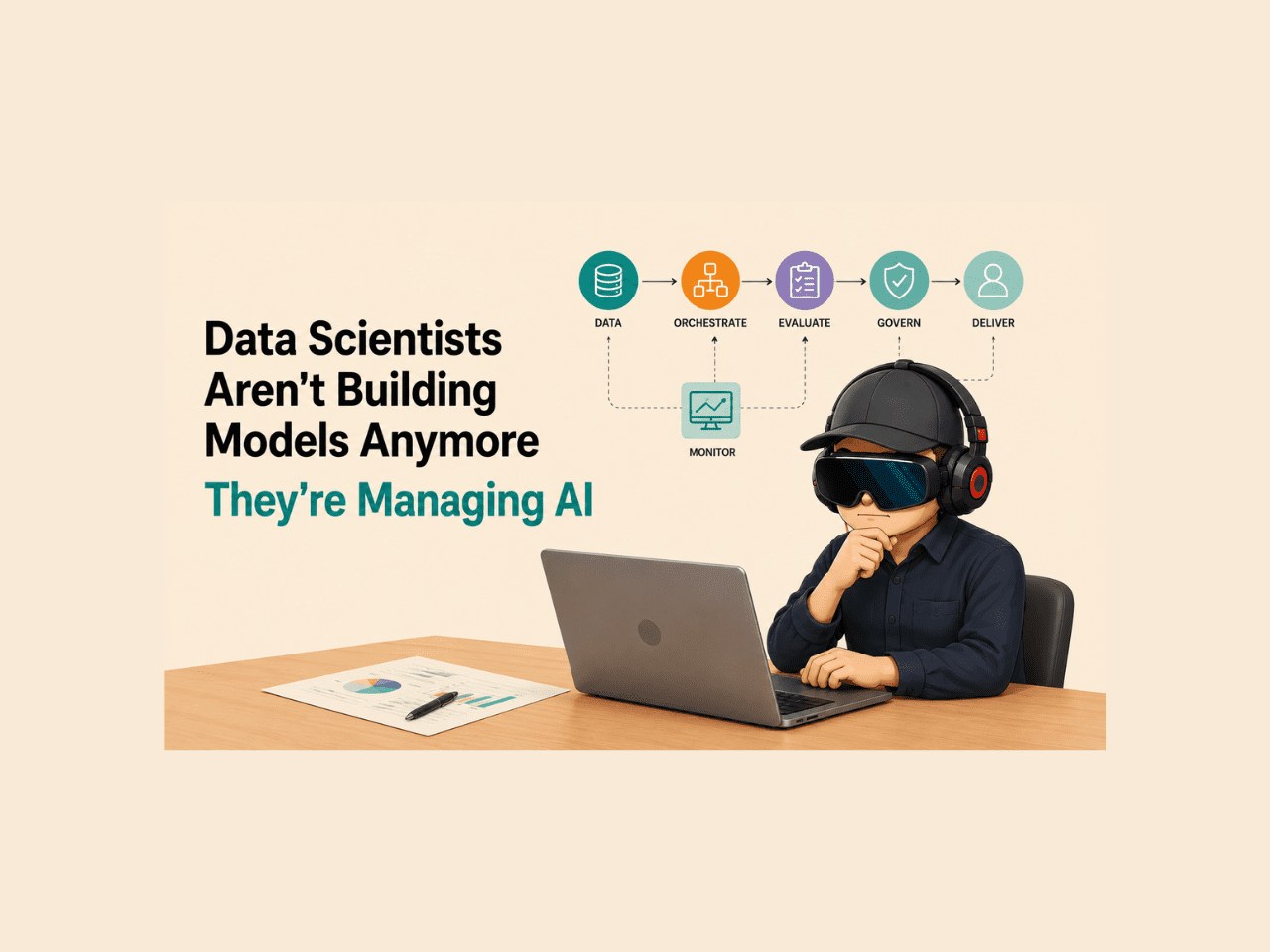
The era of the "model builder" as the Data Science elite is ending faster than HR departments can update their job postings. While the industry spent years fetishizing the ability to train neural networks from scratch, the real sector has pivoted to more pragmatic priorities. Generative AI has effectively automated the grunt work: writing SQL queries, cleaning data, and basic visualization are now delegated to the systems themselves. Based on 2025–2026 dynamics, the market has stopped paying for architecture—it is paying for ruthless oversight of the output.
The Anatomy of the Salary Premium
Financial evidence of this shift in the US labor market is more than compelling. Specialists with AI skills are seeing a 56% pay bump, equivalent to roughly $18,000 per year. However, this capital isn't flowing into traditional mathematical research. According to LinkedIn, the most sought-after competencies are now AI literacy and LLM proficiency. The drivers behind that $18,000 raise are prompt engineering, RAG (retrieval-augmented generation) implementation, MLOps, and the establishment of compliance frameworks.
The premium is no longer paid to those who can train a model from scratch, but to those who can integrate it into a workflow and ensure the system doesn't lie.
The boundaries of IT are finally dissolving. Analysis by Lightcast shows that 51% of AI-related job openings are now located outside traditional development departments. AI competencies are transforming into a management and operational function rather than an isolated "pen" for programmers. A specialist's task is no longer making a model work in a sterile researcher's notebook; it is taking responsibility for what that model delivers to the real world.
From Writing Code to Agent Orchestration
Business is moving from monolithic code to multi-agent infrastructure. Frameworks like LangGraph, CrewAI, and AutoGen handle data collection and feature engineering with almost no human intervention. This explains the explosive growth in demand for multi-agent systems—up 1445% according to Gartner estimates for the period between early 2024 and mid-2025. In this environment, a data scientist's job becomes about decomposing complex goals into subtasks for agents and building "fuses" to prevent cascading failures. This is a transformation from classical development into distributed systems design, where a single hallucination at the input stage can poison an entire corporate workflow.
Gartner predicts that by the end of 2026, 40% of enterprise applications will include AI agents.
The modern practitioner treats the model as a commodity component—nothing more.
The transition is complete: the data scientist has officially moved from the laboratory to the control room.
As McKinsey research confirms, the human role has been reduced to the orchestration of autonomous systems. The primary task now is deciding exactly which autonomous outputs require a human signature before they reach the end user.