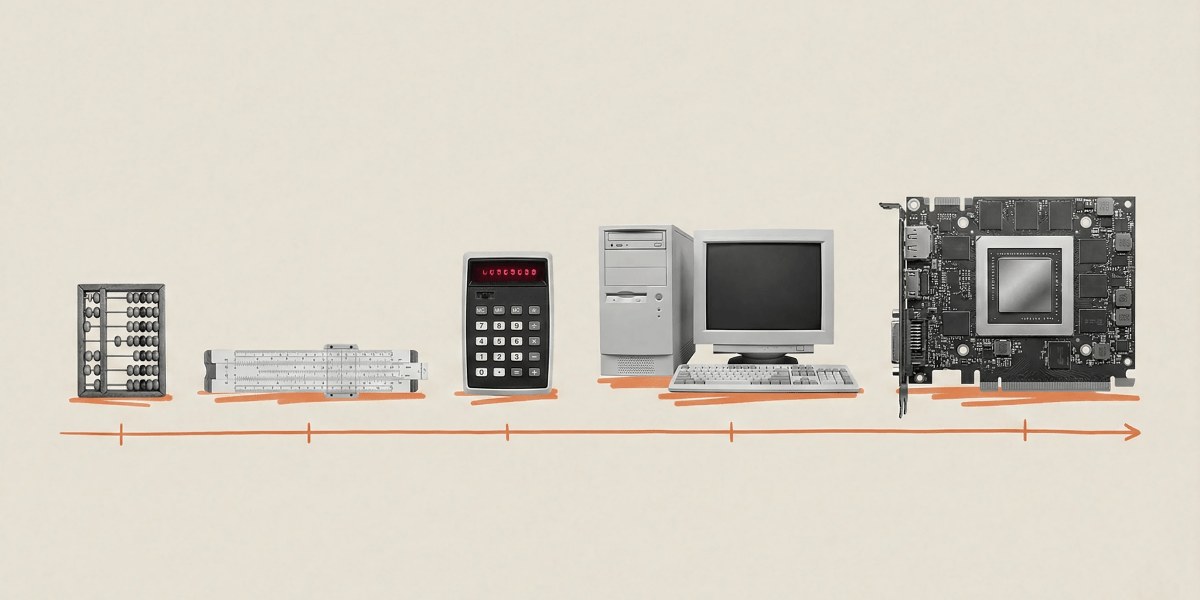
Mustafa Suleyman, a co-founder of DeepMind, is deliberately challenging our assumptions about linear progress, asserting that artificial intelligence will not encounter a ceiling in the foreseeable future. He identifies the exponential growth in computing power and the avalanche-like increase in data volumes as the primary drivers of this trend. "We are only at the beginning," Suleyman states, emphasizing that our intuitive understanding of speed and scale is inadequate for this new reality. Our logic, forged in a "linear world," simply fails to grasp the magnitude of change where training data for advanced models has grown a trillionfold in fifteen years, and computational power has surged from 10^14 to over 10^26 floating-point operations.
This acceleration is fueled by three key factors. Firstly, a revolution in hardware is underway. Nvidia chips already deliver 2250 teraflops, seven times more than six years ago. Proprietary developments, such as Maia 200, promise superior performance per dollar invested. Secondly, new memory technologies, like HBM3, are tripling data transfer speeds. Thirdly, high-speed interconnects such as NVLink and InfiniBand allow for the aggregation of hundreds of thousands of GPUs into a single, immensely powerful computing cluster. These are evolving beyond mere "computers" into something akin to a collective intelligence.
The results of these transformations are striking. Training large language models that once took hours now takes minutes. According to research from Epoch AI, the computational power required to achieve a given level of performance doubles every eight months, outpacing even Moore's Law. Concurrently, the cost of owning AI models has decreased so dramatically that AI has become radically more accessible. Leading AI labs are increasing their computing capacity by nearly fourfold annually. By the time of the article's publication in MIT Technology Review, global AI computing power had reached the equivalent of 100 million of the most powerful H100 GPUs. For Nvidia, these appear to be golden times, as they have clearly mastered the art of building the "picks and shovels" for the AI gold rush.
This exponential growth in AI means that businesses must do more than simply adapt; they must undergo continuous transformation. Those who ignore this seismic shift risk being left behind as the competitive landscape reshapes itself at an unprecedented pace. This is not about adopting new trendy tools, but about a fundamental rethinking of operational processes and strategic priorities. For those seeking stability, prepare for tomorrow to arrive much sooner than you think.