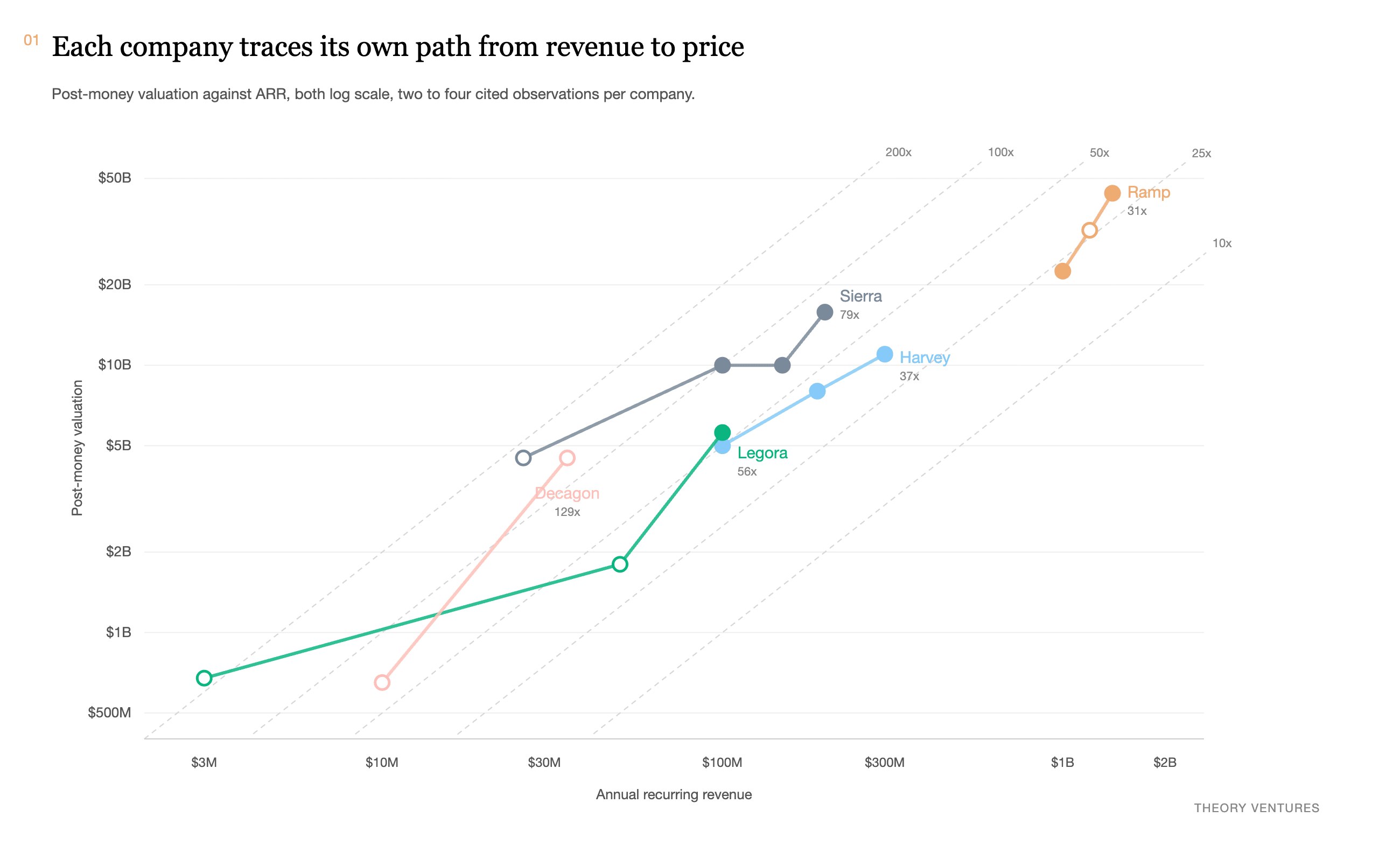
The velocity of AI market adoption has officially shattered the traditional SaaS scaling playbook. We are no longer looking at gradual climbs, but at vertical takeoffs. According to data from Tomasz Tunguz, three heavyweights—Harvey, Sierra, and Legora—all breached the $100 million annual recurring revenue (ARR) threshold within a staggering nine-month window of each other. Harvey’s CEO Winston Weinberg announced this milestone in August 2025, followed by Sierra in November—hitting the mark in just seven quarters—and Legora in April 2026. This compressed timeline confirms that enterprise customers aren't just 'testing' AI; they are rewiring their core operations around it. Yet, paradoxically, the financial markets have stopped rewarding this growth with any sense of uniformity.
The Disconnect Between Growth and Multiples
If you still believe the venture capital dogma that faster growth automatically commands a higher valuation multiple, the current AI landscape will disappoint you. Harvey, Sierra, and Legora were valued at 50x, 100x, and 56x revenue respectively, but growth rates alone fail to explain this massive delta. As Tunguz’s analysis highlights, the fastest-growing company in this group was actually priced near the bottom of the multiple range. Investors have effectively pivoted, ignoring raw speed in favor of 'category leadership.' We are seeing companies trading within isolated 'multiple bands' that remain stubbornly fixed regardless of how much ARR they stack. For instance, Decagon clings to a 129x multiple at a $35 million scale, while Ramp, generating $1.4 billion, operates in an entirely different orbit. The premium is no longer for the hustle, but for the fortress.
Typically, multiples compress as a company scales, but the sustained acceleration for Legora, Sierra, and Ramp suggests a market that has abandoned the old gravity in favor of a permanent premium for industry-standard tools.
This trend signals a bet on what Tunguz calls the 'AI harness'—the infrastructure and specialized plumbing that becomes indispensable to a specific industry. Investors are betting that these aren't seasonal winners, but the new utilities of the AI era. While a 100x ARR multiple was considered a 2021-era hallucination, it has returned with a vengeance. The difference? The underlying growth today is roughly three times faster than it was five years ago. This isn't just cheap money; it's a desperate scramble to own the winners of a winner-take-all market.
Risks of Extreme Valuation Caps
However, maintaining these atmospheric multiples—ranging from 25x to 125x current ARR—is a dangerous game as these startups enter the deep scaling phase. While Harvey secured a $5 billion Series E in June 2025 and Sierra hit a $10 billion valuation by September, the pressure to grow into these numbers before a public exit is immense. Legora’s $5.6 billion Series D extension in April 2026 shows a hint of sobriety, reflecting a more conservative multiple than Sierra’s, despite both companies performing at elite levels.
Founders still pitch a future where AI incumbents capture all the value, framing 100x multiples as a 'bargain' for future monopoly power. But the data tells a more cynical story: companies are getting stuck in valuation bands that ignore their actual performance. The industry promised that scale would eventually bring efficiency and multiple compression. Instead, the entry fee for category leadership continues to skyrocket, while the actual correlation between how a company performs and what it costs has quietly vanished.