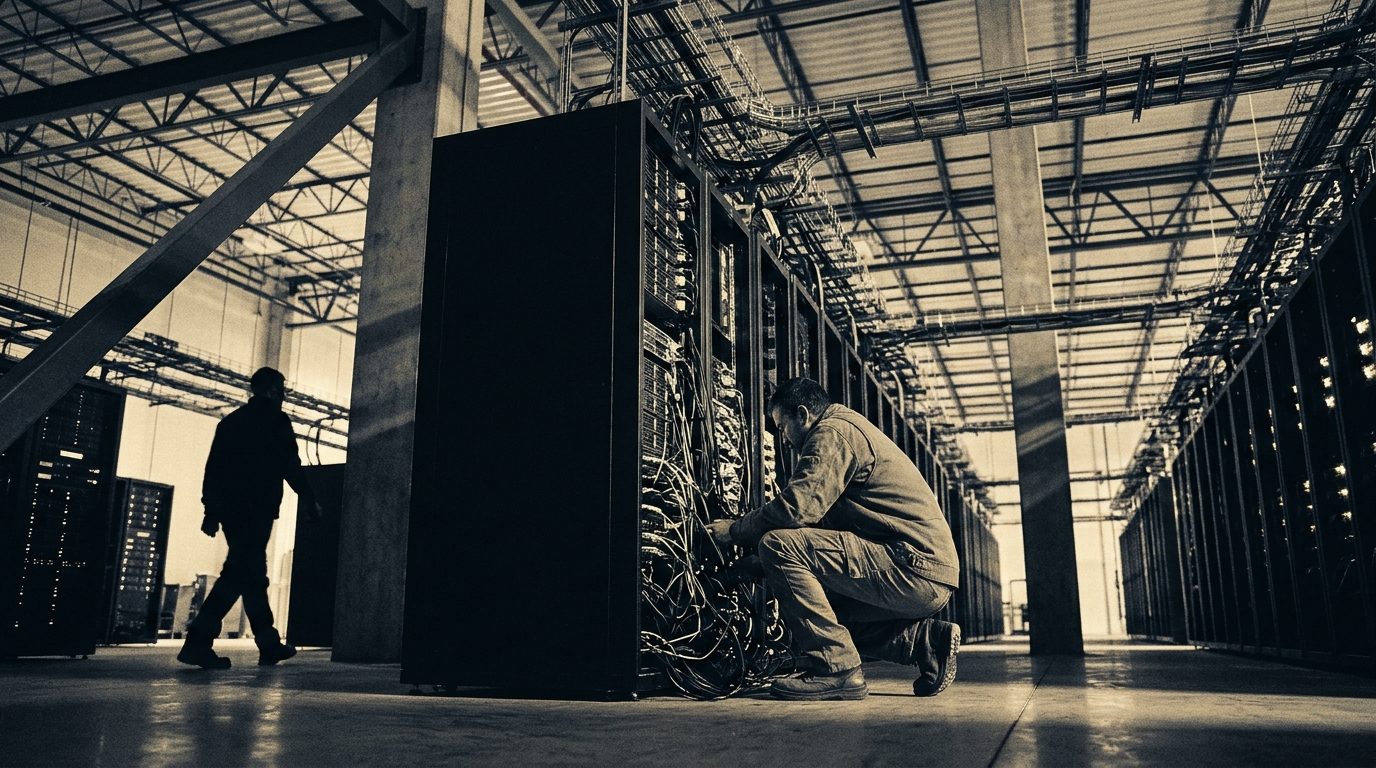
While Alibaba Group once funded business operations through comfortable retail margins, capital expenditure climbed 60% to 50.48 billion yuan as the company redirected cash reserves toward artificial intelligence hardware. Alibaba posted revenue of 271.52 billion yuan for the three months ended September 30, beating analysts' average estimate of 269.81 billion yuan, according to LSEG data. Demand for artificial intelligence computing and cloud infrastructure helped offset weakness in the retail core, but the cost of maintaining that growth trajectory is consuming operating cash flows.
Revenue from Alibaba's AI cloud and computing services rose 53% year-on-year to 60.97 billion yuan. Yet customer management revenue, linked to advertising and merchant services, declined 5% during the quarter. The infrastructure race in computing power requires massive capital commitments while the retail foundation that pays for them experiences slowing growth.
"Customer management revenue, linked to advertising and merchant services, declined 5% during the quarter."
This operational divergence leaves Alibaba relying on enterprise software demand at the exact moment its cash generation from merchant services is contracting. The corporate bet assumes cloud workloads will eventually yield self-sustaining cash flows before retail returns deteriorate further.
Surging Cloud and Cash Outflows
Expansion across corporate clients showed significant momentum across enterprise segments. As Alibaba stated, recurring revenue from external cloud customers grew 67%, while revenue from external customers overall increased 64%. Furthermore, Alibaba's AI-related product revenue recorded triple-digit growth for the thirteenth consecutive quarter as clients increased their reliance on external cloud services for training and deploying machine learning applications.
Can triple-digit growth in AI products and a 53% surge in cloud revenue genuinely justify a severe cash flow deficit and missed earnings?
Alibaba's financial statements show that the physical cost of data infrastructure immediately penalizes bottom-line metrics. Alibaba's free cash flow outflow widened to 34.47 billion yuan during the quarter. Non-GAAP net income increased 92% to 19.9 billion yuan, helped by stronger operating performance and lower quick-commerce losses. However, adjusted earnings per American Depositary Share came in at 8.10 yuan, falling below analysts' estimate of 11.16 yuan because of the capital requirements tied to physical server capacity.
"Alibaba’s free cash flow outflow widened to 34.47 billion yuan, while capital expenditure climbed 60% to 50.48 billion yuan."
Every percentage point of customer growth in computing services requires parallel investments in silicon, facilities, and power distribution systems. Instead of generating immediate excess cash, hyper-growth in server workloads creates continuous cash requirements.
The Silicon Pipeline
Alibaba continues to build out computing infrastructure to handle long-term enterprise demand. The company plans to expand its global data-center capacity to more than 20 gigawatts by 2032. Supporting such immense power capacity requires proprietary hardware developments to control server costs and run applications efficiently across distributed networks.
To address long-term compute expenses, Alibaba's chip-design unit, T-Head, unveiled a new AI processor expected to be commercially available in early 2027.
What came before
Revenue from customer management shrank over the quarter as the free cash flow deficit widened to 34.47 billion yuan. The in-house processor from T-Head will not reach the commercial market until early 2027, leaving the company to carry physical infrastructure expenses on a tightening merchant base. Can enterprise computing demand generate self-sustaining cash flow before Alibaba's retail engine weakens too far to support its data centers?