AI · This text was generated with artificial intelligence
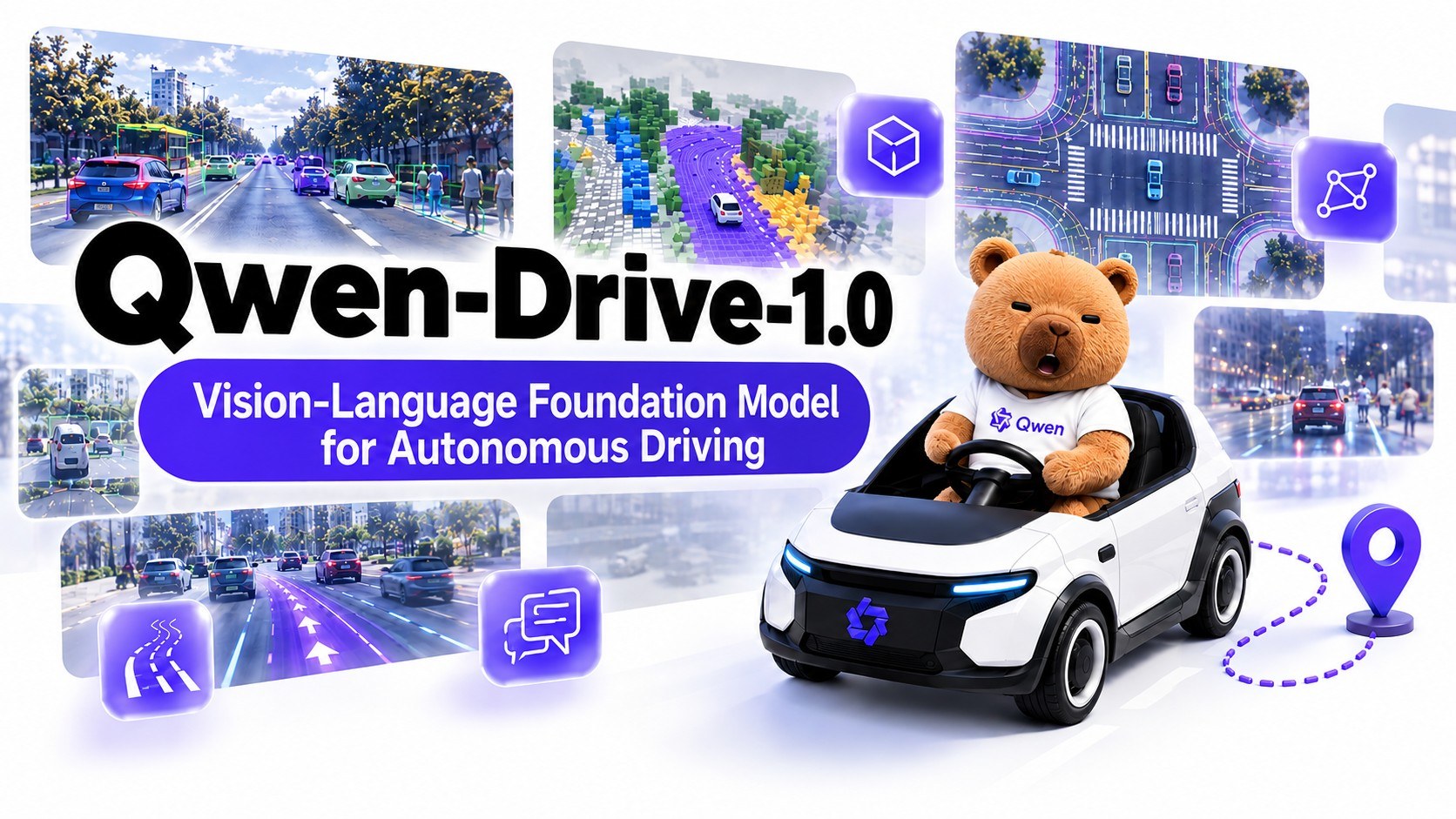
Developing an end-to-end driving system that handles high-level reasoning alongside sub-second physical trajectory control remains a hard engineering bottleneck. Alibaba's research division recently introduced Qwen-Drive 1.0, an architecture that attempts to unify 3D spatial perception, conversational interaction, and path planning inside a single multimodal framework without degrading the underlying LLM's core capabilities. Built atop the Qwen3.5-4B base model, the project tests whether generative vision-language models can reliably pilot vehicles in complex environments.
Spatial Grounding and Architectural Additions
Standard vision-language models routinely stumble when translating visual scene descriptions into physical coordinates; describing a scene is not the same as parsing geometric depth. To bridge this spatial gap, Qwen-Drive 1.0 integrates two dedicated components into the base model: a module that generates 3D bird's-eye-view representations by detecting bounding boxes, lane layouts, and occupancy grids, alongside a specialized Planning Expert for trajectory calculation.
Critically, Alibaba's researchers discovered that freezing the base vision-language model while training only the downstream planning expert yielded poor spatial accuracy. Viable trajectory output required end-to-end co-training of the foundational VLM across 24 aggregated traffic datasets, enabling the system to retain general conversational reasoning while projecting spatial waypoints.
"The planned maneuver also doesn't always match the reasoning the model gave beforehand."
Disconnects in Trajectory Planning and Explanations
Simulation benchmarks demonstrate both the operational gains and the structural vulnerabilities of this setup. Reinforcement tuning halved off-road navigation failures from 24% to 12%—a solid benchmark delta, yet a failure rate far too permissive for production deployment without deterministic rule-based safety overrides.
More concerning is the architectural disconnect between generated explanations and executed trajectories. The model's post-hoc or simultaneous textual reasoning frequently contradicts the actual physical vectors computed by the planning head. This pseudo-interpretability creates major safety risks: an operator or monitoring system receiving a sensible natural-language justification while the vehicle executes an entirely divergent physical maneuver. Deploying generative multimodal stacks in safety-critical robotics will remain stalled until model reasoning and physical action vectors are structurally synchronized.