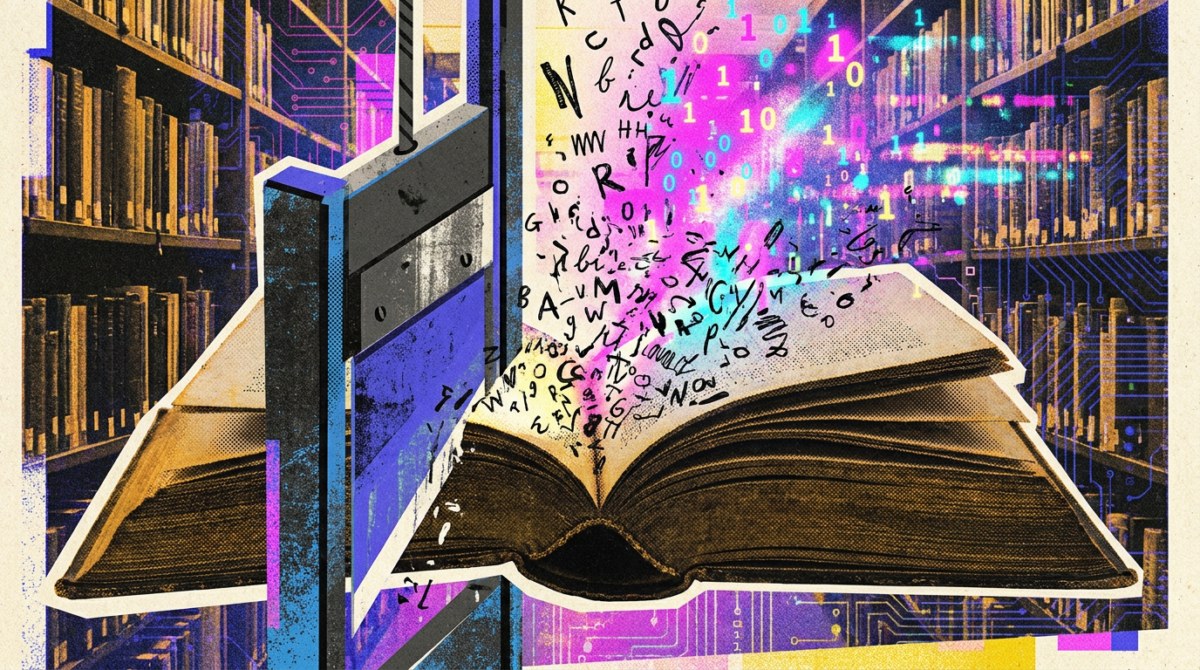
Amazon has set up a book-destruction assembly line in Las Vegas, snapping up physical volumes, slicing off their spines for high-speed automated scanning, and junking the paper copies to feed its Nova AI models. An investigation by 404 Media exposed the operation by planting an AirTag in a batch of rare books, tracing the shipment directly to Amazon’s VGT3 facility—an internal unit ironically branded with a T-Rex clutching a book.
To bypass the bottleneck of manual scanning, workers shear the spines to run loose leaves through high-velocity sheet-fed scanners, permanently destroying out-of-print texts in the process. Amazon confirmed it acquires physical books through standard commercial channels to improve its products. For enterprise strategists, the underlying motive is obvious: frontier labs are vacuuming up pre-2022 printed catalogs via ISBN sweeps to obtain clean human prose free of synthetic AI pollution, unlocking obscure knowledge that never existed on the open web.
Amazon is leaning into a controversial copyright loophole pioneered by Anthropic’s Project Panama, where destructive scanning was defended as fair use precisely because the physical source materials were pulped rather than resold into circulation. While legal teams may argue the first-sale doctrine permits buying and pulping physical inventory, systematically liquidating rare printed titles into proprietary weights creates an aggressive gray zone that will inevitably trigger the next wave of publisher class-action litigation.