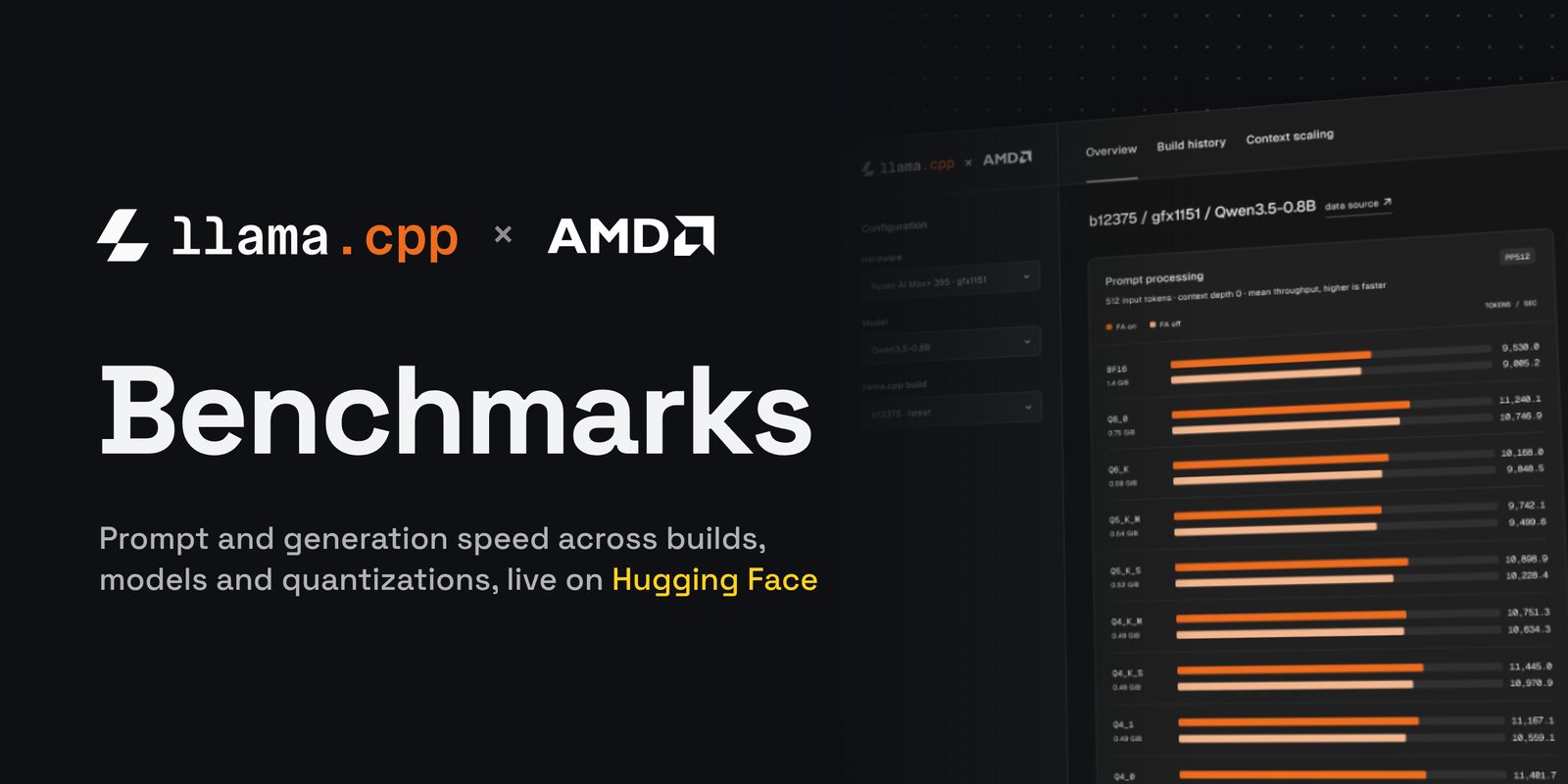
The llama.cpp × AMD Benchmark dashboard is available on Hugging Face, introducing automated tracking for prompt processing and text generation performance across llama.cpp builds, models, and quantizations on AMD Ryzen and Radeon hardware.
Local inference performance changes as models, kernels, and builds evolve. The release opens a structured way to evaluate moving quantised open-source models onto local AMD architectures instead of absorbing continuous rental fees for hyperscaler infrastructure. For corporate technology leaders, calculating the total cost of ownership shifts from predictable hourly cloud instances to capital expenditure on local workstations. Yet, migrating core operational pipelines away from centralized cloud infrastructure requires weighing these potential savings against strict service-level agreements and hardware maintenance overhead. As data-center GPU rentals consume a significant share of operational budgets, engineering teams look to local silicon to trim recurrent overhead, provided that throughput metrics justify the capital outlay.
Quantization Metrics and Pipeline Architecture
The configuration interface allows engineers to select specific hardware, individual models, and designated llama.cpp builds. Current hardware options are the Radeon 8060S (gfx1151) and the Radeon AI Pro R9700S (gfx1201).
In the Overview tab, teams can compare quantizations for one hardware profile, model, and build using two baseline metrics starting at context depth zero. The metric PP512 measures processing 512 input tokens without generation, while TG128 measures generating 128 tokens without an existing context, with both charts plotting the mean throughput in tokens per second. Memory bandwidth constraints on consumer silicon heavily influence these throughput numbers, directly dictating how efficiently weights stream from memory during token generation. When evaluating hardware performance for enterprise deployments, memory bandwidth often proves to be the primary bottleneck, limiting concurrent user requests and restricting the scale of models that can run locally without severe latency penalties.
"We want those changes to be easy to inspect for any AMD developer: pick a hardware, a model and a build, compare quantizations, and follow performance over time."
As Hugging Face explained, tracking these numbers across iterations highlights how runtime optimizations translate into throughput. Beyond isolated benchmarks, the Build history tab tracks PP512 and TG128 across all recorded builds for the chosen setup, and the Context scaling tab maps out how token-generation throughput behaves as the active prompt context expands. But how do these automated test runs maintain consistency across weekly code releases?
Automated Test Workflows and Architecture Sweeps
The testing pipeline relies on standard benchmarks executed through the llama-bench tool against prebuilt binaries distributed by llama-install.sh, which is the build and installation project behind llama.app. The public gfx1151 and gfx1201 workflows run weekly, logging results with Flash Attention enabled and disabled across 10 repetitions per configuration.
The benchmark workflow and underlying results are public, so you can also inspect how we benchmark inference performance.
As the Hugging Face report details, the monitored model lineup covers dense and mixture-of-experts architectures, including Inkling 2 Mini, Qwen, Gemma, gpt-oss, and LFM models. Supported GGUF formats span Q4_K_M, Q8_0, other quantizations, and higher-precision formats such as BF16 and F16. Raw metrics are stored in the public ggml-org/install.sh-benches-data Storage Bucket on Hugging Face, where standard test runs use <build>/<hardware>/<model>/<quant>.jsonl and workload sweeps save to <quant>-tg.jsonl files.
A central operational objection remains: consumer AMD silicon may lack the memory capacity and memory bandwidth required for high-concurrency production deployments compared to specialized enterprise accelerators. Hugging Face acknowledged that the AMD team provided test infrastructure and helping validate the setup, yet the public dashboard currently tracks only isolated workloads under zero-depth and scaling contexts on the Radeon 8060S and Radeon AI Pro R9700S. The prospect of replacing enterprise cloud clusters with local client hardware meets the boundary of a test suite restricted to single-device test runs and two chip targets.
Against the field
Memory bandwidth strictly limits concurrent queries and stalls large models unless teams accept massive latency spikes. Weekly llama-bench pipelines now capture the resulting token generation throughput on Radeon 8060S and Radeon AI Pro R9700S over exactly 10 runs per configuration. The TG128 metric tests the generation of just 128 tokens without context, revealing the real limit of the silicon.