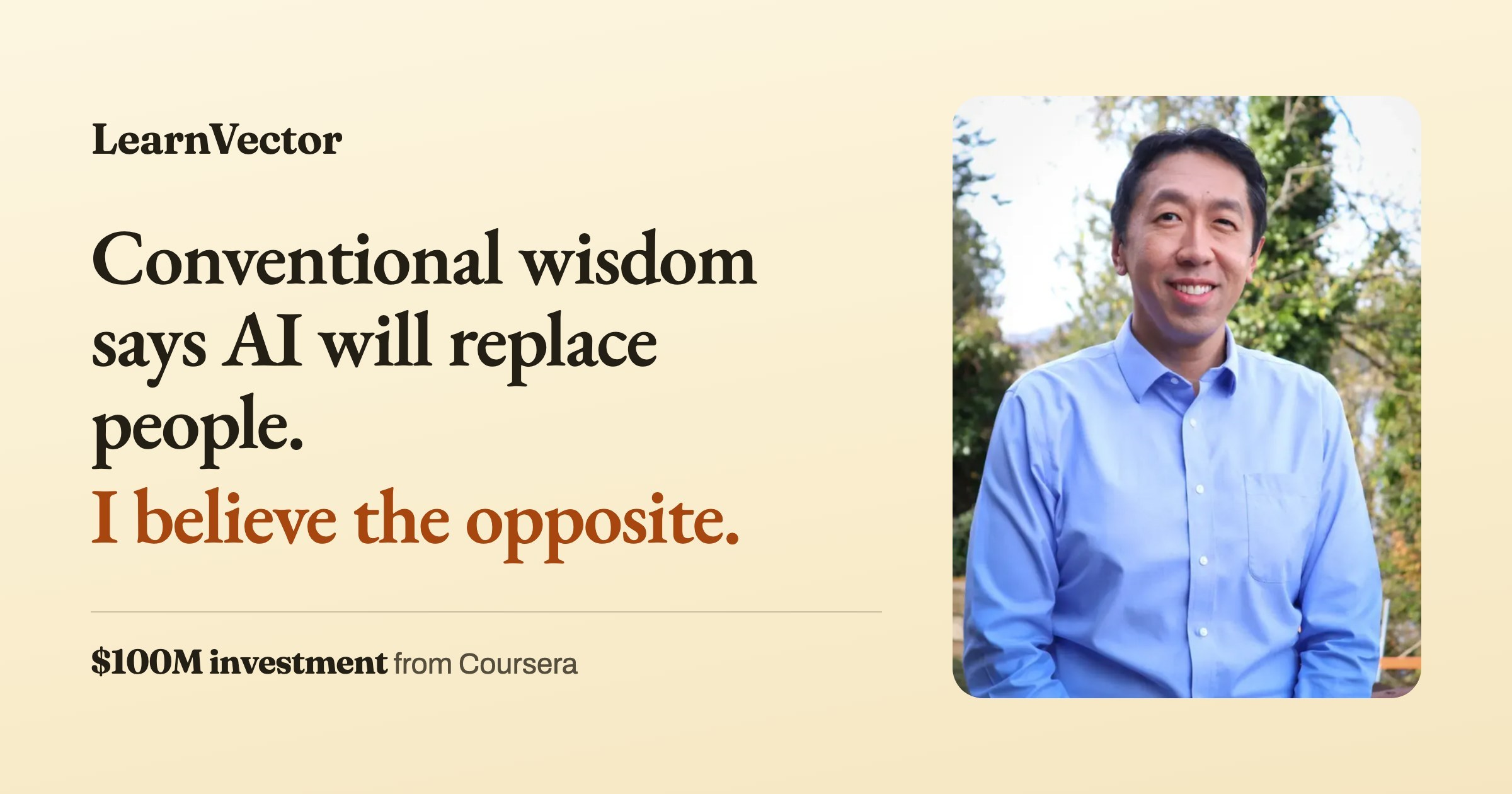
The era of assembly-line education, where a single lecturer broadcasts to millions, is nearing its end—and its own architect is the one swinging the hammer. Andrew Ng, the founder of Coursera, is launching LearnVector, a project designed to finally dismantle the "one-to-many" model. Despite fifteen years of digital expansion, online courses have failed to escape the shadow of the medieval lecture hall: every student still receives the same content at the same pace. This new startup, backed by a $100 million investment from Coursera itself, looks like a corporate hedge against a rapidly aging business model.
Solving the Two-Sigma Problem
The fundamental gap LearnVector aims to bridge is the chasm between mass instruction and actual mastery. According to Andrew Ng, the challenge of personalized mentorship was never a pedagogical theory issue—it was strictly a matter of unit economics. For centuries, high-quality education remained a luxury limited by cost, geography, and time. Massive Open Online Courses (MOOCs) solved the reach but failed on effectiveness. Data confirms the reality: a student with a personal tutor progresses significantly faster than a participant in a mass digital sprint. LearnVector intends to solve Bloom’s "2 Sigma Problem," making personal mentorship accessible to everyone with a smartphone, not just the elite.
"We will shift learning from a broadcast format to a one-on-one dialogue."
This shift represents a transition from passive content consumption to guaranteed proficiency. Ng is openly critical of the current hype surrounding chatbots, labeling them dangerous "crutches": without a clear framework and pedagogical logic, AI assistants simply perform tasks for the student without building actual skills. LearnVector, instead, is developing adaptive systems for cognitive development. These tools don't just provide answers; they map out an individual journey, accounting for the specific student's context and pace. The goal is ambitious—to turn learning from a heavy chore into a daily instinct, replacing tedious cramming with an engaging process.
Personalization Economics and Corporate L&D
Coursera's $100 million investment isn't an act of charity; it’s a cold business calculation. LearnVector doesn't plan to operate in a vacuum, with deep integrations planned for Coursera and Udemy. The startup handles the heavy lifting—the knowledge delivery engine and the AI experience—that aims to radically overhaul L&D (Learning and Development) strategies. For businesses, this means a sharp decline in the cost of upskilling and talent retention through personalized educational tracks.
"A chatbot can provide an answer, but an answer is not yet an education."
The business case for this transformation rests on a scarcity of trust and time. In an information-saturated world, the value of verified, accurate, and relevant training only increases. LearnVector's first products are slated for a 2027 release. Essentially, we are witnessing Coursera attempting to buy a ticket to a future where value is created not by owning a library of video lectures, but by the technology that guarantees an employee has actually mastered a skill, rather than just clicking "complete course."