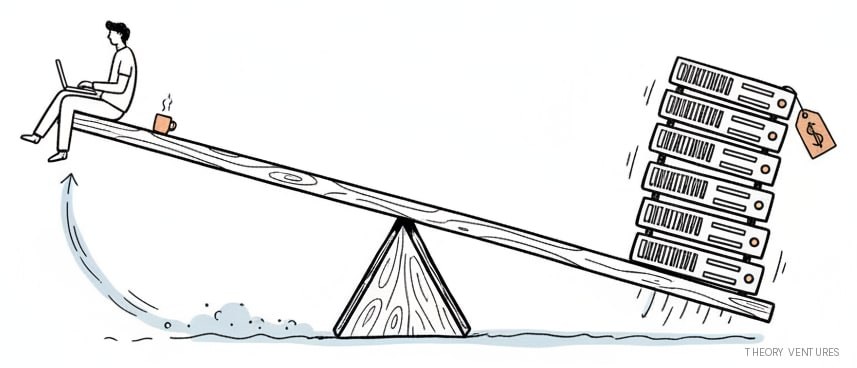
While the mass market still talks about "digital transformation," Dario Amodei’s Anthropic has moved into an era of total capital incineration. According to data from Tomasz Tunguz, the company spends 2.3 times more on computing power than its entire payroll. Each engineer at Anthropic carries $515,000 in annual infrastructure costs, dwarfing the average salary of $224,000. This isn't just an imbalance; it is an all-in bet. Anthropic believes that flooding the market with hardware is the only way to survive the race.
The chasm between AI labs and traditional business
The gap between frontier labs and the rest of the world has become almost comical. According to the Ramp AI index, even the industry elite—the top 1% of software companies—spend only 40% of a developer's salary on AI costs, roughly $89,000 compared to that same $224,000 salary baseline. For the median business, these expenses are a statistical rounding error at $137 per year. While the corporate sector cautiously experiments with neural networks, Anthropic plans to spend $2 million on servers per employee by 2026, targeting a total of $10 billion in training and inference costs.
For now, the "bright future" looks like a half-million-dollar bonfire burning every year to keep a single engineer's workstation warm.
Key takeaways from the AI giant economy
Revenue efficiency: Anthropic and OpenAI generate $14 million and $6.5 million in revenue per employee, respectively—figures the Forbes Global 2000 can only dream of.
Surging consumption: Goldman Sachs forecasts a 24-fold increase in token usage driven by autonomous agent scenarios.
Bubble risks: By 2029, either AI spending will hit 230% of payroll across the entire market, or the sector will collapse under deflationary pressure—generation prices are dropping tenfold annually.
Competition: Open-source models are gaining ground on proprietary solutions, casting doubt on the long-term margins of closed labs.