Software development budgets face rigorous financial scrutiny as generative artificial intelligence expenses scale to account for significant shares of total operational costs. Anthropic has validated its business model by posting an operating profit in the second quarter alongside a 900% net revenue retention rate, while client expenditures multiplied ninefold between the third quarter of 2025 and the third quarter of 2026 [1, 2].
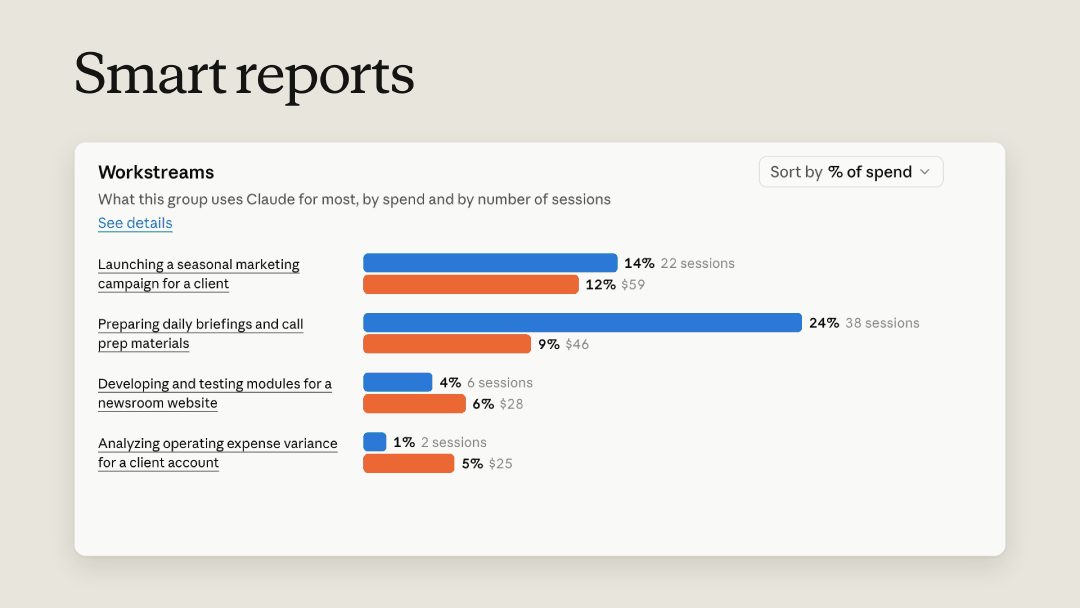
This explosive growth in AI coding costs forces enterprises to demand transparent unit economics and measurable ROI from vendors, particularly as most Fortune 500 companies have yet to realize substantial financial gains from AI deployments amid skyrocketing token consumption. Addressing market demands for cost control, the company introduced a new suite of reporting tools designed to provide corporate clients with granular visibility into the utility returned per dollar spent. How exactly can CFOs evaluate the tangible yield of such expenditures under tight budget constraints?
Control Tools and Development Economics
New analytics capabilities allow engineering leaders and managers to evaluate completed team output over specific timeframes, associated costs, and workflow bottlenecks via internal reports and employee surveys. The company states that collected data will not be used to train baseline models by default. Additionally, it is rolling out shared team budgets to govern token expenditures, shifting AI utilization from an experimental line item to a manageable operating expense.
"Even if you argue that 2% is still small, a 10x jump like that is a shock that most CFOs were not prepared for," noted Nicholas Arcolano, chief scientist at Jellyfish, in an interview with TechCrunch.
Meanwhile, Anthropic-powered products, including Claude Code, account for nearly a third of all proposed code modifications submitted for review. According to Nicholas Arcolano, chief scientist at Jellyfish, this precipitous surge caught most financial executives off guard, compelling companies to pivot from open-ended spending strategies to aggressive process optimization.
Competitive Dynamics and Infrastructure Barriers
As Nikolas Albarran, AI product leader at Jellyfish, pointed out, Anthropic's market traction stems less from momentary benchmark victories and more from established enterprise workflows and engineering stack familiarity. Users standardize operational processes around operational tools, cementing switching costs into a substantial barrier to vendor migration.
"We've reached a point where the technology is mature enough that once you are in this workflow, switching away becomes increasingly difficult because you've already invested the necessary effort," stated Nikolas Albarran, AI product leader at Jellyfish.
Leading artificial intelligence laboratories are actively investing in deployment teams, embedding engineers directly into client organizations to assist with onboarding, while Anthropic's new reporting dashboards serve as a streamlined counterpart to this hands-on support.
For comparison
A ninefold surge in enterprise spending on tokens marks the moment AI software development shifts from a tech experiment into a massive operational expense. Anthropic's staggering 900% net revenue retention proves engineering teams are deeply hooked on tools like Claude Code, which already generates nearly a third of all proposed code changes. Instead of dispatching hands-on forward-deployed engineers to every customer, the vendor is embedding cost analytics and team budgets directly into its product to give CFOs measurable visibility. Will built-in cost analytics convince Fortune 500 finance chiefs of a clear return on investment before soaring token bills trigger enterprise budget cuts?
Our stories: Claude Outpaces ChatGPT: Up to 30% Cost Savings & New AI Features (March 26); Anthropic IPO S-1 Filing Reveals Enterprise Metrics (October 27).