De novo binder design has long subjected structural biologists to grueling computational bottlenecks, demanding weeks of manual pipeline orchestration and screening per target. While domain-specific machine learning pipelines have accelerated structural predictions, physical verification in wet laboratories remains a brutal, expensive filter. Experimental findings from Anthropic indicate that frontier general-purpose reasoning architectures can execute early drug design and analytical chemistry workflows directly from raw experimental data.
Benchmarking Minibinder Generation
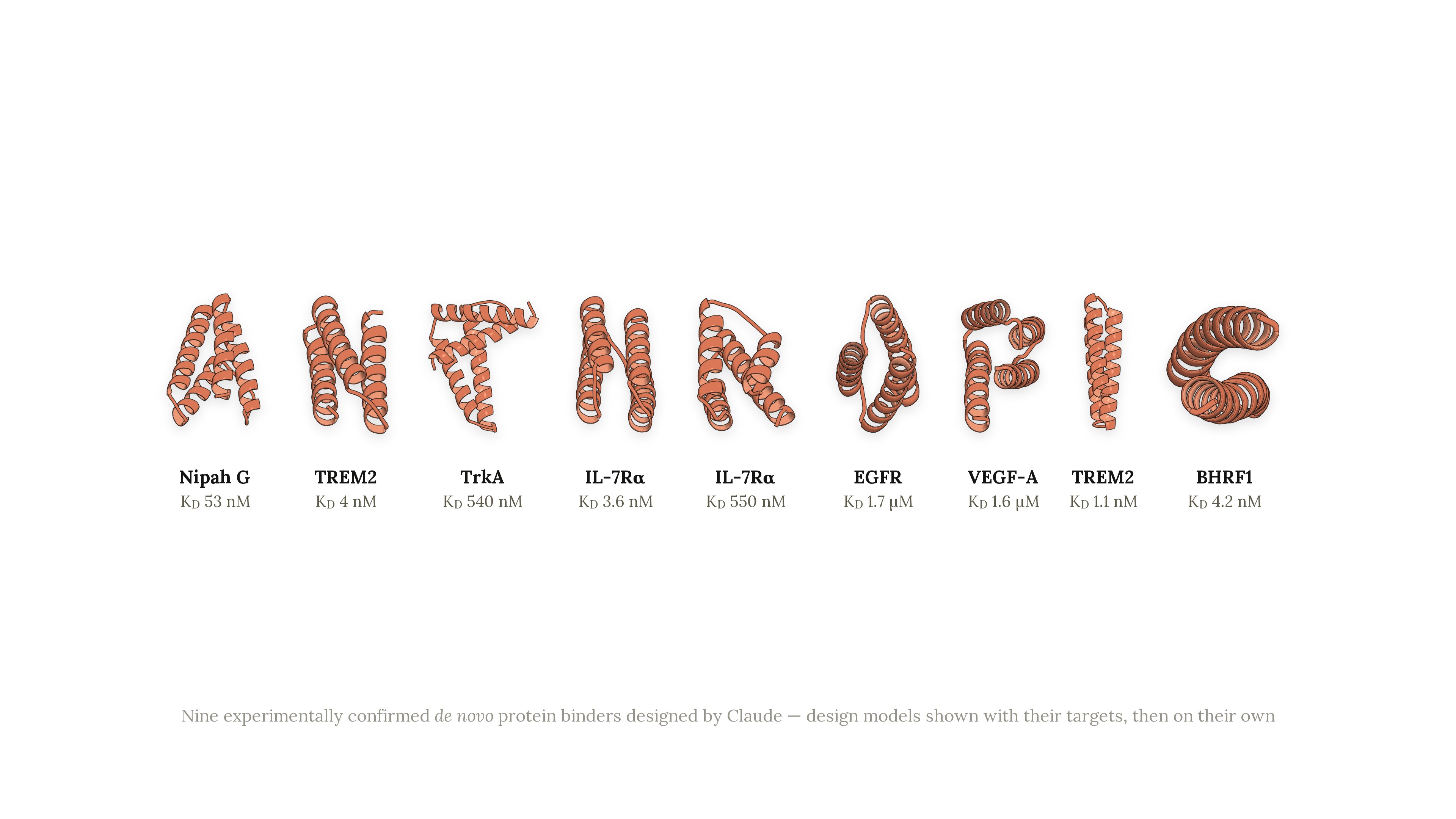
In an experimental campaign evaluated across 15 biological targets, Anthropic deployed frontier reasoning models to design small binding proteins from scratch. Experimental validation confirmed successful binding across 14 of the 15 evaluated targets.
Claude designed protein binders against 15 targets, succeeding against 14, with individual hit rates reaching between 22% and 35%.
These hit rates represent a substantial leap over standard computational protein design campaigns, which typically plateau at success rates between 10% and 15%. Across several targets, the strongest generated minibinders achieved binding affinities several times tighter than previous scientific benchmarks, transitioning early-stage drug design away from narrow, rigid bio-computational stacks toward universal reasoning models.
Analytical Chemistry from Raw Spectroscopy
Beyond macromolecular design, Anthropic evaluated how general models handle routine laboratory analysis. Researchers tasked the system with processing raw nuclear magnetic resonance (NMR) and liquid chromatography–mass spectrometry (LC-MS) spectra straight from a contract research laboratory using a concise two-sentence prompt.
The model returned finished analyses in 23 and 19 minutes, calculating purity at 96.4% compared to the contract lab's 96.33% and matching baseline values on hydrogen counts. This confirms general-purpose architectures can automate primary data interpretation without dedicated cheminformatics software, compressing wet-lab screening cycles from months to days and drastically cutting candidate validation overhead.
Yet the practical friction remains grounded in physical reality. While reasoning models compress computational turnaround from months to hours, physical wet-lab synthesis and assay preparation impose an irreducible latency floor. Automated spectral parsing cannot bypass synthesis bottlenecks or biological unpredictability, setting clear practical boundaries for LLMs in early drug discovery.