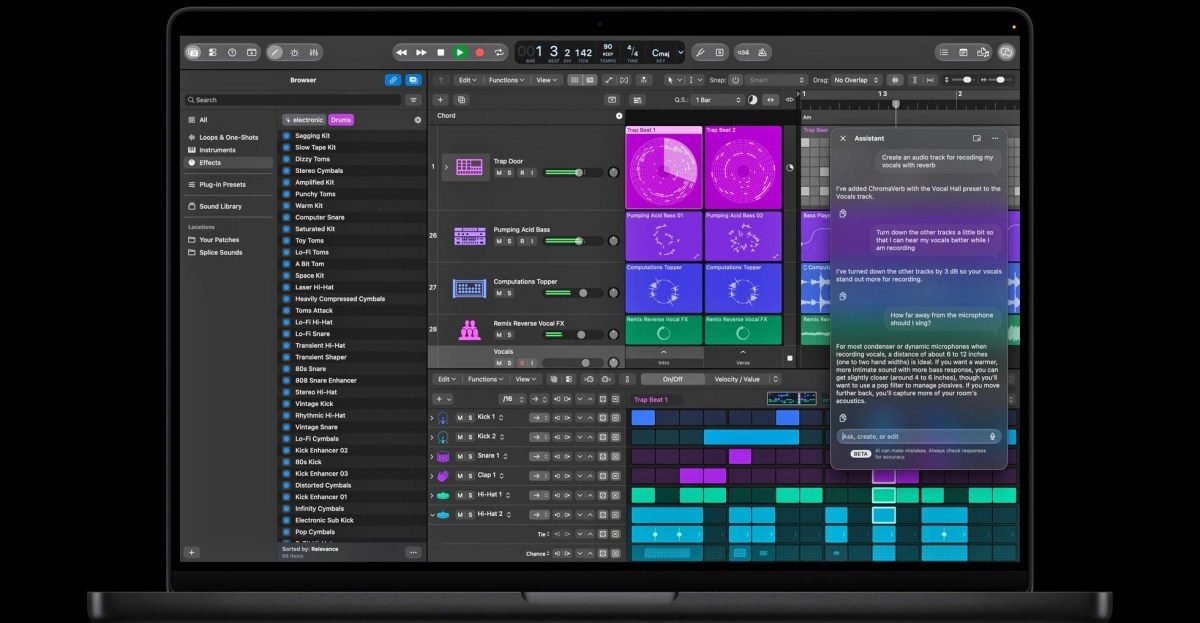
A one-time purchase price of $49.99 now gates expanded conversational artificial intelligence inside Logic Pro. As reported by 9to5Mac, Apple has updated Logic Pro with an option to “Buy More Usage” following a support article released in early September that outlined usage limits for certain Apple Intelligence features. The move marks Apple's first instance of charging users for extended access to its AI assistant tooling.
This pricing mechanism creates a precedent: Apple is directly shifting third-party cloud compute expenses onto users through paid consumption tiers. While Apple promotes on-device processing across its ecosystem, the creative features that exceed local capacity rely on external frontier models. Specifically, the Intelligence Usage Packs allow users to maintain access to Apple Intelligence capabilities that hit operational thresholds because they depend on cloud-based AI models from OpenAI or Google Gemini. The question confronting enterprise and creative buyers is straightforward: how much will recurring cloud AI interactions inside core software actually cost an organization?
Metered Access in Creative Workflows
Inside Logic Pro, the integrated assistant handles audio engineering tasks such as setting up a vocal track from a single prompt, starting a new song, or refining an active project. According to Apple's documentation, the rate at which an account exhausts its allocation is directly “impacted by the complexity of conversations you have with the assistant.” Creators must navigate to the Intelligence Features menu under Show Usage to purchase additional bandwidth.
"The Usage Packs can only be used by the Apple Account that purchased them (Family Sharing isn’t supported)"
The structural terms attached to these $49.99 transactions represent an abrupt departure from conventional commercial software pooling. Apple specifies that the packs are strictly tied to the individual Apple Account that bought them, entirely excluding Family Sharing. Although Apple explains on its website that unused capacity rolls over from month to month, that balance expires 12 months after the purchase date, creating a firm operational ceiling rather than a perpetual asset.
What happens when single-seat licensing terms meet team-based professional production?
Individual billing friction immediately enters the studio budget. Professional users often argue that metering basic conversational workflows acts as a hidden recurring tax on operational productivity, complicating cost projections. Apple's explicit restriction against license pooling forces multi-seat production environments to fund isolated $49.99 increments per user profile rather than managing an aggregated compute budget across an entire department, directly driving up operational costs as a hidden subscription model.
Expanding the Token Model Across Creator Studio
This billing architecture will not remain isolated to audio engineers. Logic Pro is merely the initial proving ground. The paid usage option is expected to expand across the broader Apple Creator Studio suite this month, reaching Pixelmator Pro, Final Cut Pro, and Motion. Productivity software is slated for the same rollout, with Pages, Keynote, and Numbers scheduled to integrate the metered chatbot.
This rapid expansion outlines the stark divide between hardware marketing narratives and cloud balance sheets. Consumers were pitched integrated artificial intelligence running across their premium devices; in practice, high-complexity creative prompts run headfirst into external server invoices that Apple routes straight back to the buyer's credit card at $49.99 per pack.
What came before
Apple once sold its creative tools as self-contained software powered by local hardware, but now handling complex queries inside Logic Pro requires a fresh payment of $49.99. The company passes external compute bills from OpenAI and Google directly to creators, barring studios from sharing capacity across seats through Family Sharing. This individual billing turns messy because unspent capacity expires after 12 months, forcing production teams into an unpredictable recurring tax on creative work. Will production houses keep paying isolated $49.99 packs for every workstation once this billing model expands into Final Cut Pro and Pixelmator Pro?