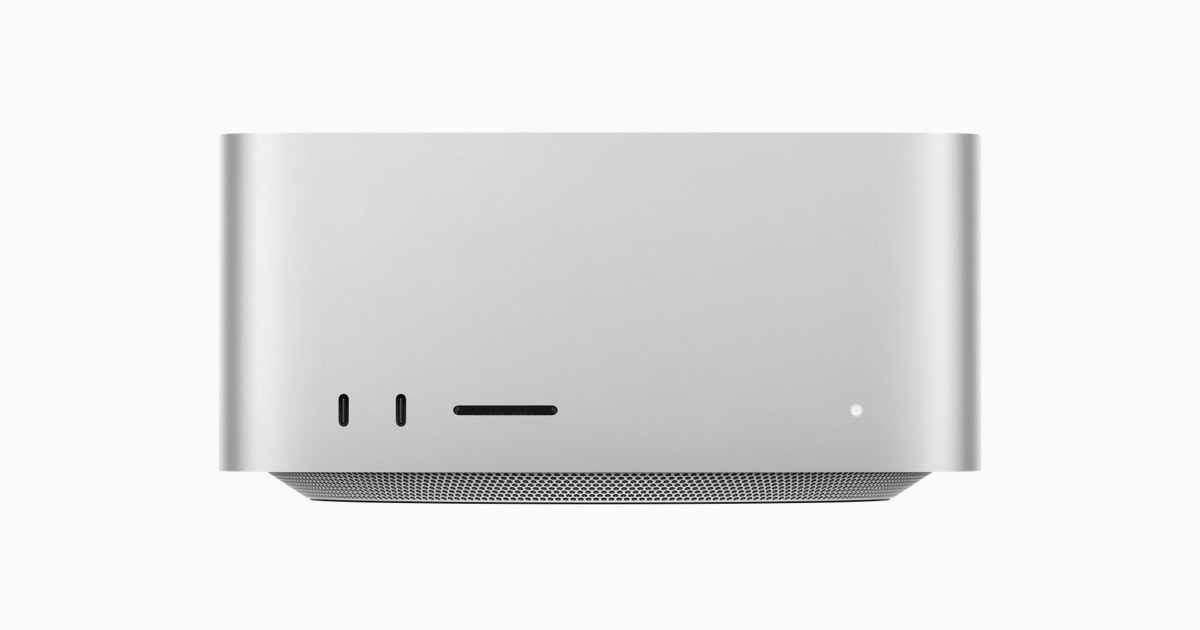
Engineering teams and R&D labs running frontier open-weight models have long been held hostage by centralized cloud infrastructure. Deploying multi-hundred-billion parameter models historically meant swallowing exorbitant hourly GPU rentals, volatile token billing, and persistent data privacy exposure. Apple's latest desktop iteration directly targets that operational expense profile.
On August 25, 2026, Apple introduced the Mac Studio lineup powered by M5 Max and M5 Ultra silicon. The top-tier M5 Ultra configuration pairs a 36-core CPU and an 80-core GPU with up to 512GB of unified memory. Shipping September 22, the system targets engineering leads evaluating the direct total cost of ownership of desktop workstations against recurring cloud compute pools.
Hardware Architecture and On-Device Capacity
The architectural core of the platform is its shared memory matrix. The entry-level M5 Max configuration incorporates an 18-core CPU, an up-to-40-core GPU with per-core Neural Accelerators, and 128GB of unified memory. The M5 Ultra doubles that silicon footprint, yielding claimed 4.3x AI throughput gains over prior generations.
Johny Srouji, Apple’s chief hardware officer, highlighted the local footprint during the announcement.
“With the powerful M5 Max and the incredible capabilities of M5 Ultra, Mac Studio ushers in a new era of desktop computing, delivering huge performance gains for pro workloads and AI inference with frontier-class models.”
Unified memory bypasses the physical PCIe bottleneck: both the CPU and GPU access the shared 512GB pool without duplicating model weights across isolated buses. For enterprise teams handling proprietary IP, this enables hosting massive open-weight checkpoints and Mixture-of-Experts (MoE) architectures locally, eliminating network latency and third-party data compliance exposure.
Distributed Clustering and System Throughput
For enterprise workloads exceeding a single node, the chassis adds Thunderbolt 5 connectivity alongside Wi-Fi 7 and Bluetooth 6. Developers can daisy-chain multiple Mac Studio units into a unified compute pool. Apple claims clustering multiple systems delivers up to three times the distributed inference throughput of a standalone machine.
Apple is backing the silicon stack with macOS 27 and enterprise display support across Studio Display lines, alongside native Apple Intelligence frameworks.
Yet technical leads must weigh memory bandwidth against pure server silicon. While 512GB of unified RAM allows loading massive parameter weights directly onto an office desk at a fraction of cloud CapEx, it cannot match the raw memory bandwidth of server-grade HBM clusters during heavy parallel fine-tuning. For persistent R&D inference and prototyping on confidential data, however, the workstation pays for itself within months by replacing dedicated cloud instances with silent, localized compute.