Traditional SIEM (Security Information and Event Management) systems have effectively devolved into passive databases. In the face of next-generation attacks, businesses remain vulnerable, relying on architectures designed long before the advent of artificial intelligence. These legacy solutions are akin to wooden shields in an era of autonomous weaponry. While a standard SIEM logs every login, traffic packet, or breach attempt, the underlying architecture lacks the intelligence to connect these disparate events. The consequences are critical: deepfake-related losses already total tens of millions of dollars, and AI-powered phishing easily bypasses standard filters.
To bridge this gap, Shahar Hirschberg, former head of Amazon GuardDuty, and Dan Shiebler, who led a 60-person AI/ML team at Abnormal Security, have launched Artemis. Unlike legacy platforms that treat logs as mere text, Artemis introduces a semantic understanding of data. A conventional SIEM fails to recognize that user 'jdoe' in Okta and 'john.doe' in AWS are the same individual. Artemis, however, transforms raw logs into a live infrastructure model that maps users, assets, their relationships, and the overall security posture. Processing over a billion events per hour with over a dozen enterprise deployments already active, the project proves that autonomous logical inference at network scale is the new industry standard.
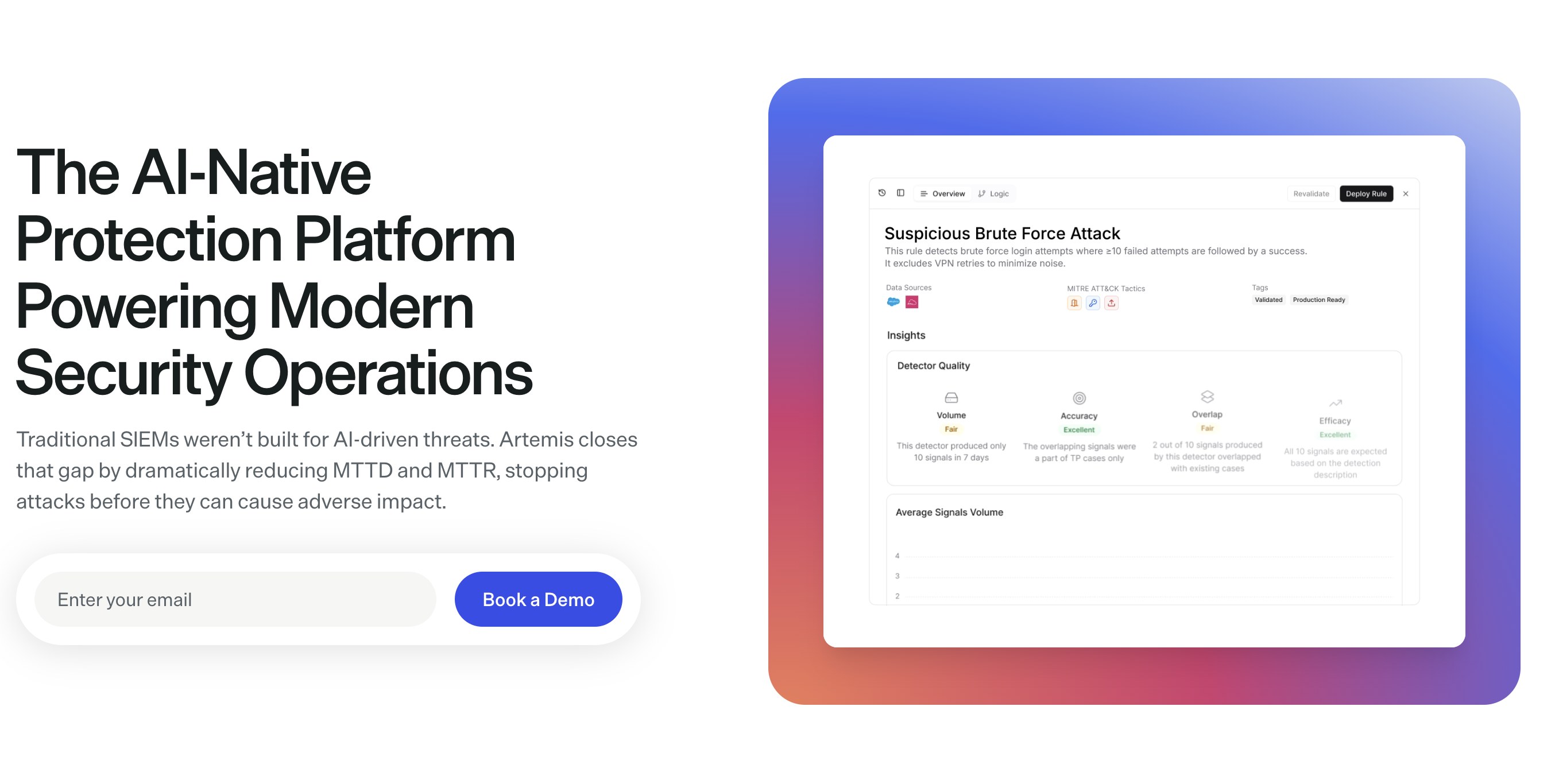
The primary operational shift lies in the transition from brittle, manually written rules to agentic threat detection and self-learning. Classic platforms degrade over time; engineers must manually update detection rules at the slightest change in log formats. Artemis utilizes multi-step AI agents that dynamically query data, aggregate information, and analyze context to verify threats. The system improves with every incident or proactive threat hunt, converting new patterns into permanent, fully autonomous detection methods.
The result is a platform that does more than just store and search data—it is capable of independent reasoning. In a world where offensive tools are increasingly automated, shifting to semantic defense and autonomous systems has become a critical requirement for the survival of modern security teams.