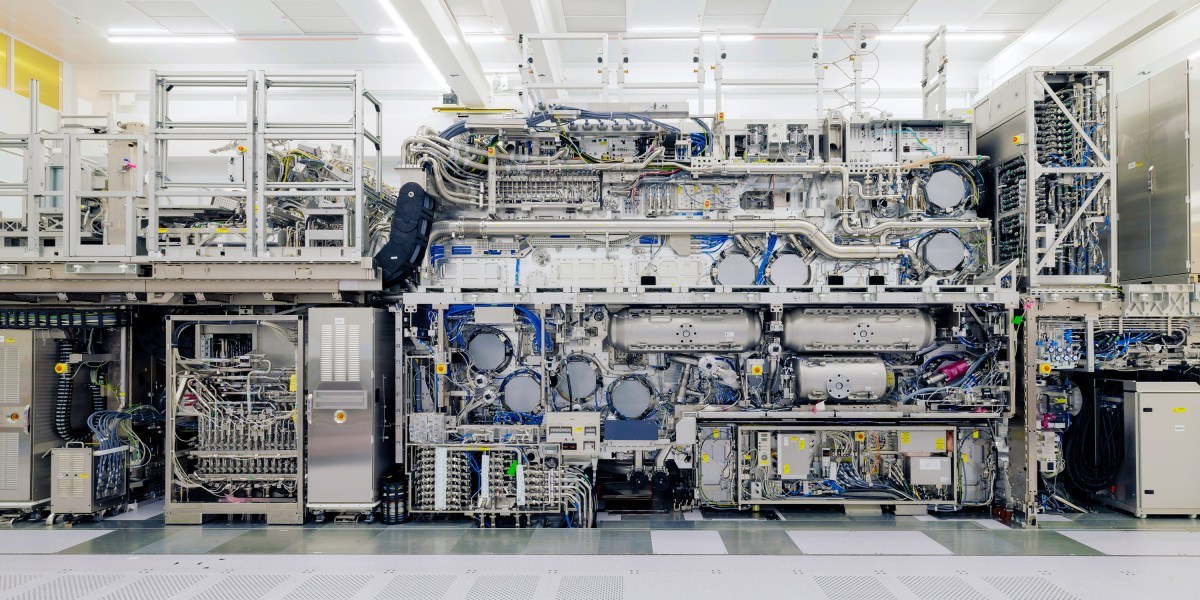
The AI era has hit a physical wall, and breaching it costs $400 million per attempt. Jos Benschop, ASML’s Corporate VP of Technology, describes his latest creation as a monstrous machine the size of a double-decker bus, weighing over 150 tons. This is more than a lithography tool; it is a complex mechanism resembling a futuristic V8 engine, encrusted with thousands of tubes and pressurized tanks. According to Benschop, the system utilizes mechatronic devices to hold mirrors with atomic precision—representing the absolute limit of modern manufacturing capabilities.
The first generation of EUV machines required $10 billion and 16 years of development, but the current High-NA iteration goes further. It targets a resolution of just 8 nanometers—roughly the width of 40 silicon atoms. In effect, ASML has monopolized the physics of the process, creating a bottleneck that dictates the pace of global AI progress.
The Anatomy of a Monopoly
The technical leap from 13 nanometers to the 8-nanometer standard is achieved by firing lasers at droplets of molten tin tens of thousands of times per second. This process generates radiation beyond the visible spectrum. While politicians debate sovereignty, ASML remains the industry's sole linchpin: without these machines, the ambitions of OpenAI or Anthropic remain nothing more than a collection of slides.
The Economics of Density
A $400 million price tag per unit is radically reshaping the capital expenditures of leading foundries. As Benschop notes, this technology allows customers to shrink transistor sizes to extreme values, which is critical for energy efficiency. This is not merely a race for Moore’s Law for the sake of impressive figures; it is a direct response to the "hunger" of server farms training next-generation neural networks. Immense transistor density is the only way to curb power consumption during LLM inference.
Without High-NA tools, the industry risks hitting a plateau in computational density.
This creates a dangerous reliance on a narrow circle of players—the ASML and TSMC duopoly. The latter uses these machines to manufacture the vast majority of the world's chips, anchoring entire value chains to its operations.
Strategic Risk and Scaling
Dependence on an increasingly expensive supply chain is transforming the equipment market from a commodity business into a scramble for scarce machinery. The sheer scale of ASML’s 200-cubic-meter technology suggests that capital alone is not enough to compete—decades of specialized expertise are required. The production schedules of a single Dutch company now define the strategic roadmaps of every major AI developer.
ASML has monopolized the future of computing power with a $400 million entry fee. Global AI performance gains are tied to a single firm’s ability to ship systems on time. Equipment costs are becoming the primary constraint on technology scaling as systems move toward full-scale deployment.