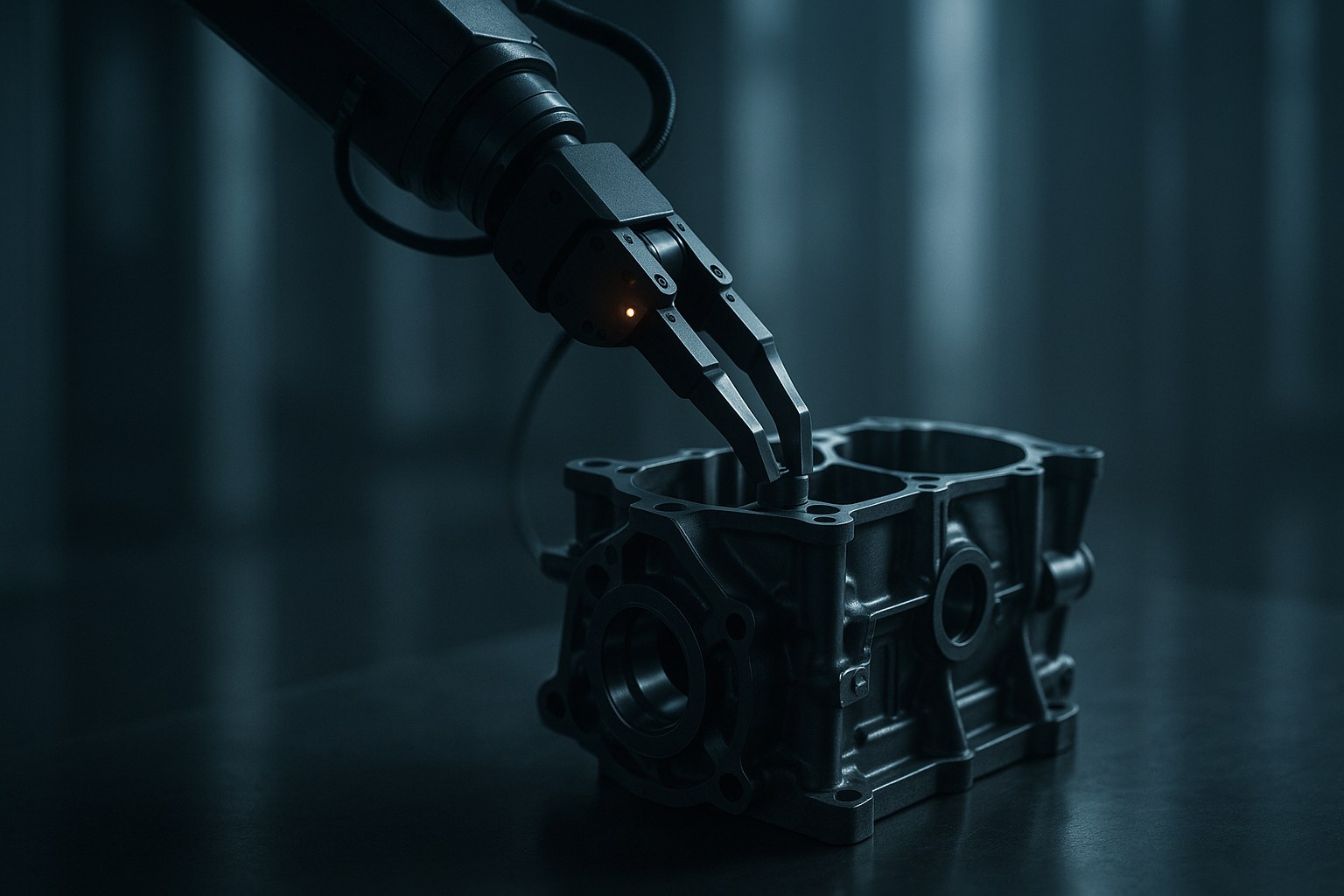
Modern vision-language models (VLMs) often behave like interns who have only read the manual: they approach assembly as a visual puzzle while completely ignoring the laws of physics. While standard benchmarks focus on simple furniture assembly, the industrial sector demands mastery of complex geometries and six-degree-of-freedom (6-DoF) trajectories, where every rotation and force vector matters. Researchers from Mitsubishi Electric Research Laboratories (MERL) and Rutgers University have identified a critical bottleneck they call "3D hallucinations": without accounting for physical constraints, models suggest assembly steps that are impossible to execute in the physical world.
To bridge this gap between digital imagination and physical reality, a team led by Danruo Li and Jiahao Zhang introduced AssemblyBench. This massive synthetic dataset features 2,789 objects ranging from hydraulic pumps to gearboxes. The key differentiator isn't just scale, but methodology: the researchers built a pipeline that automatically generates instructions directly from CAD files. Instead of abstract text commands, the system processes full 3D component models, step-by-step diagrams, and—critically—the actual motion trajectories required to join parts together.
To leverage this data, the team developed AssemblyDyno, a transformer-based model that simultaneously predicts assembly sequences and 6-DoF trajectories. Using a soft attention mechanism, the system maps technical drawings to 3D shapes. According to the study, AssemblyDyno significantly outperforms its predecessors in pose estimation accuracy and trajectory feasibility. It serves as a clear example of how reasoning, when coupled with physical parameters, is beginning to supersede simple context scaling.
For CTOs and R&D departments, this marks a paradigm shift: the era of hard-coding robots for a single operation is ending. The bottleneck is no longer image recognition, but the integration of physics into the model's "reasoning core." While AssemblyDyno excels in simulation, the ultimate test lies in the transition to hardware, where microns matter. In the near future, the value of industrial AI agents will be measured not by their ability to describe a part, but by their capacity to feel the resistance of metal within a complex mechanical joint.