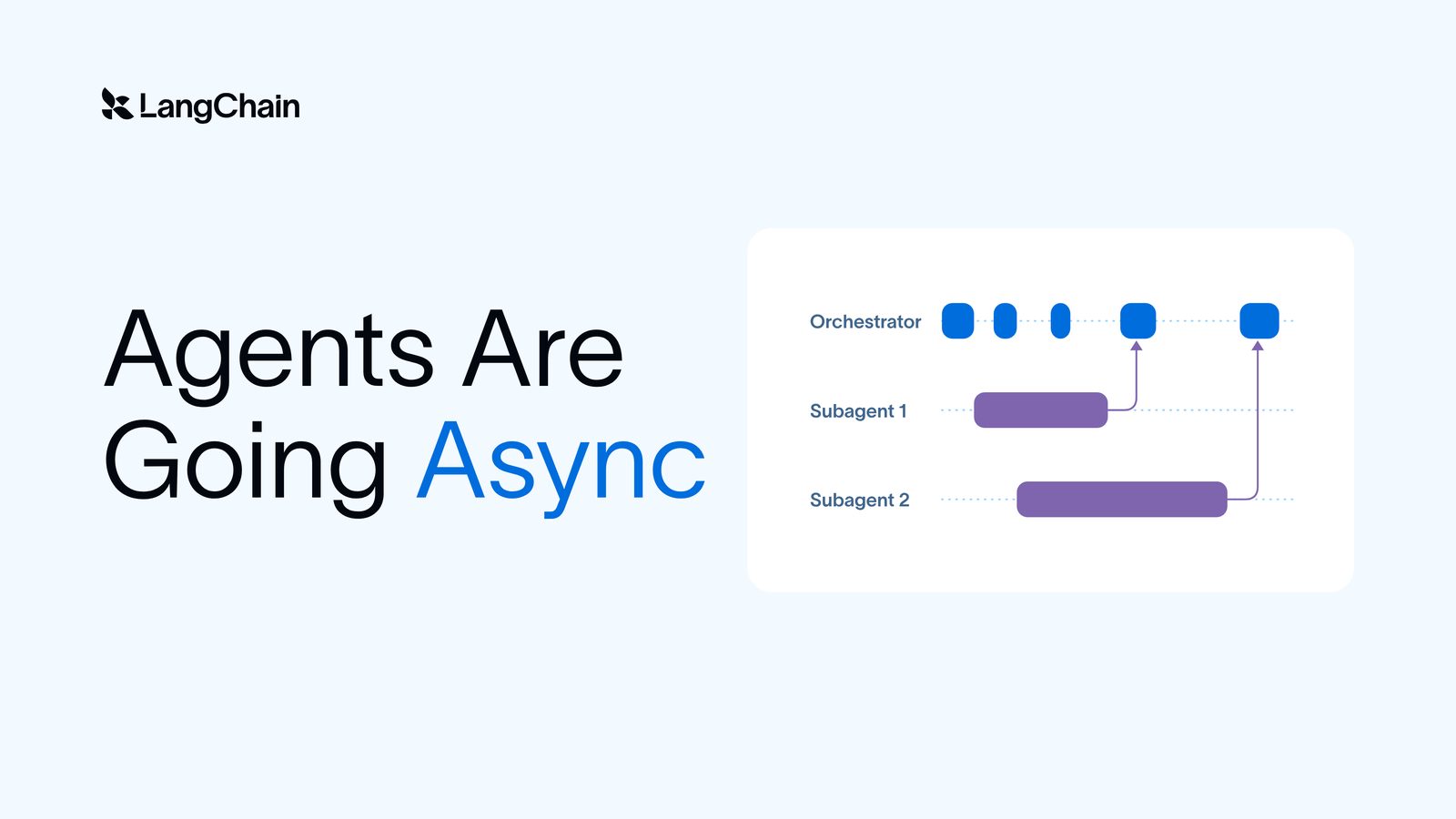
How can engineering teams prevent autonomous agents from locking up enterprise workflows when task runtimes expand? In standard architectures, execution halts whenever a model initiates an external process. According to engineering analysis, this can be visualized directly: "Imagine a chief of staff who disappears every time you hand them a big project and only comes back once it's done." In a standard ReAct loop, each long tool call blocks the execution sequence entirely, forcing every downstream task to queue behind it. This synchronous bottleneck degrades responsiveness and caps system throughput, directly inflating compute costs per completed transaction.
The industry is moving toward separating user interaction from long-running execution to protect operational margins. Asynchronous subagents split an agent into an orchestrator that stays available to the user and subagents that run tasks in the background, reporting back to the primary agent upon completion. As infrastructure architects point out, this shift alters how autonomous systems scale in production: capacity expands with the volume of background workers rather than the execution duration of a single loop, mitigating idle-time expenses.
Orchestration Mechanisms
Leading AI implementations show that background execution is becoming standard across development platforms. Claude Code runs subagents in the background by default, OpenAI's infrastructure hands work to background workers to make progress on several things at once, and DeepSeek Harness built its super agent around a router that talks to people and background workers that run tasks in parallel. In these setups, long-running processes execute without preventing the primary interface from receiving new user inputs, preserving operational continuity.
How do systems manage concurrent background processes without losing context? The architecture relies on dedicated management tools and dynamic state tracking to prevent memory leaks and redundant token consumption.
"The orchestrator manages async subagents with five tools."
These controls consist of start_async_task, which starts a subagent on its own thread and returns right away; check_async_task, which gets a task's status and its result once finished; update_async_task, which sends a running task new instructions; cancel_async_task, which stops a running task; and list_async_tasks, which lists every task and its status. Furthermore, every unfinished task is listed in the orchestrator's system prompt, allowing the agent to track in-flight workloads continuously without recalculating historical context from scratch.
Execution Strategies and Integration
When controlling active tasks, the system applies specific runtime behaviors based on operational requirements. The interrupt update strategy stops the current run and restarts the subagent with the new instruction, serving direct corrections. Alternatively, the enqueue update strategy holds the follow-up until the current run finishes, queuing supplementary tasks.
Broader infrastructure providers are aligning with non-blocking execution patterns across their tooling layers to reduce latency overhead. OpenAI recently added support for async tool calling, where the model keeps working after it calls a tool. Async subagents are available in Deep Agents for Python and JavaScript, and in Managed Deep Agents, while task notifications remain in beta with potential API changes ahead.
Managing asynchronous subagents introduces complex state tracking and notification overhead, potentially complicating debugging and increasing operational friction in production environments. Asynchronous subagents establish an execution model where compute scales across background threads rather than blocking synchronous loops. Infrastructure adoption across Claude Code, DeepSeek Harness, and OpenAI demonstrates that decoupling the user orchestrator from task execution is required for complex enterprise operations. Organizations deploying autonomous agents must determine whether their current toolchains support non-blocking execution before expanding task complexity, returning directly to the core operational dilemma of how to maintain a responsive chief of staff without burning through unmonitored compute cycles.
What it means
Compute costs and interface latency drop significantly the moment autonomous setups stop freezing on every external tool call. The standard ReAct pattern effectively locks the entire execution pipeline during prolonged tasks, leaving subsequent actions stuck in a synchronous queue. Shifting to an async sub-agent architecture fixes this bottleneck by splitting the system into an interactive orchestrator and background workers, as seen in Claude Code and DeepSeek Harness. The grand vision of unified AI autonomy turns out to work best as a standard office hierarchy: one manager fielding questions while background staff handles the actual chores.