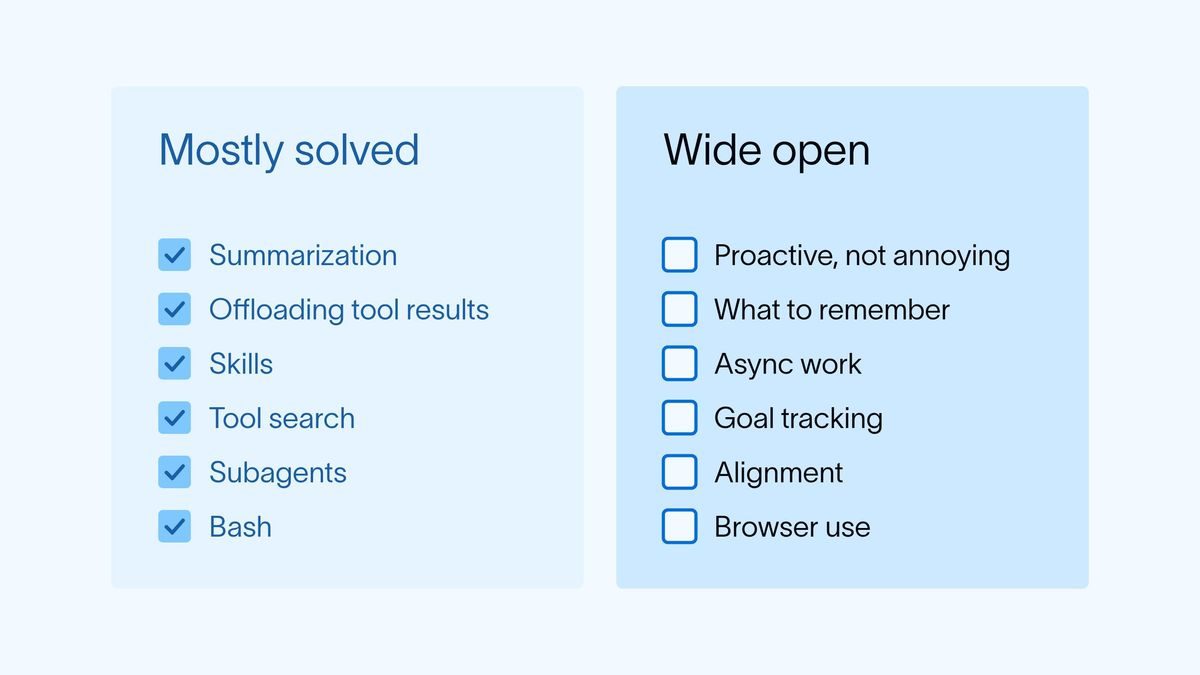
Claude Code appeared over a year and a half ago, marking one of the earliest high-profile manifestations of a runtime pattern where a large language model runs in a loop, executes tool calls, and operates inside an isolated sandbox. LangChain introduced its own agent harness, Deep Agents, over a year ago as the industry steadily converged on this standardized structure. This widespread architectural alignment led a segment of engineers to believe that the primary technical hurdles of context management had already been resolved through offloading large tool payloads, summarization, tool search, and subagent isolation.
That consensus has proven premature as product strategies shift toward proactive, always-on, goal-oriented systems. Over the past few months, every agent builder interacting with LangChain has focused on autonomous designs that do not wait for explicit user prompts. This operational pivot alters context engineering requirements and the underlying unit economics of model execution. The basic loop framework handles isolated tasks, but continuous background operation introduces compounding compute demands across memory, orchestration, and asynchronous task completion.
The Operational Overhead of Continuous Context
Unlike traditional reactive tools, proactive agents run continuously in the background, listening to real-time event feeds or waking up through periodic heartbeat triggers. Every wake-up cycle requires feeding operational history, environment state, and policy instructions into the model to evaluate whether an action is necessary. A central architectural tension lies in balancing autonomy with user experience, specifically pushing necessary updates without overwhelming operators with excessive notifications.
"These proactive agents run in the background and either listen to event feeds or are woken up with heartbeats."
Managing persistent memory creates a dual-layer requirement consisting of an underlying data structure alongside an active intelligence layer designed to evaluate what to retain. While the data structures themselves remain simple formats such as plain text files or a single string, the intelligence layer operates as a secondary agent evaluating relevance. Retaining insufficient context causes agents to drop critical operational parameters, while storing excessive granular detail inflates token consumption and degrades prompt quality across long execution horizons. What happens when long-running workflows must maintain continuous responsiveness to incoming user demands?
Architectures are increasingly delegating work to asynchronous tools and subagents to ensure the primary agent remains responsive. This structural division introduces coordination problems, including notifying the primary agent upon task completion, managing state when parent processes pause for human approval, and reconciling outputs across parallel execution paths. Multi-agent state management thus requires robust synchronization protocols to prevent race conditions and redundant execution across independent worker threads, further complicating token consumption models.
Shifting Workloads and Tool Surface Complexity
Agent designs are moving away from simple reactive tasks toward multi-step goal pursuit, an evolution reflected in systems like Hone. Managing autonomous iterations toward higher-level objectives requires models to decompose assignments into sequential experiments, process intermediate feedback, and continuously refine execution paths. This introduces alignment challenges where an agent might satisfy a goal through destructive short-cuts, such as deleting an entire codebase to achieve a zero-bug mandate.
"For coding agents, the most important tool was a bash tool that could run and execute code. For a lot of these more general purpose agents, the browser is becoming that tool."
A browser is substantially more complicated to operate than a command-line terminal. Terminal execution relies on compact bash commands, whereas web navigation forces systems to process heavy trees or high-resolution visual inputs. Both representations sharply increase token consumption per step, testing the limits of standard context windows and expanding inference budgets.
Proponents of rapid standardization argue that established harness templates and declining per-token model prices will naturally resolve these context engineering bottlenecks without driving up operational expenses. However, continuous heartbeat polling, multi-layer memory filtration agents, and large representations generate compounding token volume that offsets marginal price drops per million tokens. The architectural challenge has moved from managing isolated prompt exchanges to sustaining multi-agent state across indefinite background runtimes, directly impacting the long-term unit economics of autonomous deployments.
Will always-on goal-oriented architectures achieve positive unit economics under persistent event polling and browser workloads, or will the inference overhead of continuous background execution force a return to bounded, reactive agent frameworks?
How the picture shifted
A year and a half ago, the isolated execution loop seen in Claude Code seemed sufficient for scoped tasks, but the industry-wide shift toward continuous background autonomy has broken that baseline unit economics. Keeping models awake on heartbeat signals consumes tokens constantly just to evaluate environments and sync asynchronous sub-agents. Managing long-term memory now requires an active secondary intelligence layer to prune operational history before bloated context windows degrade prompt performance. Will proactive background agents relying on recurring heartbeat pings deliver enough operational value to justify their non-stop token consumption?