What happens to managerial operational capacity when artificial intelligence stops waiting for instructions and starts executing workflows independently?
Personal agents such as Muse, Instinct, and OpenAI's dots popularized proactive software agents that operate in the background toward broader objectives instead of idling for a manual prompt. As Hone framed it directly, its Engines operate as AI that is "assigned goals rather than tasks." By taking on higher-level targets, these autonomous systems manage multi-step processes that unfold over days or weeks. However, the operational economics shift rapidly once agents move beyond passive question answering: human oversight quickly becomes the primary constraint on execution volume.
Shifting Schedules and Attention Overhead
Production telemetry indicates that system execution triggers have already decoupled from human operators. LangChain runs two proactive agents internally: GTM Agent, an automated sales agent that tracks inbound leads and generates outbound communications, and Robin, an engineering agent that reviews incoming code and drafts pull requests. As LangChain documented, both agents were built on Managed Deep Agents, where more than 70% of runs now come from schedules rather than an ad hoc human prompt.
When systems initiate actions on automated timetables, the core cost center pivots away from computational inference charges toward the scarce attention of operational managers. An autonomous assistant that reviews incoming messages must decide whether to escalate an alert or handle the thread quietly. If every automated action demands verification, management spends more hours supervising routine tasks than executing strategic responsibilities. How do autonomous systems maintain operational alignment without overwhelming executive bandwidth?
The Architecture of Agent Memory
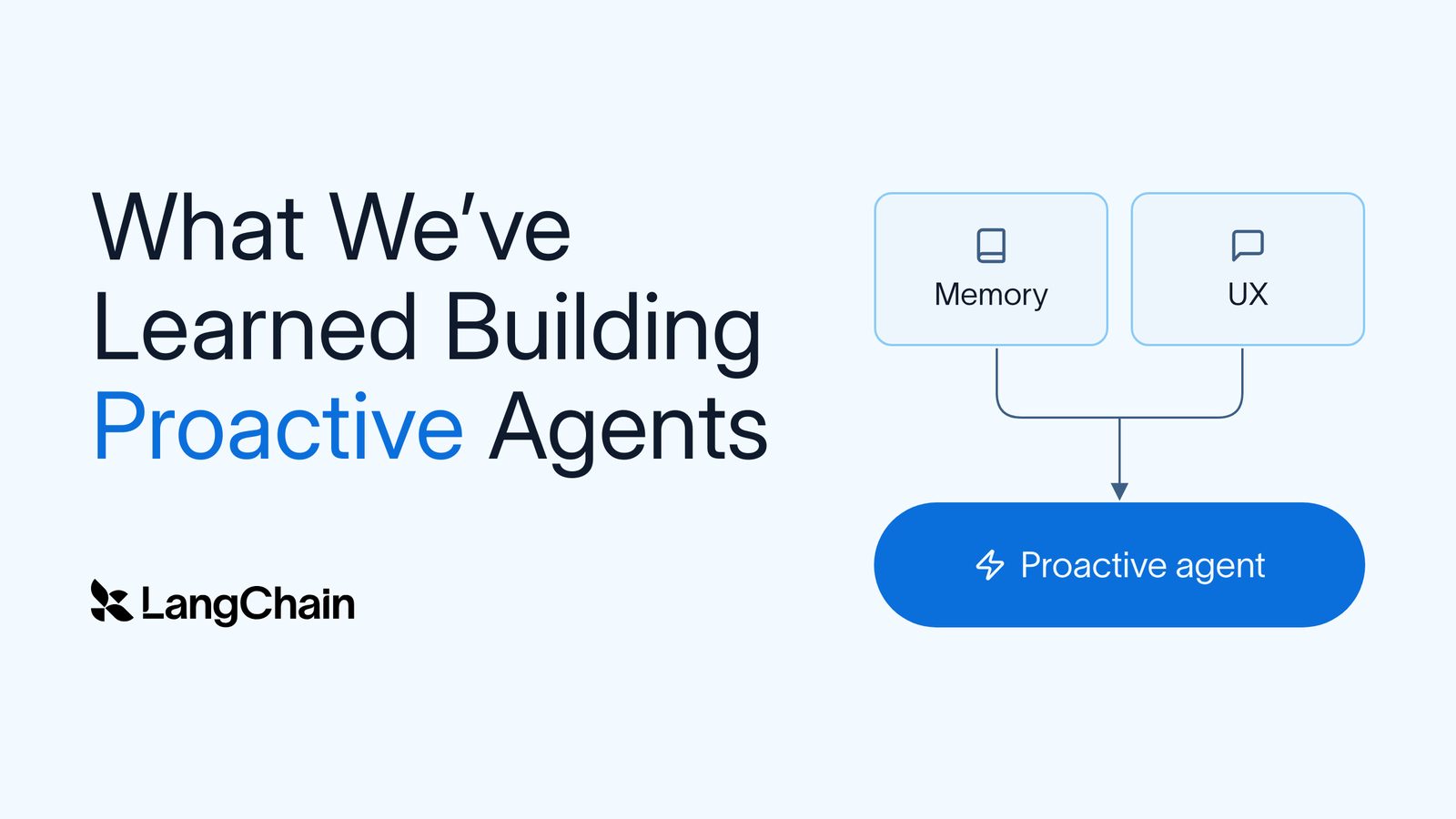
The answer rests on an agent's memory architecture, which relies on three distinct operational signals gathered across time. As LangChain outlined, the first input is seed memory, which establishes precedent and baseline context before an agent executes its first run, such as analyzing a user's sent email folder to replicate communication tone.
"As they take on more goals, your attention becomes the scarce resource."
LangChain emphasized this operational trade-off while explaining why proactive software must continuously refine its internal models. The second signal is feedback memory, captured in the present when a supervisor approves, edits, or rejects an agent's drafted output with a specific reason. The third signal consists of outcomes, which register subsequent real-world reactions, such as whether a drafted outreach message receives a positive client reply. Through these feedback loops, the system learns what actions succeed without requiring manual prompt engineering for every task.
Long-Term Maintenance and System Drift
A persistent misconception holds that storing autonomous history in text files or databases guarantees long-term operational accuracy. In practice, maintaining useful memory involves three systemic hurdles: salience, expiry, and duplication. The agent must decide what information merits retention, detect when data goes stale, and consolidate new observations rather than storing duplicate facts that breed contradictions.
To address this degradation, many proactive agents implement an operational process known as dreaming. This scheduled background routine scans recent execution traces and updates persistent memory before the next cycle begins, systematically pruning stale records and integrating verified patterns.
Autonomous agent scaling hinges on the precision of these internal maintenance cycles. As scheduled executions account for the vast majority of software actions, organizations that fail to automate memory pruning will see supervisory overhead eliminate their operational gains. Systems that refine memory autonomously protect managerial time, transforming continuous background execution into scalable capacity rather than an unmanageable stream of administrative interruptions.
How the picture shifted
Where does the real operational bottleneck emerge when software stops waiting for human prompts? Systems previously ran strictly on manual commands, whereas over 70% of runs for tools like Robin and GTM Agent at LangChain now trigger on automated schedules. With autonomous routines operating continuously, the primary expense shifts from inference computing to human supervision over automated actions. The ceiling on autonomous agent adoption is dictated by memory architecture filtering out manual oversight rather than raw computing capacity.