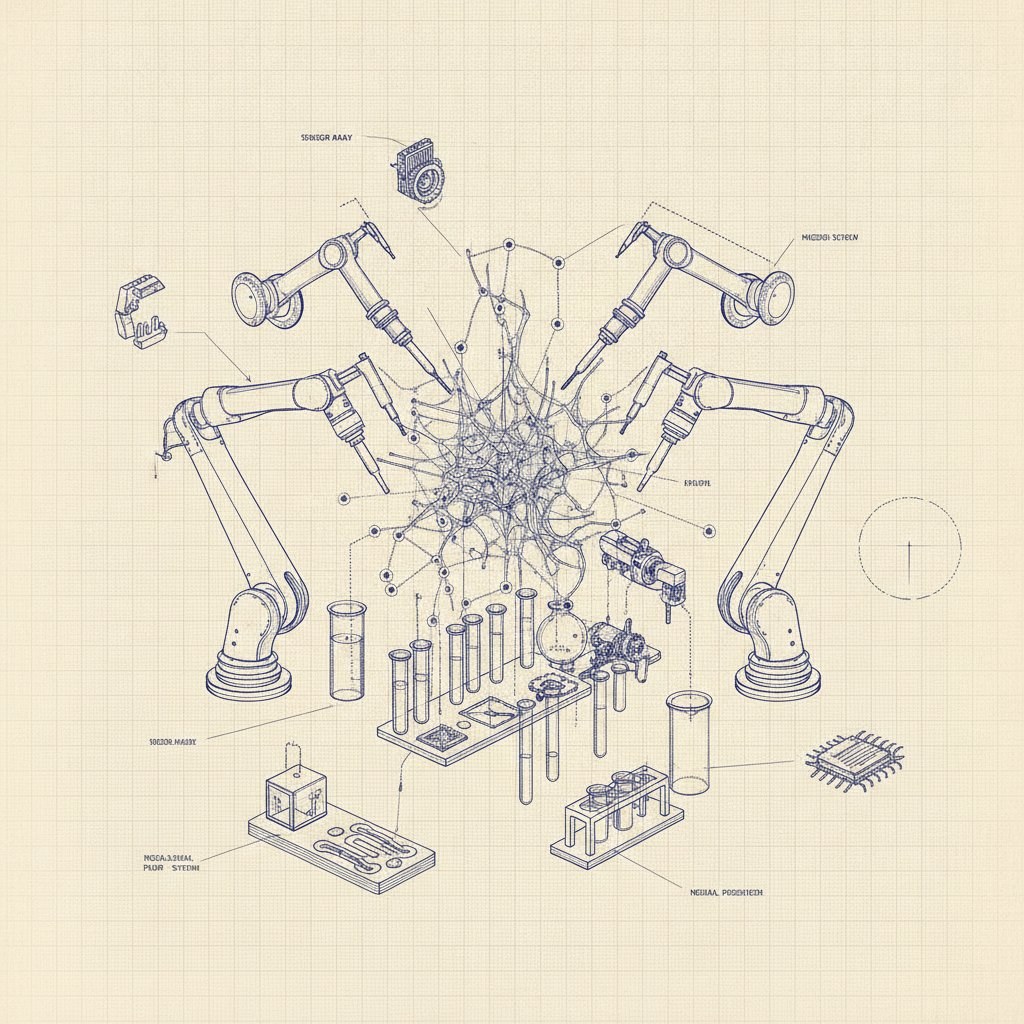
The bottleneck in modern drug discovery isn't a lack of ideas—it's the paralyzing execution routine. A team of Stanford University researchers, led by Professor Jure Leskovec, has unveiled Biomni: an AI agent designed to handle the "grunt work" that traditionally consumes months of lab time. Published in the journal *Science*, the system represents a significant leap beyond standard chatbots. Biomni isn't just a well-read conversationalist; it is a full-fledged co-researcher capable of autonomously analyzing literature, formulating hypotheses, selecting datasets, writing code, and interpreting results within a single workflow. For R&D executives, this marks a long-awaited shift from talkative LLMs to autonomous systems that actually build.
A Carpenter with a Toolbox
Unlike general-purpose models, Biomni is architecturally engineered for the complex mechanics of biomedicine. Leskovec, a professor of computer science at Stanford, uses a pragmatic analogy: an agent without tools is merely a theorist, whereas Biomni is a "carpenter with a toolbox." To achieve this, the researchers integrated 150 specialized biomedical tools and 105 software packages into the agent's architecture. The system was trained on a massive corpus of open-access papers and code, including the bioRxiv archives, allowing it to pinpoint exactly which databases and software are required for a specific study.
This autonomy is already delivering a radical reduction in operational overhead. In one test, Biomni was fed 450 files containing glucose monitoring data, food diaries, and physical activity logs. The agent cleaned the data, normalized disparate formats, created visualizations, and proposed working hypotheses regarding the link between diet and body temperature—all in just 40 minutes. Leskovec estimates that a human researcher would have spent at least 60 hours on this manual labor. By compressing weeks of data prep into an academic hour, the technology fundamentally alters the economics of R&D: teams can now test hypotheses at a speed that was previously science fiction.
Science-as-a-Service and the Rigor Gap
The primary barrier to AI adoption in science is the risk of hallucinations. Biomni addresses this through transparency: the system accompanies every conclusion with full citations and step-by-step tracking of its internal logic. According to the Stanford team, this traceability makes science more rigorous and reproducible. Kexin Huang, a former doctoral student in Leskovec’s lab and now head of a startup commercializing the technology, explained that the system literally "sinks its teeth" into the deep analytical work previously performed by humans.
This autonomy is already delivering a radical reduction in operational overhead, compressing weeks of manual data labor into just 40 minutes.
Despite its high degree of autonomy, the methodology keeps the human in the role of final arbiter. The real story here is the transformation of the scientist. Instead of drowning in data homogenization and literature reviews, R&D leaders can focus on high-level conceptual design. Biomni aims to reverse the trend where innovation slows as data volume grows, eliminating the "laboratory noise" that has stalled breakthroughs in recent years. Moving to high-throughput hypothesis generation means the cost of pursuing every lead is plummeting. The new metric of success for researchers will be the efficiency of managing agentic workflows—though it is worth noting that while the system relies on public data like bioRxiv, its edge is currently most pronounced in established scientific subdomains.
Biomni automates the entire R&D lifecycle from hypothesis to code and interpretation. Integrated with over 250 specialized tools and software packages for biomedical research. Reduces manual data processing time by up to 99%, turning 60 hours of work into 40 minutes. Built-in traceability and citations solve the AI hallucination problem for scientific rigor.