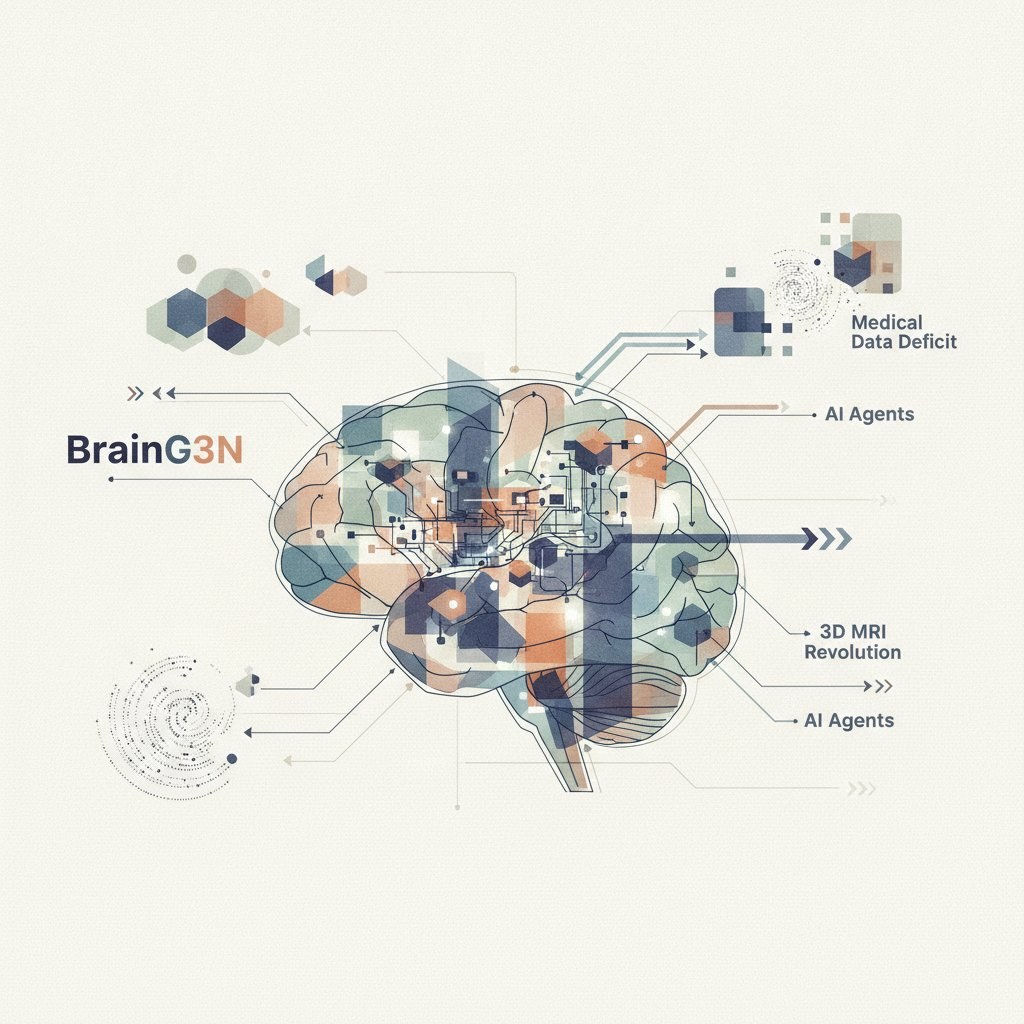
For years, medical AI development in neuro-oncology has hit a brick wall: you either prioritize privacy and suffer from "data starvation," or you use synthetic data that looks impressive but remains clinically useless. Standard diffusion models frequently produce anatomical hallucinations, turning a diagnostic tool into a digital noise generator. Researchers from Stanford and Ghent Universities have proposed a way out: BrainG3N, a system that decouples visual fidelity from clinical accuracy.
At the heart of the solution lies a dual-purpose tokenizer based on a frozen 3D Masked Autoencoder (MAE). Instead of merely copying pixels, the system generates embeddings that work equally well for clinical diagnosis and high-precision 3D reconstruction. The technological shift is fundamental: BrainG3N was trained on a massive dataset of 35,309 scans from 18 open cohorts, covering ten disease categories. According to Max Van Poucke and Ibrahim Gulluk, this approach allows for direct control over six key variables during generation.
Key Takeaways of BrainG3N Technology
Combines discrete and continuous data representations to eliminate anatomical errors. Trained on a record-breaking set of 35,000 MRI scans across 10 pathology categories. Enables the generation of realistic 3D scans based on specific clinical parameters.
In testing across 23 linear probing tasks, the BrainG3N encoder outperformed established leaders like BrainIAC and MedicalNet in 21 cases. For MedTech business leaders and R&D directors, this signals a shift from simple imagery to the creation of full-scale "digital twins." It is now possible to simulate disease progression and fine-tune diagnostic neural networks on rare pathologies that are physically impossible to collect in sufficient volume from real clinics.
This is not just another content generator; it is a precision instrument for expanding training sets without losing touch with biological reality.
The Stanford and Ghent team has effectively created a unified brain MRI embedding space that serves both the clinician and the "data factory." It is an elegant way to scale medical AI training while bypassing the legal minefields and logistical barriers associated with transferring confidential patient data.