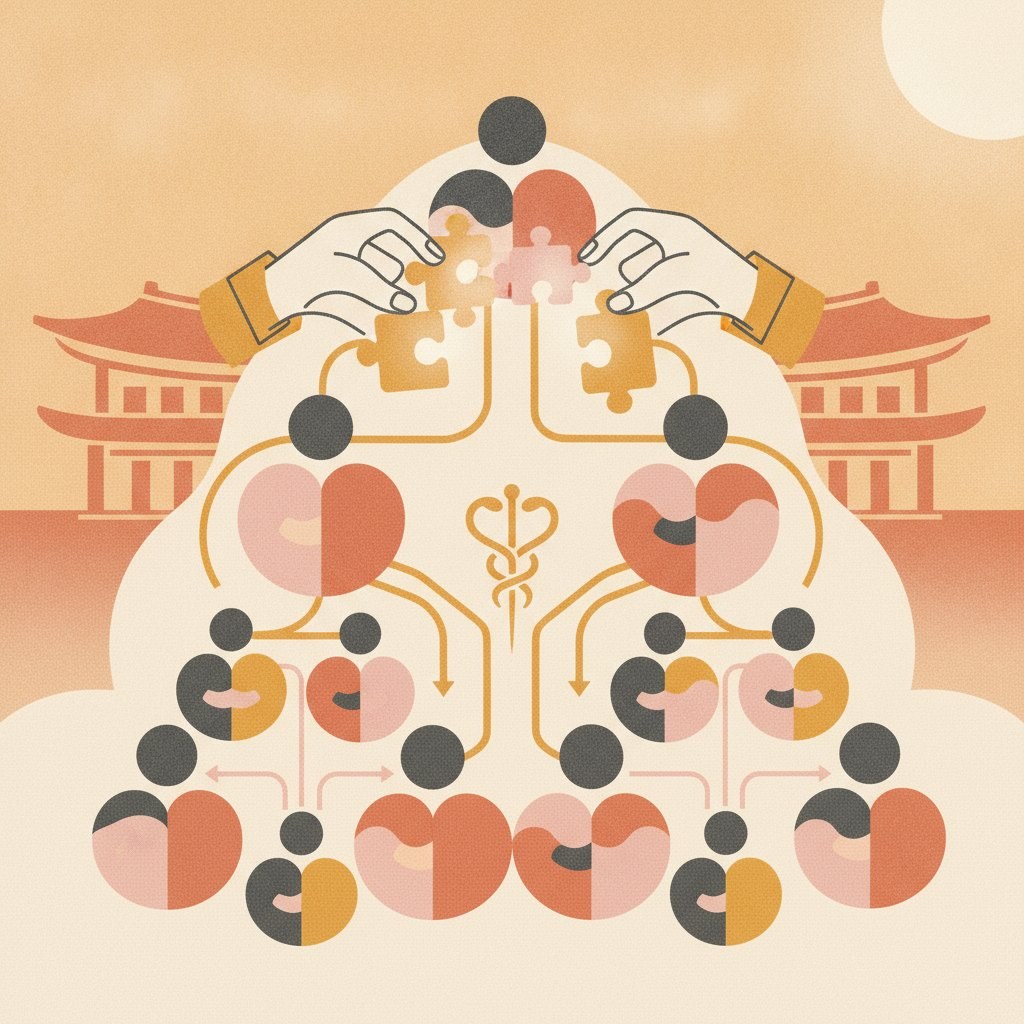
The fundamental failure of medical AI to date has been its lack of situational awareness. In cardiology, context is everything: an identical atrial fibrillation signal might be a minor finding in a fit 30-year-old, but it’s a clinical emergency requiring immediate anticoagulation in an elderly patient with hypertension. As researchers Sukju Oh and Sukkyu Sun from Dongguk University rightly observe, simply labeling a rhythm is a technical exercise, not a medical one. Their proposed framework, Cardiologent, attempts to move the needle from simple classification to hierarchical decision support.
Unlike standard large language models that ingest isolated data points, the Cardiologent architecture mimics a clinical team. It uses a multi-agent system to process multi-modal inputs, including single-lead ECG and PPG signals from wearables. The workload is distributed: individual agents ground their findings in specific signal features rather than spitting out generic labels, while a central reasoning engine synthesizes these into a comprehensive patient profile. This profile is then cross-referenced against the patient’s medical history and current clinical guidelines. To mitigate the 'black-box' problem, a critic agent audits every conclusion against cited literature, providing a paper trail for the human physician to follow.
In testing, the system achieved an Intraclass Correlation Coefficient (ICC) of 0.74, matching the level of consensus found between human cardiologists. For the MedTech sector, this isn't just about 'detecting' more cases—though the authors claim they can capture the 32% of atrial fibrillation instances currently missed. The real value lies in the hierarchy itself: by automating the triage of urgency and diagnostic significance, the system addresses the looming burnout crisis in primary care.
However, we should remain skeptical of the transition from benchmark success to high-stakes clinical deployment. While Cardiologent provides an 'auditable' logic chain, the burden of liability remains firmly with the doctor. We are seeing a shift where AI no longer just identifies a wave on a screen, but rather cites the manual while the human professional continues to carry the risk. It’s an agentic hierarchy that streamlines the workflow, but it’s far from replacing the clinical intuition it seeks to emulate.