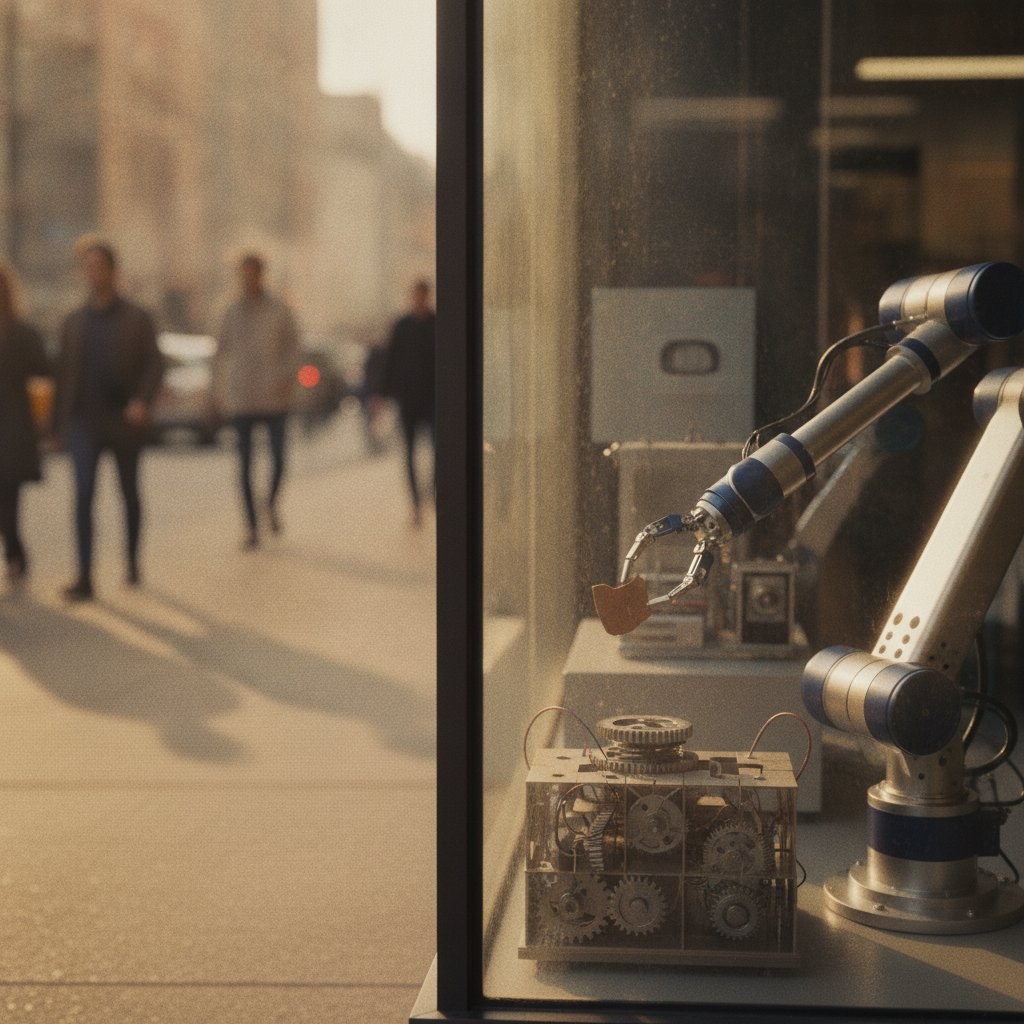
The wall between digital reasoning and physical action is starting to crumble. For decades, robotics has leaned on the crutches of highly specialized code, where every joint movement was manually scripted. However, a fresh study from the Anthropic Frontier Red Team—conducted by Shmuel Berman, Michael Ilie, Jia Deng, and Daniel Freeman—proves that the future lies not in specialized code, but in the zero-shot capabilities of general-purpose language models. Tests across diverse platforms, ranging from toys to the Unitree Go2 quadruped and complex humanoids, confirm that modern LLMs have learned to transform sensory perception into physical strategy without any prior training on robotic datasets.
A Shift Toward High-Level Abstraction
The key breakthrough here isn't in motor power, but in the level of abstraction. Anthropic’s data shows that attempting to force a model to directly control torques is a dead end; at the lowest level of abstraction, AI usually fails. However, performance skyrockets as soon as the interface shifts to generating controller code or managing a robot’s pre-trained policy. In this hierarchy, Claude acts not as the driver, but as the orchestrator: it assesses the scene, understands the hardware status, and issues high-level instructions that a separate neural network then translates into joint coordination. This architecture allows a model that has never seen gait data to navigate a quadruped through a maze or lift a plate from a table and place it on a stove.
"A general-purpose chat model, without any specialized training, is already capable of writing and uploading its own tools during a successful run to guide a robot through obstacles."
This tectonic shift means the economic bottleneck is moving. While the industry once suffered from a shortage of rare robotics engineers, the deciding factor is now the quality of multimodal orchestration. Latest-generation models show steady growth in logical task synthesis, even though low-level direct hardware control remains unstable. For complex humanoids, the LLM becomes the brain that delegates physics to pre-trained algorithms, focusing instead on the intent behind the actions.
Physical Hallucinations and Response Latency
That said, don't expect robots to replace all manual laborers tomorrow. The transition from simulation to the real world is still fraught with technical friction. The precision required for micro-manipulations is currently beyond the reach of direct LLM control. The gap between "seeing the scene" and "executing a flawless grip" remains the primary obstacle to full autonomy.
Reliability is another critical business risk. As Anthropic’s researchers note, mission success depends not just on the model’s intelligence, but on the control interface and the quality of the platform itself. AI is still prone to "physical hallucinations" in 3D space, where a logically sound action fails to account for the laws of gravity or inertia. The path from a laboratory "successful run" to industrial-grade fault tolerance is a chasm that has yet to be bridged.
If Claude can navigate physical environments without viewing a single frame of robotic training data, it raises a fundamental question: what is the current market value of the proprietary datasets corporations have spent decades collecting? It appears that the "general knowledge" of frontier AI is beginning to devalue narrow specialization faster than we anticipated.