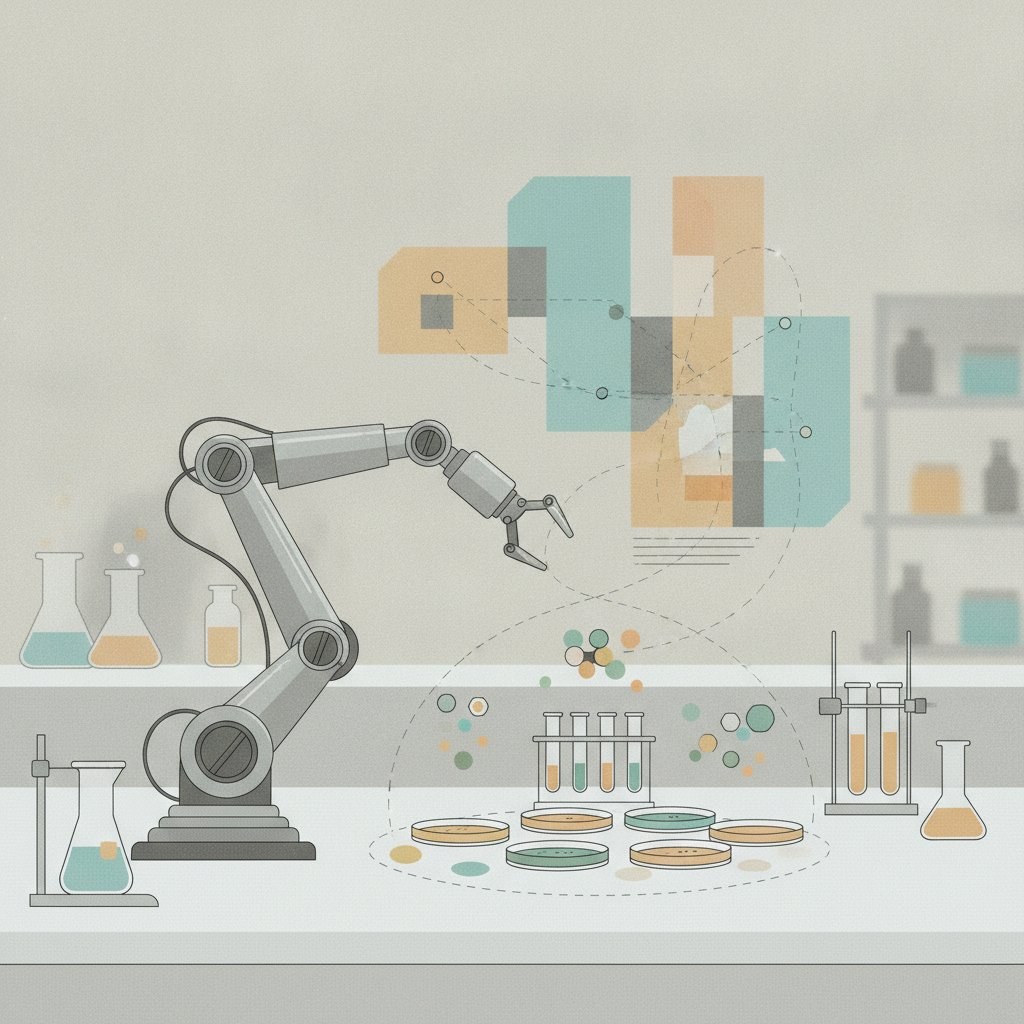
Artificial Intelligence in science (AI-for-Science) has become a virtuoso at generating hypotheses and planning synthesis. However, at the final validation stage, even the most brilliant digital ideas inevitably hit the wall of physical reality. This is the "validation bottleneck": a digital mind generates thousands of variations per second while a lab technician or an expensive robot spends hours struggling with a single test tube. Self-driving labs (SDLs) promised to solve this, but in practice, they often turn into costly "black holes" that churn through samples without a clear strategy, burning budgets on low-efficiency tests.
The DOE Agent Loop: A Common Sense Filter
To break R&D out of this cycle of endless iterations, Kyunghoon Heo of the Korea Institute of Electronic Technology and Chiho Lee of the Korea Institute of Materials Science have proposed integrating Agentic Design of Experiments (DOE) into the process. Unlike classical automation, this approach uses an AI agent as a highly skilled intermediary that synthesizes domain knowledge and engineering constraints before testing begins. The agent doesn't just run the conveyor—it analyzes past results and preemptively cuts off configurations that are physically impossible or dead ends.
Interaction between an agent and a testbed does not guarantee results on its own. Without integrating a priori knowledge and strict physical feasibility checks, the cycle will simply spin its wheels.
In practice, the agent acts as an intellectual filter. By leveraging accumulated scientific expertise, the system reduces the number of trials-to-target. This is critical in materials science and pharmacology, where every physical run can cost thousands of dollars.
Surrogate Models: Saving on Precision
The second barrier is the exorbitant cost of high-precision measurements. Obtaining data with perfect resolution is time-consuming and resource-heavy, often turning project budgets into dust. The architecture proposed by Heo and Lee offers a solution through a cost-aware surrogate agent. The system predicts expensive high-fidelity results by drawing on a pool of cheap, low-resolution data. Here, the agent acts like a CFO: it evaluates the level of uncertainty and decides whether to pay for a premium test or if a prediction based on budget metrics is already reliable enough.
The SDL architecture closes the planning-experiment-analysis loop without human intervention. The first agent reduces the number of iterations using domain expertise. The second agent minimizes the cost per iteration through predictive modeling. Research accuracy is maintained while radically reducing expenditures on physical sensors.
The transition from "dumb" automation to agentic SDLs represents a paradigm shift. The primary metric in R&D is no longer the speed of running tests, but the economic efficiency of validating each idea. For business, this provides a direct path to slashing operational costs in scientific discovery by killing off unpromising leads before the first sample ever hits the machine. However, risks remain: in high-stakes industries like pharmaceuticals, data reliability requirements are extreme, and over-reliance on surrogate models without proper calibration could end up costing more than the experiments themselves.