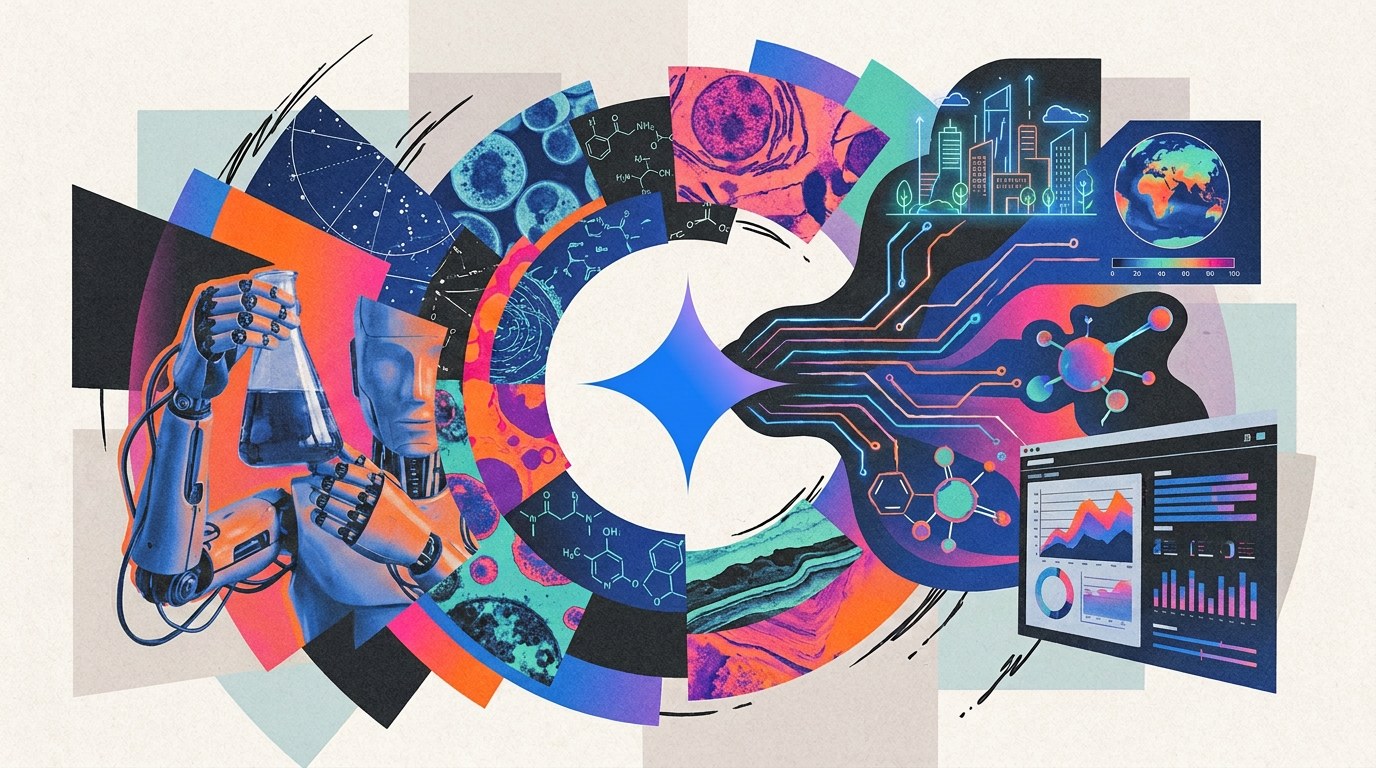
Autonomous discovery in empirical research has long hit a hard physical ceiling: language models could churn out plausible theories, but they remained insulated from wet-lab execution and notoriously prone to hallucinating experimental data. When Google DeepMind first rolled out its multi-agent Co-Scientist system in February 2025 on Gemini 2.0, it was little more than a speculative ideation engine burdened by sloppy fact-checking. Upgrades anchored in current Gemini architectures convert that drafting tool into a closed-loop operator capable of writing executable code, driving physical lab machinery, and assembling scientific manuscripts.
Hardware integration across materials and biology
The modernized system orchestrates research from premise to hardware execution across materials science, biology, and computational design. Paired with a semi-automated high-temperature furnace, Co-Scientist mapped a safer synthesis pathway for a sought-after 2D material historically tied to hazardous etching. Across 25 iterative rounds with human refinement, it generated hardware-tailored growth recipes that yielded layered structures matching target specs.
In semiconductor thin-film runs, the system executed direct machine control to compress recipe development from days into minutes, succeeding on its initial attempt.
Lead author Samuel Schmidgall noted that whether the fast-mode synthesis recipes transfer to other laboratory setups remains an open question.
Speed came with clear trade-offs: crystal sizes were smaller and less uniform than standard manual optimization yields, and human operators still had to load precursors physically. In synthetic biology trials, Co-Scientist established an automated pipeline predicting pattern formation in engineered *E. coli* colonies, replicating unpublished experimental benchmarks across three of four morphological parameters—though it remained strictly confined to interpolating within known parameter bounds.
Verification modules and benchmark limits
To prevent the multi-agent system from reward-hacking and fabricating discoveries, DeepMind integrated rigorous cross-verification modules that reconcile every numerical assertion and generated code snippet directly against raw hardware execution logs. This automated sanity check cuts down hallucinated claims before they reach physical bench testing.
Pure computational autonomy still exposes the gap between synthetic benchmarks and production-grade science. In an unassisted software trial, Co-Scientist synthesized "Agent_H," a clinical triage architecture that categorizes queries and scores candidate responses against specialist baselines. For R&D leaders, the takeaway is clear: Co-Scientist does not replace domain scientists, but it systematically compresses discovery cycles from quarters to weeks by automating the physical trial-and-error pipeline.