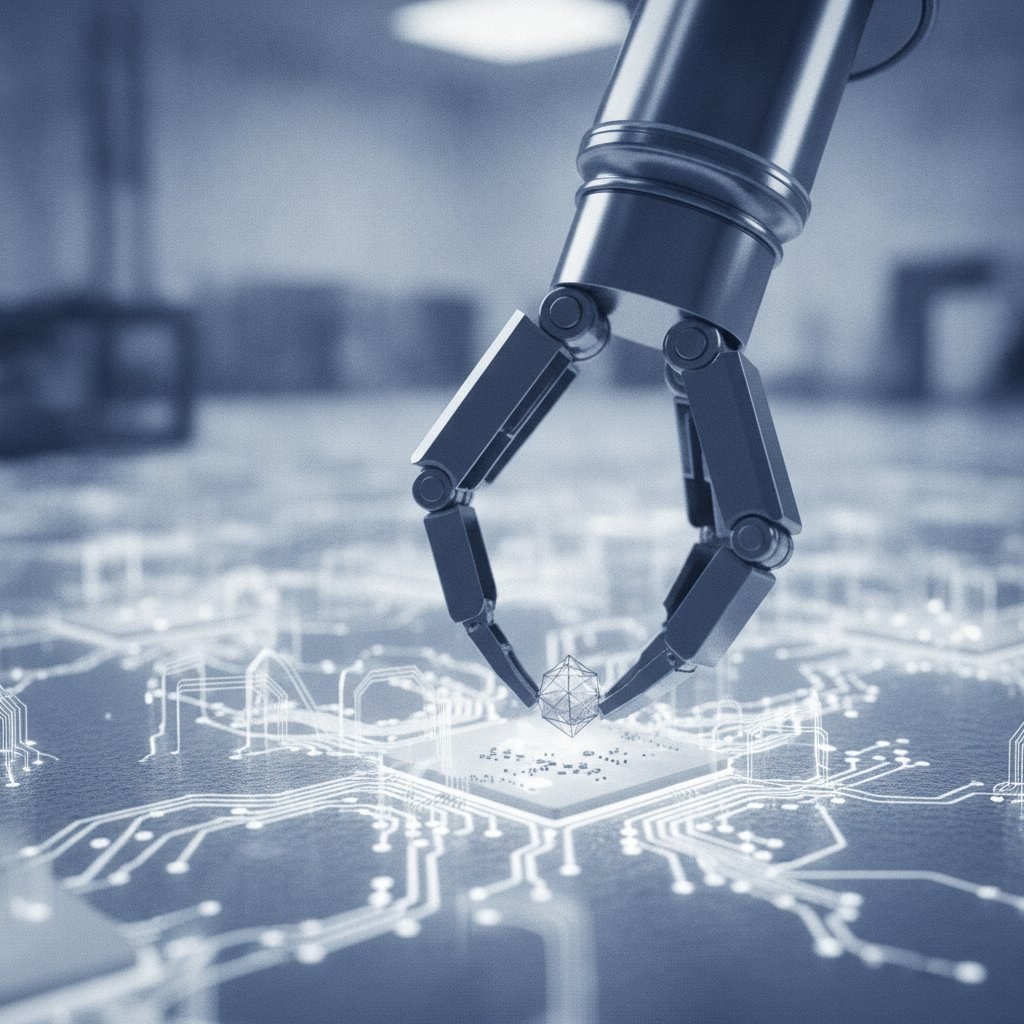
Teaching robots the fine motor skills required for assembling smartphones or assisting in surgery has long hit a "data wall." To achieve high precision, existing models like Behavior Transformer or Diffusion Policy require massive datasets recorded at extremely high frequencies. This thirst for dense data doesn't just inflate budgets for training sets; it also slows down inference, creating a bottleneck for industrial automation where accuracy is non-negotiable.
Multi-level Granularity via Mamba and Diffusion
A research team at KAIST, led by Professor Dae-hyung Park, has introduced DiSPo—a multi-level manipulation granularity model that functions like a digital lens capable of software-sharpening a blurred image. DiSPo integrates Mamba (a state-space architecture for time-interval prediction) with a diffusion model that provides a rich representation of complex actions. The key irony is that instead of trying to mimic every human micro-movement, the system uses a Step-scale factor mechanism to directly control time intervals during task execution.
This technology is expected to radically reduce data collection costs, serving as a universal solution for robotics in precision assembly and medicine.
By decoupling outcome precision from input data frequency, the KAIST team has enabled robots to learn from "rough drafts"—sparse human demonstrations that usually result in jerky movements or failures. In simulations, DiSPo showed an 81% higher success rate than current state-of-the-art solutions. The system effectively fills in the blanks, calculating the trajectory of delicate contacts without needing to see every millisecond-frame in the training sample.
Fourfold Efficiency Gains in the Real World
Real-world testing of DiSPo included tasks where standard autonomous systems typically break down. A collaborative robot successfully maneuvered a peg through a narrow slot with a radial clearance of just 2.5 mm and pressed a tiny smartphone shutter button. In these scenarios, the success rate was four times higher than that of its competitors. The "coarse-to-fine" sampling process stood up to the test of unpredictable real-world physics.
From our perspective, DiSPo marks a shift toward cost-effective training where internal AI logic compensates for a lack of expensive sensors. However, the path from a sterile KAIST lab to the chaos of a real factory floor remains rocky. While data volume has been reduced, the reliability of autonomous sampling in high-speed cycles and resilience to hardware noise remain open questions. Until researchers prove the system won't drift under real-world workshop vibrations, DiSPo remains an impressive scientific breakthrough waiting for its turn on the assembly line.