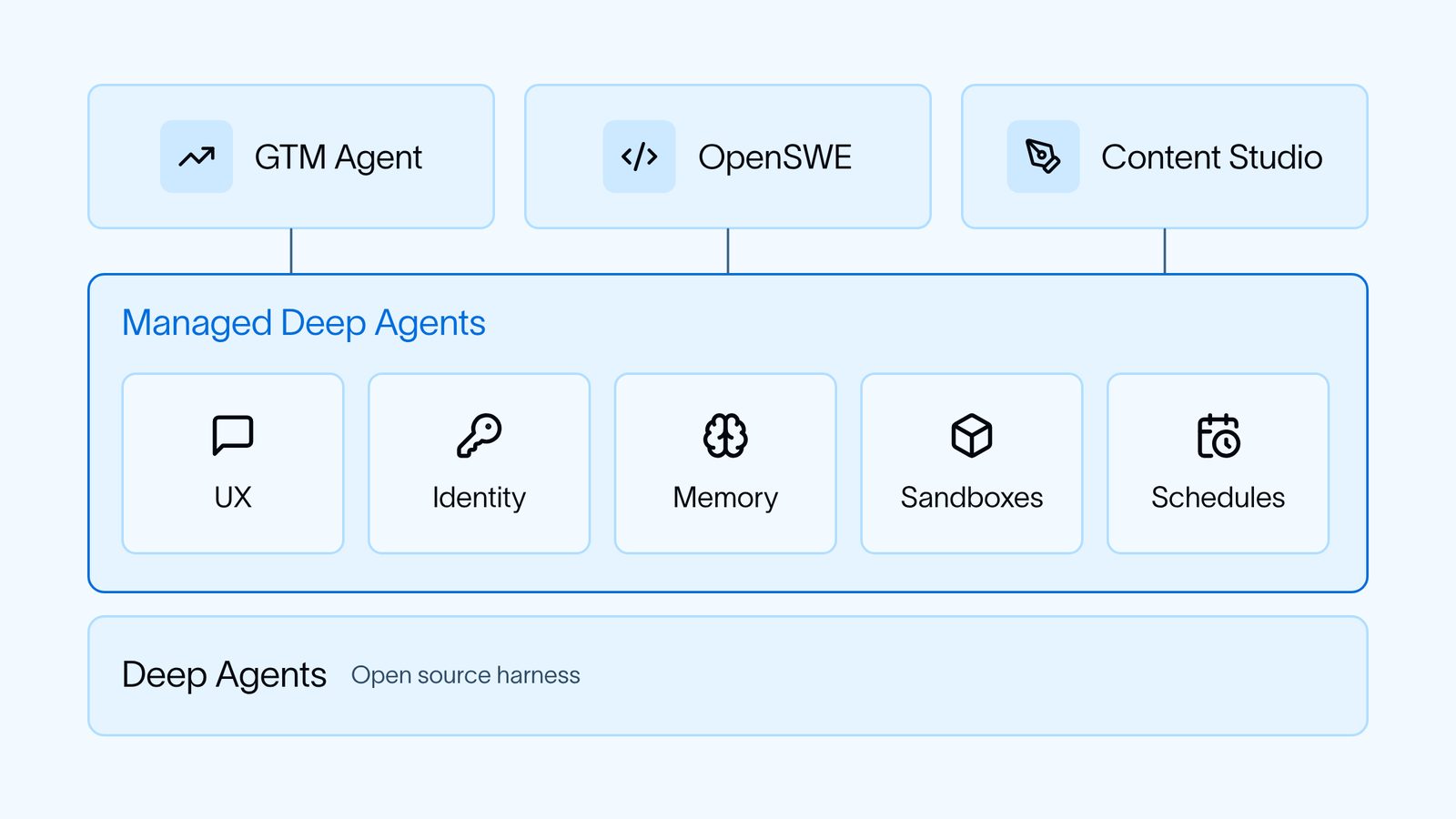
LangChain built internal agents across marketing, sales, and engineering that changed how those teams work, moving past isolated chat interfaces into proactive architectures that integrate directly into existing enterprise operations. As the internal deployment demonstrates, transitioning from passive assistants to automated operational units requires standardized infrastructure and persistent background execution.
All of these agents are built in the same way, establishing a repeatable recipe for building company harnesses across organizations.
Workflow Integration and System Memory
All our agents live where people already work, which for us is Slack. The deployment includes specialized systems such as the GTM Agent, a proactive, always-on agent that assists with go-to-market activities; OpenSWE, our engineering agent that drafts and reviews pull requests; and Content Studio, our marketing agent that drafts assets aligned with our style and positioning.
When deploying these systems across teams, managing permissions requires strict delineation between user-level actions and automated background tasks. When messaged directly, OpenSWE acts on behalf of the user, but during background runs it operates under its own identity. Similarly, the GTM Agent uses a fixed identity for certain tools while acting on behalf of the invoking user for others. Content Studio applies a parallel logic, executing some tools through the user and others through a fixed set of credentials.
All agents have two tiers of memory: global memory that applies to all users, and user memory that only applies to the specific user.
This tiered memory structure allows autonomous workflows to maintain operational context without exposing sensitive data across unauthorized user boundaries. Furthermore, code execution isolation remains a baseline requirement for these deployments, as all agents follow the pattern of running outside the sandbox while securely connecting to it for execution. In multi-tenant environments, this demands careful resource partitioning to prevent cross-tenant data leakage and ensure that background jobs executing under fixed service credentials do not inadvertently escalate privileges or access unauthorized internal endpoints.
Scheduled Automation and Infrastructure Takeaways
The operational shift toward ambient execution redefines how administrative and technical pipelines consume computational resources. A significant percentage of runs are scheduled rather than explicitly invoked by humans, marking the transition to persistent ambient agents.
OpenSWE listens for pull requests and reviews them autonomously upon creation, maintaining continuous oversight without human dispatchers. This background processing model shifts software maintenance costs from human hourly rates to predictable cloud execution fees and constant compute overhead. Unlike interactive chat interfaces where token consumption is bound to immediate user query-response loops, background execution harnesses run continuous polling, event listening, and multi-step reasoning loops that accrue continuous inference costs regardless of active human engagement. Managing this transition requires balancing the predictable financial outlays of cloud execution and container provisioning against the reduction in manual oversight hours, forcing engineering leaders to evaluate whether the continuous compute tariff of autonomous agents under multi-tenant conditions undercuts the labor savings achieved by automating routine code reviews and go-to-market tasks. The transition confirms that standalone chat applications fail to capture operational value until embedded into persistent, multi-tenant execution harnesses.