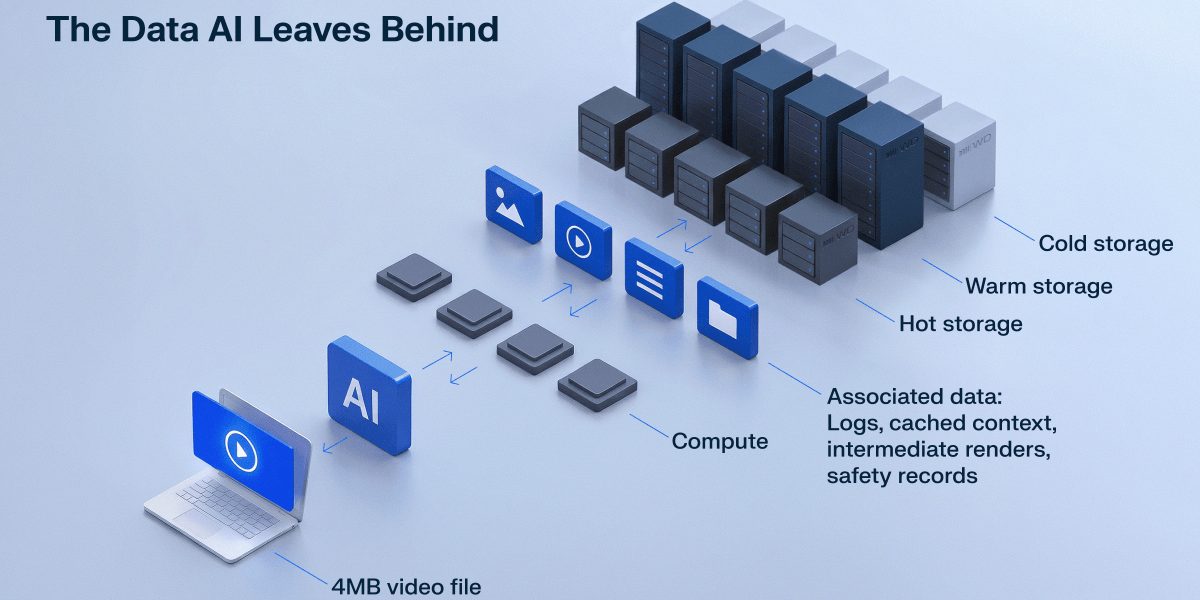
Ask most executives to picture the cost of AI, and they will likely see racks of power-hungry GPUs and a perpetual waitlist for silicon. But that mental model leaves out the silent line item: data storage. What happens to the data after a model responds? Much of the back-end data generated by billions of daily prompts, images, and videos must be stored indefinitely. Unlike predictable training runs that have a defined start and finish, inference runs continuously every time a model answers a prompt, leaving a permanent digital footprint in its wake.
Take AI-generated video workloads, where back-end spend swells due to the massive volume of associated technical artifacts. As a senior product manager at a hyperscale cloud service provider explained in a recent report, having more storage acts as a necessary buffer to keep expensive GPUs busy, noting that the biggest operational challenge is ensuring that silicon never waits for data because hours of GPU idle time burn capital very fast.
You can think of having more storage as an optimization for keeping the GPUs busy
Put in strict financial terms, if enterprise storage spend grows 25% year over year while compute budgets follow a cyclical and predictable path, storage eventually outpaces the infrastructure line that receives the lion's share of executive attention.
The Avalanche of Generative Back-End Data
Internal measurements by Western Digital found that an 8-second clip returned to a user as a modest 3.97MB 720p file left more than 500MB of associated technical data behind on the back end. That represents a staggering 130-fold increase over the output file size visible to the end user. Scaling this volume to an enterprise generating longer and higher-resolution video pushes the back-end footprint into hundreds of gigabytes per clip. McKinsey projects that AI inference demand will grow at a 35% compound annual growth rate through 2030, compared to 22% for training, driving inference to make up more than 40% of total data center demand by the end of the decade.
Industry-wide recognition of this infrastructure expansion is confirmed by a Western Digital-sponsored IDC global white paper surveying 763 IT and business decision-makers. Nearly 95% of respondents reported an increase in data volume directly tied to generative AI over the preceding 12 months, with roughly 61% reporting growth rates of 25% or more. Furthermore, 96% of respondents anticipate needing faster archive retrieval speeds just to support ongoing inference or retrieval-augmented generation pipelines.
Recalculating the Total Cost of Ownership
Compute demand rises and falls with training cycles, product launches, and hardware refreshes, but the volume of retained data never drops back down when compute demand plateaus. Model logs, synthetic outputs, and inference results accumulate relentlessly as organizations hoard data for longer retention periods. For the vast volumes of data that must be kept and periodically revisited, hard disk drives provide a cost-effective, high-capacity foundation that retains a decisive cost-per-terabyte advantage over flash storage.
A leadership team that budgets AI strictly as compute plus a rounding error for storage is walking into a trap. That rounding error inevitably balloons into a significant fraction of the program's total cost within 12 to 18 months—precisely the moment when executives sit down to evaluate whether to expand or kill the initiative.