Bots accounted for 54% of global web traffic in 2026 after crossing the 51% threshold in 2024, altering the composition of internet activity as autonomous software assumes purchasing tasks. That shift accelerated rapidly when monthly AI agent traffic jumped 8x in two months between August and October 2026. Rather than welcoming this expanding volume of automated checkouts, enterprise storefronts are shutting them out.
United Airlines updated its terms this week to ban AI agents from booking tickets, explicitly reserving the right to cancel any reservation bought by a bot. Amazon has similarly blocked third-party AI shopping agents from its store. The question is why digital storefronts would reject these buyers.
The friction stems from the breakdown of the underlying unit economics that fund modern consumer retail. The reason lies in their income statements:
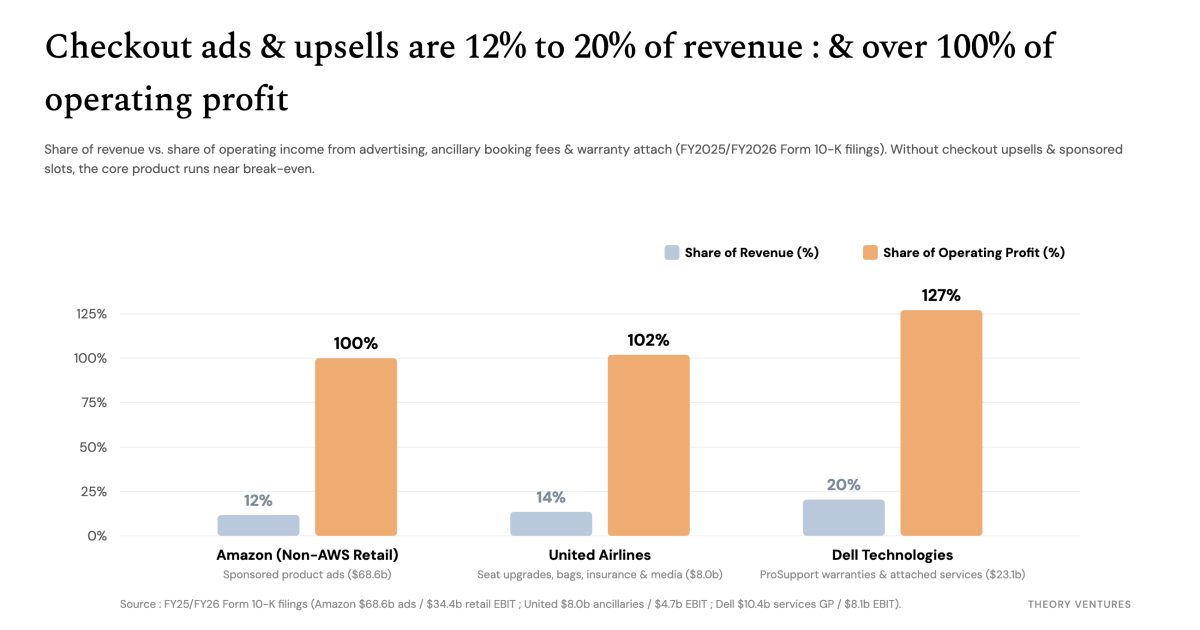
"in modern e-commerce, the base product merely breaks even ; ads, upgrades & warranties supply the profit."
When autonomous agents execute procurement, they optimize strictly for the core item and dismantle this cross-subsidization architecture entirely.
The Breakdown of Funnel Cross-Subsidization
Corporate public relations framing attributes these bot restrictions to platform security, yet corporate income statements point to balance-sheet defense. In traditional retail and travel funnels, base products function as breakeven anchors designed to steer shoppers toward ancillary purchases. Autonomous software bypasses these monetization funnels by design.
An AI agent is a buyer on a mission that skips sponsored listings, declines Economy Plus unless explicitly instructed, and unchecks the extended warranty on a Dell Latitude. By stripping the shopping transaction down to its bare product cost, autonomous shoppers starve the margin engines that cover enterprise overhead. This directly hits the revenues of digital platforms.
This is evident in the companies' operating figures. Last year, Amazon collected $588b of retail revenue, but advertising is the only profit in it. The company generated $34.3b from $68.6b of sponsored listings at roughly a 50% margin, which accounts for all of the $34.4b in retail operating income. When an agent ignores ad placement auctions to extract the cheapest matching item, that entire $34.4b income engine loses its functional mechanism.
United Airlines operates on identical structural economics relying on ancillary fees instead of search advertising. Its $4.8b of seat and bag upgrades, $3.2b of credit card and loyalty fees, and trip insurance commissions together top its entire $4.7b of operating income. The base airfare operates at an underlying loss without those add-on fees. Hardware supply chains display the same financial architecture: Dell hardware is sold at a 13.7% gross margin which does not cover $14.6b of operating expenses. Instead, Dell ProSupport warranties and attached services at a 44.8% margin generate $10.4b of gross profit, or 127% of Dell's $8.1b in operating income.
Monetization Models and Take Rates
Some platforms use the opposite model.
Shopify powers independent merchant websites and collects a 3.1% toll on every dollar processed, with 78% of it coming from payment processing and merchant services. Because the platform charges the exact same percentage cut whether an order contains high-margin warranties or raw inventory, autonomous buyers create pure incremental volume without damaging its unit economics.
"In September, it opened checkout to browser agents across every eligible store."
Shopify widened access while its advertising-dependent peers built algorithmic defenses against incoming automated browsers.
Enterprise merchants built on loss-leader economics now face a direct structural choice: raise base prices, charge an explicit agent checkout fee, or invent wholesale incentives that persuade bots to upsell. Until platforms re-price their checkout funnels, the friction remains entrenched where Dell relies on auxiliary service margins generating 127% of its operating income while Amazon extracts all $34.4b of its retail profit from search advertising.
How the picture shifted
Why would digital storefronts lock out paying customers when automated traffic is growing so fast? The blunt answer is that software ruins the cross-subsidies keeping consumer platforms profitable. By late October every automated purchase required manual confirmation, yet letting software clear transactions without human friction instantly bypasses the high-margin add-ons. Digital storefronts will sacrifice core transaction volumes rather than let autonomous agents strip away the profitable add-on fees that subsidize them.
Our stories: Walmart Opens to AI Shopping Agents While Amazon Blocks Them (October 22).