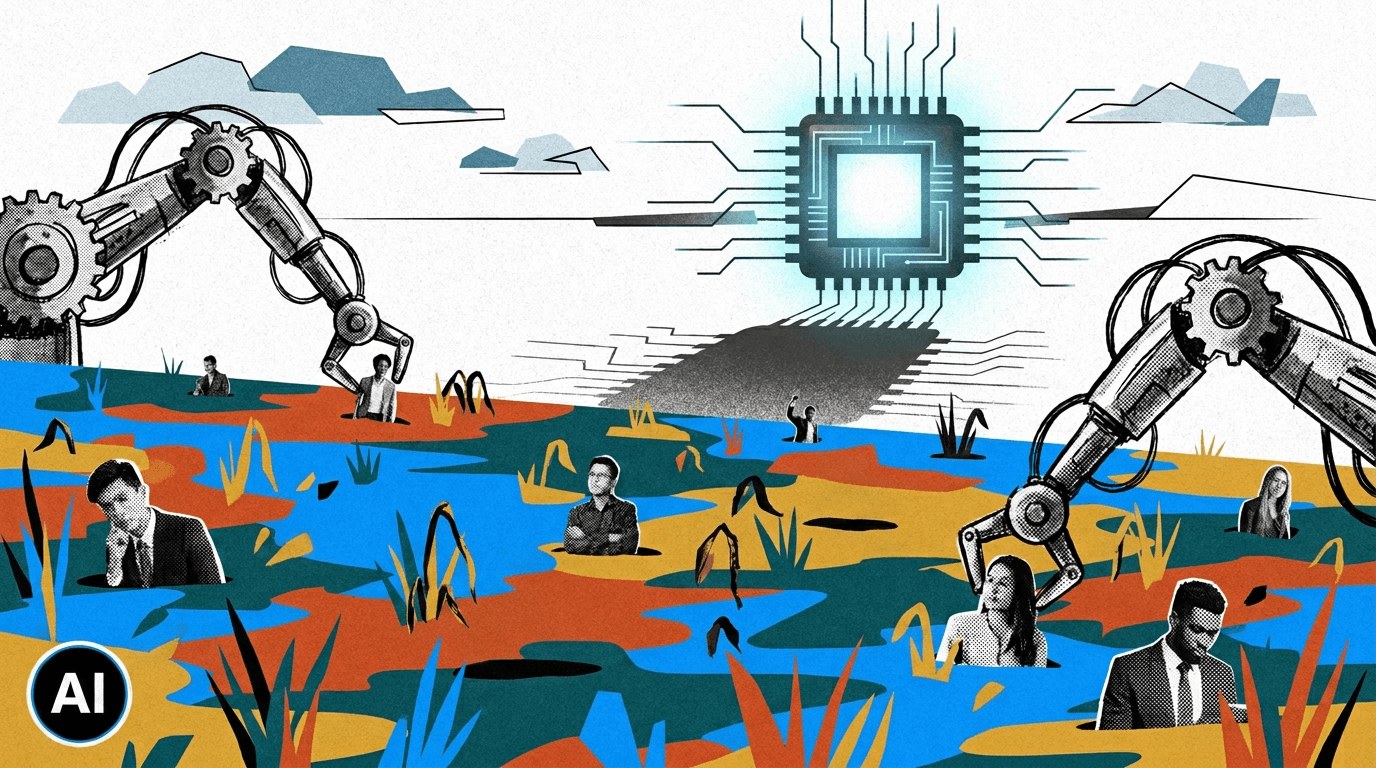
When a single enterprise automates entry-level workflows with AI models, it internalizes immediate cost savings while externalizing the destruction of foundational talent across the broader industry. In a research paper published in the journal Human Resource Development Review, Nolan Lovett of the NATO Special Operations University applies Garrett Hardin’s classical 1968 concept of the "tragedy of the commons" to human capital development. Just as individual herders acting with short-term rationality inevitably deplete shared pastures, enterprise AI adoption currently exhausts the collective cognitive pipeline on which entire sectors depend.
Senior talent does not materialize out of thin air. Developing senior engineers, analysts, and strategists requires years of navigating routine friction, debugging edge cases, and resolving operational failures. Lovett identifies two distinct mechanisms breaking this pipeline. The first is direct job elimination, where generative models absorb traditional entry-level workloads. The second is cognitive displacement: junior employees leaning heavily on AI output achieve artificial productivity without expending the iterative problem-solving effort required to build mental models and professional intuition.
The Validation Tether and the Talent Pipeline
This structural deficit creates an acute operational risk that Lovett terms the "validation tether." Effectively auditing complex AI outputs demands domain-level mastery—the exact asset being systematically eroded. Plausible-looking model outputs routinely bypass surface-level review; detecting hallucinations or flawed logic requires nuanced contextual knowledge that prompt-reliant operators simply lack.
The ability to oversee AI systems effectively depends on exactly the kind of deep domain knowledge that AI use is wearing away.
Over-reliance compounds this vulnerability into cognitive atrophy. Professionals trained to treat automated summaries as authoritative lose the analytical reflex to challenge machine output. More critically, the organizational feedback loops where junior staff once stress-tested assumptions against operational realities are vanishing alongside junior headcount.
Because the senior executives and architects leading businesses today built their expertise decades ago, the systemic consequences of automating junior roles since 2023 will remain largely invisible until roughly 2030 to 2045. Lovett calls this the "Human Reserve Paradox." Without deliberate intervention—such as restructuring onboarding and training programs to prioritize technical validation and contextual depth over mere speed—enterprises will discover that short-term efficiency gains have hollowed out their senior decision-making capacity.