AI · This text was generated with artificial intelligence
Industrial robotics has long hit a "glass ceiling" in passive safety: machines simply freeze to avoid turning a worker into mincemeat. However, the real barrier to scaling in the industry isn't the physical distance between a human and a manipulator, but the absence of what the Italian Institute of Technology (IIT) calls Shared Embodied Intelligence. According to a study published in Nature Machine Intelligence, the gap between a robot that merely evades a collision and one that actively assists is bridged by merging physical embodiment with internal representations of the partner. This is an attempt to move away from viewing the robot as a tool toward a model of biological systems—like a wolf pack, where coordination allows the group to achieve what is impossible for a lone individual.
The Architecture of Shared Embodied Intelligence
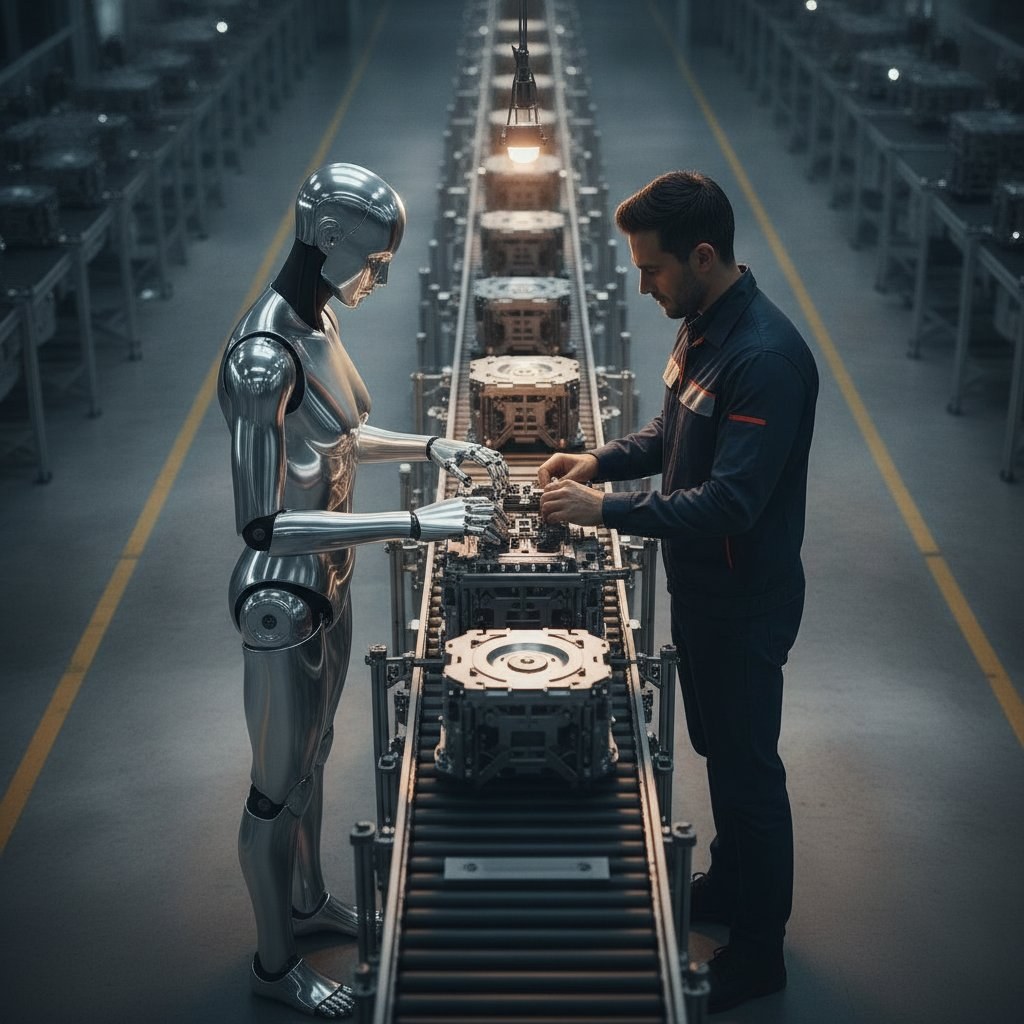
The developed framework optimizes the ergoCub’s hardware and control systems based on specific human ergonomic metrics. We are not talking about soft padding on the chassis, but rather the integration of human body models directly into the machine's physical intelligence. By modeling interaction as a function of hardware configuration, the humanoid predicts the stress on its partner's joints and muscles, adjusting its movements in real-time to minimize that strain. In this paradigm, the robot acts more as a responsive biological extension of the operator than a static piece of machinery.
Shared embodied intelligence integrates the cognitive abilities and physical attributes of an agent, optimizing them for deep collaboration with living beings.
This approach allows for the simultaneous refinement of both software and morphology—the robot's form and the range of its joint movements. The design philosophy draws on the concept of embodied cognition, where physical traits evolve alongside intelligence to solve specific environmental tasks. Put simply, ergoCub is engineered so that its safety and comfort parameters are "hardwired" into the very geometry of its movements.
Verifying Ergonomics in the Future of Logistics
The choice of a humanoid form factor for ergoCub isn't a nod to fashion; it's pragmatic. Such platforms operate in spaces designed for people and utilize the same levers and fulcrums. The IIT methodology treats the human and the robot as a single integrated system. Using data on human body dynamics, ergoCub changes its grip, lifting height, and force distribution so that the operator maintains an optimal posture. This shifts the focus from pure operational speed to the long-term preservation of the workforce—a critical factor in logistics, where high turnover due to injury and physical exhaustion eats into profits.
Businesses should reconsider how they calculate ROI for robotic deployment: primitive throughput is being replaced by the preservation of human capital through ergonomic optimization. However, the path from an arXiv preprint to mass adoption on the shop floor is blocked by steep computational requirements. "Human-aware" algorithms require massive resources to process models in real-time. Executives must understand: the next generation of robots will be safe not because they are wrapped in foam, but because they will learn to predict employee fatigue before the worker even feels it.