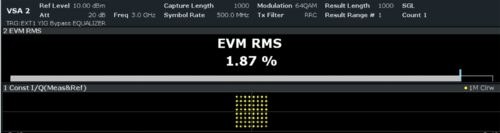
While the industry obsesses over FLOPs and context windows, the physical reality of 5G and Wi-Fi 7 is quietly sabotaging AI reliability. As we push toward 4096QAM modulation—where a single symbol packs twelve bits into an impossibly crowded constellation—the margin for error vanishes. According to a technical analysis by IEEE Spectrum and Rohde & Schwarz, the proximity of these constellation points means even microscopic deviations in phase or amplitude trigger immediate bit errors. For an autonomous agent or a real-time AI system, these aren't just 'network issues'; they are direct hits to inference latency and decision-making integrity.
Error Vector Magnitude (EVM) has moved from an obscure RF metric to a critical KPI for any technical lead managing distributed AI. The Rohde & Schwarz data proves that as we scale modulation orders to hit peak throughput, the sensitivity to signal impairments grows exponentially. When your system faces amplifier compression, phase noise, or I/Q gain imbalance, the resulting EVM degradation doesn't just slow down the stream—it breaks the deterministic nature of agentic workflows. We are seeing a shift where physical layer failures, often hidden by simple traffic monitoring, become the root cause of AI performance decay in edge deployments.
Traditional monitoring is no longer enough; diagnosing the health of an AI-driven network now requires deep-tier analysis of the physical layer. The IEEE Spectrum report highlights that distinguishing between wideband noise and hardware-specific gain imbalances is the only way to maintain the high-throughput demands of modern cellular and 802.11 standards. If your 2026 deployment roadmap includes 4096QAM without a mandatory audit of constellation diagrams, you aren't building a seamless AI network—you are building a house of cards that will collapse at the first sign of RF interference.