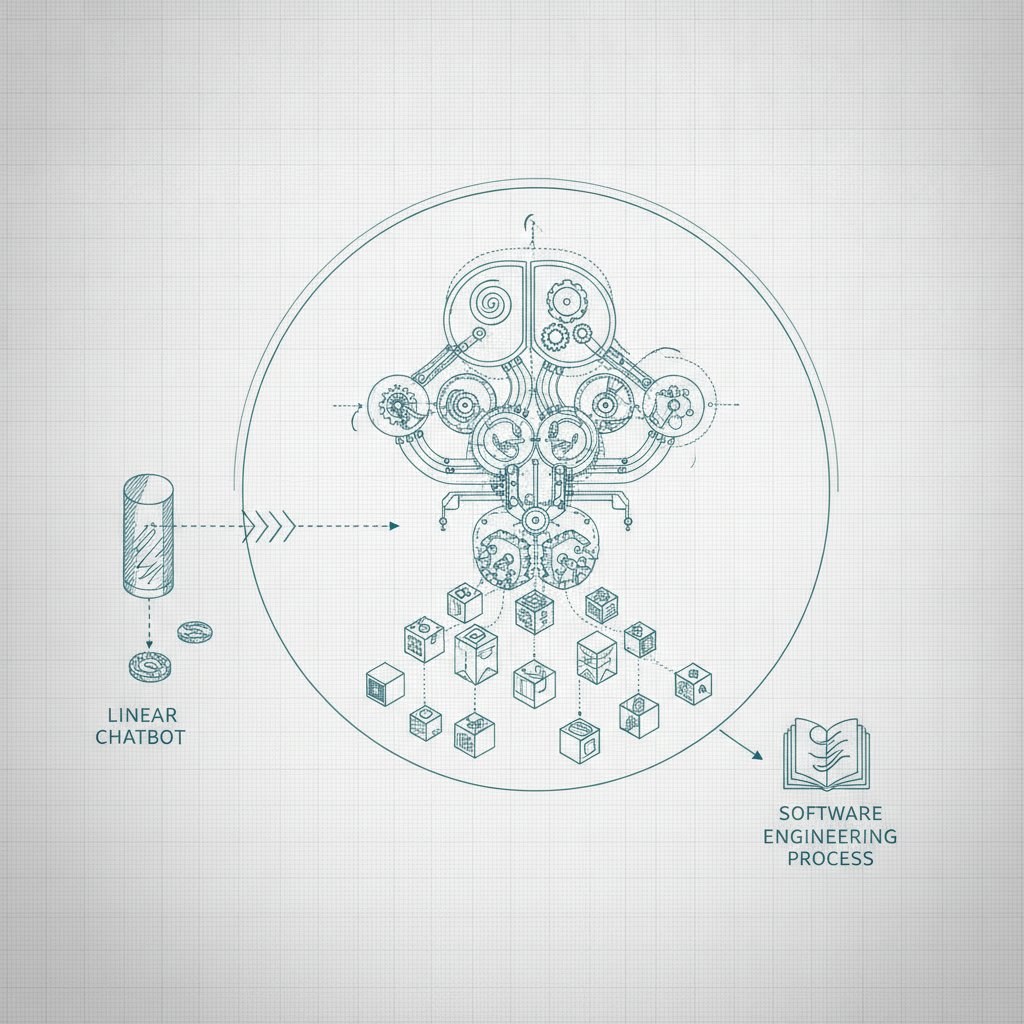
The novelty of "AI-generated code" has finally worn off. The industry has finished playing with chatbots and is moving toward designing sophisticated "engineering entities." Fresh data analysis—from theoretical frameworks on arXiv to field reports from engineers—confirms that the era of linear scripts is over. AI assistants are being replaced by hierarchical systems where you don't just hire a virtual coder; you build a digital department. In this setup, agents manage other agents, and the human role evolves from a copy-paste operator into an architect approving the final result via a GUI.
Current "vibe-based automation"—where developers bounce tasks back and forth with ChatGPT—is a dead end. It merely transforms a skilled engineer into a frazzled tester of third-party interfaces. Practitioners note that this routine quickly kills motivation. To break this cycle and achieve true autonomy, the industry is adopting an architecture that researchers on arXiv (cs.AI) have aptly dubbed "Matryoshka."
Matryoshka Architecture vs. Monoliths
The logic is simple: instead of stuffing a single model with an infinite context window and hoping for a miracle, you build a hierarchy. In the Matryoshka Agent concept, an Orchestrator handles long-term planning and issues strategic directives. Specialized Sub-Agents then execute these tasks using a specific set of tools.
Separating strategic planning from resource-intensive execution significantly reduces the reasoning load in long contexts and enables efficient iterative refinement.
This approach cures the primary ailment of modern LLMs: the hallucination cascade. Under the Matryoshka framework, even modest models deliver abnormally high results. For instance, Qwen3-4B-Instruct performing as an orchestrator rivals o4-mini, while for Qwen3-30B-Coder, this structure provides nearly a 37% performance boost in complex machine learning tasks. For business, this means the ability to migrate from expensive proprietary APIs to local hardware without sacrificing quality.
The New Economics of Orchestration
Linear KPIs, such as lines of code or closed tickets, are becoming obsolete in the world of autonomous agents. The efficiency of this "digital crowd" requires a different metric. The OrchBench benchmark proposes evaluating the quality of orchestration plans by simulating Directed Acyclic Graphs (DAG) of dependencies.
OrchBench results correlate with real-world code execution in Claude Code at a level of 0.816, while requiring only 1.3% of the tokens and 10.3% of the time of a full run.
There is a critical insight here for CTOs: mindlessly scaling the number of agents leads to diminishing returns. Research shows that coordination errors quickly erase the benefits of parallelism. Development unit economics are no longer calculated in "man-hours," but in the cost of tokens per successful cycle (makespan) within a strict error budget. Investment must focus on the precision of information transfer between nodes, not the sheer number of virtual heads.
Transitioning to Autonomous Cycles
We are witnessing a fundamental shift from AI prompting to full-cycle systems. Modern use cases, such as an AI autopilot for C++, are already capable of navigating the entire path from a Jira ticket to verification in a live interface. To maintain control, management must stop viewing neural networks as "advanced search." They are full architectural components. Risks remain, but they are now localized within the orchestration layer rather than scattered across random chatbot hallucinations. The future of development belongs to autonomous departments where an employee's value is defined by their ability to manage this complex hierarchy, not their typing speed.